Search This Blog

Showing posts with label FCI show. Show all posts

Tuesday, June 18, 2013

Von Moosbach-Zuzelek dachshunds at the NATC Zuchtschau

I have only few minutes to write this post so I know that we will probably have several more posts about North American Teckel Club events, which took place on June 13-16 in Reading, PA. This one is about Sunday Zuchtschau, which was judged by a Wolfgang Trumpfheller, a conformation and hunting judge from Germany. "Von Moosbach-Zuzelek" dachshunds were represented by two 14-month-old litter mates Theo and Tuesday.

The two pictures below show Theo who is owned by Darren Doran from New Jersey. We have written about Darren and Theo several times already. At this early age he is already an accomplished dog. Few weeks ago he passed a Deer Search 20-hour blood tracking test with Prize I performance. On Saturday he passed a gun-shyness test and Water Test. And on Sunday he received "Excellent" rating at the Zuchtschau. Judge Trumpfheller gave him quite a few compliments. Congratulations Darren, we are so grateful for everything you have done with Theo.


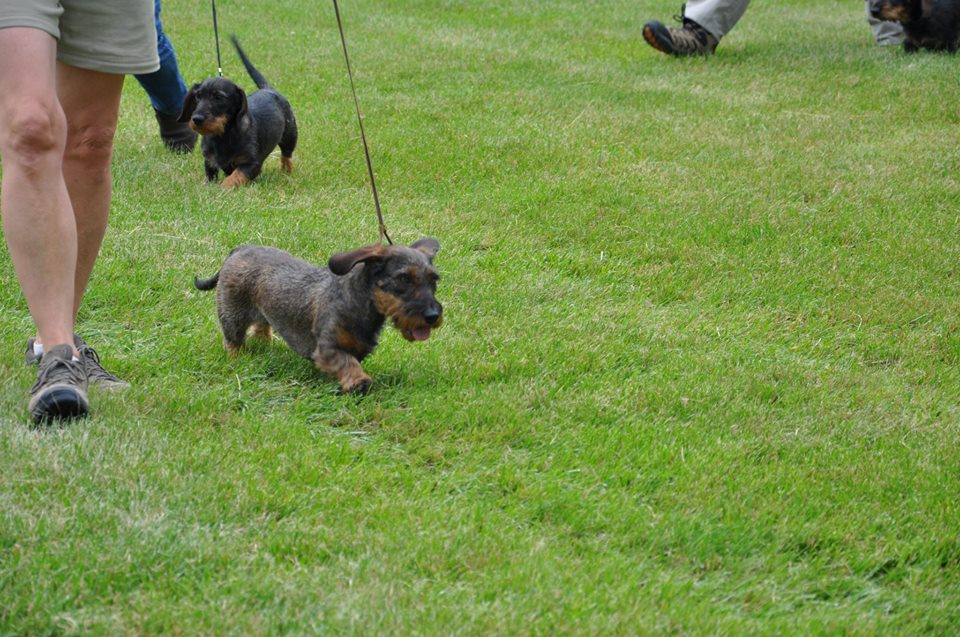
I showed Tuesday, and I did not handle her too well. Her gait in the pretty high grass was not that great. In spite of this she also received "Excellent" rating. In my opinion her weakness is in her somewhat roached topline, so I was surprised to read on her evaluation form the judge's comment "straight topline". The picture below shows Tuesday when she was in the ring with other "excellent" wires at the end of the show. She is the second dog on the left.


A big thank you to Patt Nance for taking pictures of Tuesday at the Zuchtschau!
Jolanta (me) handling Tuesday in the show ring.

For those unfamiliar with the FCI system of dogs shows and evaluations, this is a certificate I received for Tuesday at the end of show.

The evaluation form shows her weight 7.9 kg (17.4 lbs) and chest circumference 39 cm (14.4 inches). It also shows other traits that a judge evaluates.
Since Tuesday and Theo's brother Sky was "Excellent" and Best in Zuchtschau last year, it looks so far like the breeding of Paika (FC Paika v Moosbach-Zuzelek SW) to Moose (FC Nurmi von Moosbach-Zuzelek) produced some really nice looking dogs for the field.

To be continued....

Wednesday, April 3, 2013

Upcoming North American Teckel Club events

Dates: Thursday, June 13th - Sunday, June 16th

Judge: Wolfgang Trumpfheller, hunting and conformation judge from Germany

Location: 1411 Cross Keys Road, Reading and Weiser Forest, Hamburg, Pennsylvania
  • June 13: 12 pm JGHV Judges Seminar (required for all hunting judges and great tool to understand FCI hunting tests)June 14: 8 am Gun Shyness Test (blood tracking participants only), Blood Tracking Test 40 hours
  • June 15: 9 am Hit Site Evaluation Seminar, Gun Shyness Test, BHP (DTK Companion Dog Test), Water Test
  • June 16: 9 am Zuchtschau (DTK Conformation show), dogs will get a written evaluation according to FCI Standard #148
Blood tracking training lines will be available upon request only for Thursday morning, Friday late afternoon or Sunday before/after the Zuchtschau. Contact Andy Bensing for more info abensing@pbkennels.com.

Entry forms can be found at www.teckelclub.org, for more info e-mail Alexandra Weber, NATC Secretary dbarw@dejazzd.com.


Pictures from previous NATC events can be viewed at http://jola.smugmug.com/NATC

Saturday, February 16, 2013

Blog on wirehaired dackels and a video on dachshunds

For those who'd like to learn more about European dachshunds from perspective of an American living in Europe, this is a new blog to follow: http://whdackel.blogspot.com/. You will find a link to the blog in our blogroll.

Julie Weidner is a graduate student from Wisconsin, who currently lives in Switzerland, and she has acquired two European wirehaired dachshunds.  We got connected through our blog, and it looks like we are on the same wavelength.

I like Julie's post about dachshunds in the media. If you have 87 minutes to spare, watch the video she refers to at


Julie's comments about the video are right on the money. If you watch the video, you'll see Antonio Palladini, a prominent breeder from Italy http://www.val-vezzeno.it/. Tommy's sire Skuleskogens N Boris is owned by Palladini (Boris was bred in Sweden).

Even if you do not speak German or French (there is no English version as far as I know) the video is worth watching just to see how dachshunds are raised and handled in various countries. I know for sure I would not want to be a dachshund in Japan. I think around 7:30 minutes into the video you will see a dachshund playing with a young lion and standing its ground!
 
Enjoy!

Thursday, July 12, 2012

Max in the Cowlitz River: German wirehaired dachshund and his love of swimming and retrieving

So far this summer has been like no other. It is very dry here. So even though it is only mid-July, yellow leaves has been falling and grass is turning crispy brown. Days are hot and sunny, with temperatures in the high 80s and low 90s. Luckily nights are refreshingly cool. The water in our pond is very low, at the lowest level I have ever seen. The weather forecast does not predict any short term changes. Other parts of the United States suffer from even drier and warmer conditions.

Considering all this pictures of German wirehaired dachshund Max (Max von Bispingdorpe), who loves to swim and retrieve from the water, might serve us well. Max's owner, Uta Fehlhaber-Smith sent these pics with a note:

Just before Max got in a strong whirl in the pursuit of a large stick that had floated into that whirl. He made it out off it, an enormous physical challenge! The Cowlitz River is deep and fast and it curved a the place we were. The photos were shot by Laura Stutts.


Also I love the below video of Max, which Uta sent last fall. She said in her caption: The barking noise is from Luna, the hovawart, who is an excellent water retriever herself and wants to go too. ( The tiny dummy is not her thing...) She goes for the big branches and wood pieces - but I can't do both at the same time and video tape too...


BTW, congratulations are in order as Max was Best of Winners at an AKC show in Chehalis, WA on July 8. Several FCI teckels were entered at the show with the intention to educate the American judges.
Uta says: The other judge the day before preferred typical American Dachshund, but we had great time afterwards at the Pacific ocean were this little daredevil decided to swim voicing all the way through the heavy turf in pursuit of teasing seagulls. He scared me to death, since I did not know the undertow. And then when he finally returned he decided to chase the large kites people let fly at the beach, again furiously opening and running circles and figure eights with his head in the air. A kite crushed down, drilling in the sand just a few inches beside him.
Max has sired his first litter this year. For more information about his stud service contact Uta directly.


Wednesday, June 22, 2011

Importance of functional conformation in a working dachshund; NATC events - part 2

On Sunday, June 12, the North American Teckel Club held a Zuchtschau at Rockaway, NJ. A big thank you to Teddy and Carl Moritz who hosted the show at Winnebago Scout Reservation.

Zuchtschau is a conformation show where each dog is evaluated according to the FCI dachshund breed standard #148, and each dog receives a written evaluation from an FCI judge. This year the Zuchtachau was judged by  Mme Agnès de France, President of the French Teckel Club (Club des Ameteurs de Teckels). She judged for the NATC before, exactly two years ago.

What is the FCI and what is the FCI dachshund standard? The Fédération Cynologique Internationale (FCI) is an international federation of kennel clubs, and currently it has 86 members countries, with one member per country. You can see which countries follow the FCI rules by clicking here or here. Perhaps you will notice that the USA, Canada, UK and South Africa are not on the list...unfortunately. You can read more about the FCI on its website. The wikipedia states that "the aims of the F.C.I. are to encourage and promote breeding and use of purebred dogs whose functional health and physical features meet the standard set for each respective breed and which are capable of working and accomplishing functions in accordance with the specific characteristics of their breed; to protect the use, keeping and breeding of dogs in the member countries."

The North American Teckel Club is part of the DTK (Deutscher Teckelklub), which is in charge of the FCI standard of the dachshund breed as Germany is the country of the breed origin. The NATC holds two conformation shows per year and you can read about them on the NATC website.

Even though on paper the AKC and FCI standards of conformation are not that different, in reality as John says "the American show judges decided, in their wisdom, that if the original dachshund from Germany was a comparatively short-legged, long dog, then the ideal “improvement” would be to exaggerate these characteristics. Check out the big show winners in dog magazines to observe what passes for the most desirable show dachshund today. The exaggerations are most extreme in the smooth-coated  dachshunds. Perhaps they are fine lawn cruisers, but with less than two inches of ground clearance, they would be in big trouble if they had to hoist their long heavy body over a 12 inch fallen long." To download the text of the FCI standard for dachshund and commentary providing additional information go here.

The bottom line is that a hunting dachshund should be athletic and his built should be "especially suited for hunting game below ground, for beating the bush in search of game, and for trailing". So when you are thinking about acquiring your first dachshund for blood tracking, don't think about just his nose, tracking desire, intelligence and other hunting qualities, but pay attention to the parents' conformation too.

When I started to breed wirehaired dachshunds my first litter was a cross between a French working teckel (FC Fausto de la Grande Futaie) and American show dachshund (FC Rivendells Ruby Tuesday). Even though Ruby had a lot of hunt, her conformation was not extreme, and all the following generations of breeding involved FCI working dachshunds only, it was very difficult to get rid off the large- sized, low-stationed, long-bodied, deep-chested American show phenotype. When it comes to breeding, this type seems to be dominant over the lighter and more agile type with  better ground clearance and shorter body.

This picture shows Hansi (Teuffel von Moosbach-Zuzelek), who was Ruby and Fausto's grandson and was born in June 1995. He grew up to be 35 lbs, and he had extremely exaggerated conformation. Of course, we did not use him for breeding. This is not the conformation type you want in a working dachshund...or any dachshund. However, this is the type that you see very often an American show ring.

Hansi is an example of "wrong" conformation for a working dachshund. He was too large, too long and too low to the ground.
There is a reason why I am addressing this issue in my post. Recently I have realized that a number of American show wires have been imported to Europe, and to my surprise, in spite of the long and low stationed conformation, they have done very well in a show ring there. Some of them have done well in blood tracking tests too. Now American show breeders are starting to sell their pups to blood tracking homes. All I can say - do you research first and be an educated puppy buyer. Let's hope that the conformation of these dogs is going to withstand physical demands of blood tracking.

After this long introduction to conformation let's turn to the NATC Zuchtschau. The pictures are telling a story how a dachshund is evaluated according to the FCI standard.

Patt Nance with Viljo, who was rated "excellent".
First a dachshund is put on a scale and his weight is recorded. According to the FCI standard dachshunds come in three sizes. Standard Dachshund has circumference of chest 35 cm or more and its ideal upper weight limit is about 9 kg. Miniature Dachshund has circumference of chest from 30 to 35 cm measured when at least 15 months old. Rabbit Dachshund has chest circumference up to 30 cm measured when at least 15 months. Dachshunds weighing in at more than 10 kilos may not be awarded the “Excellent”.
Stephanie Marcoux is handling Whiskey, who received the "excellent" rating.
Mme Agnès de France is measuring this wirehaired dachshund's chest. As it turned out even though he was out of mini parents, his chest measurement above 35 cm determined that he is of a standard size.
Dog's bite is checked thoroughly.
And all his teeth are counted.
Mme Agnès de France showed us these drawing illustrating dachshund's teeth and jaw. The FCI standard considers absence of one or more canines and absence of one or more incisors as eliminating faults.The same goes for the lack of other premolars or molars with exceptions : the two PM1, one PM2 without consideration of M3.
A tail is checked for kinks. This was embarrassing, but as it turned out Quenotte has a kink at the very base of her tail. I have never noticed it as I was checking the tail further down. A kinky tail is an eliminating fault.

Once a dog is checked on the table, a judge observes how the dog moves.
 

Movement should be ground covering, flowing and energetic, with far reaching front strides without much lift, and strong rear drive movement should produce slightly springy transmission to top line. Tail should be carried in harmonious continuation of top line, slightly sloping. Front and hind legs have parallel movement.

Teddy Moritz with her longhaired mini Garmin who received "excellent" rating.
A dog's temperament is tested by observing his reaction to the loud noise.
All dogs are rated, and possible ratings are: Excellent, Very Good, Good, Sufficient, Disqualified and Without Evaluation. At the end of the show the best dog in each coat is selected, and the show closes with the selection of the best dog in show.

MmeAgnès de France Alexandra whose red mini longhaired Jesse James von Reblick was "Best in Show". CONGRATULATIONS to Alexandra and Jessie James!

For pictures from the NATC Zuchtschau click here


Friday, April 9, 2010

Learning about European teckels - part 1 of our trip to Germany and France (1999)

This report was written by John in October 1999, after our return from the two-week trip to Germany and France. We visited seven breeders, attended hunting tests and shows, and took along our two dachshunds, Sabina and Vamba. This most informative trip was all about European dachshunds. Even though John brought his first German dachshund in 1965, in 1999 we were in need of new hunting bloodlines.

On September 1, 1999 we landed at Düsseldorf in the heart of the industrial Ruhr Valley. We picked up our reserved rental car, loaded our two dogs and luggage and headed for Embken, west of Cologne in a pocket of agricultural land tucked up against the eastern Dutch border. There in a small wooded valley, several light years from Düsseldorf is the old mill of the von Dornenfeld Kennels presided over by Frau Lore Schlechtingen and her patient husband Helmut.


Lore Schlechtingen was the facilitator who made things happen during our trip, and she merits a substantial introduction. For over twenty years our friendship, which began with the purchase of a dachshund, had been carried on by letter and telephone. Although we had never met, she had taught me more about blood tracking and the motivation of tracking dogs than anyone else. Lore Schlechtingen has been a top breeder of working wires, both standards and minis, and her specialty, for both the big and the little dogs, has always been blood tracking. She is also a visionary, who is globally minded when it comes to dachshunds. This vision was behind her support of Deer Search and later her endeavors to introduce Americans to the broader FCI world of dachshund shows and working tests.

John Jeanneney and Lore Schlechtingen (Sept 1999)

The inside walls of the renovated water mill were covered with dog photos and trophies, which somehow fitted in very well with three carved late medieval madonnas of museum quality. Even though there were about 50 dachshunds there were no kennel dogs in the American sense. The adjoining house two acre piece of land was divided into seven fenced pens where during the day dachshunds lived and dug together in social groups of six or seven. We saw similar arrangements when we visited other breeders. Usually puppies live with their parents or other relatives; stud dogs patiently tolerate the puppy-foolishness of their offspring. GS Puck vom Dornenfeld demonstrated that an outstanding fox dog can be laid back and friendly to people and dogs.

at the Schlechtingens' place

We visited seven breeders and we never saw the typical American kennel arrangement where there is a single dog to a run. At the Schlechtingens’ place all the dogs are brought home for the night and they sleep in their own crates or beds.

We spent two days with the Schlechtingens – we went over their dogs, but also had a chance to go the woods to work Sabina on two training blood lines, laid by Lore Schlechtingen’s friend. We could see how tracking conditions were affected by the bulldozer work of wild boars. We also came across a badger den, something we have never encountered in Dutchess and Albany County.

Above - Sabina on a training line
Below -  a badger den 

The third day of our trip found us driving to eastern France to see Hubert Stoquert, the man who gave me my first lessons in training blood tracking dogs. He was also a breeder of two dogs that I imported from France, Oslo and Sherif du Bellerstein. The visit was informative, though we left with mixed feelings. As it turned out, Hubert Stoquert is not tracking any more, but his son Patrice is very active in the field. He took over 100 calls last year, but we were surprised to learn that his dog of choice is a Labrador Retriever.

From the left: Hubert and Patrice Stoquert, John Jeanneney

at the Stoquerts' place
From France we had to drive a short distance to Stuttgart. We had taken two of our dogs to Germany, so that we would be able to see from the inside how the FCI system of shows and tests worked. Our first exposure to this came when we went with Frau Schlechtingen to the international all-breed indoor show at Stuttgart; we realized then how profoundly the FCI system of dog shows differs from the AKC system.

Most appealing was the procedure of having the judge dictate an evaluation of each dog. Each dog gets undivided attention from a judge as there is only one dog judged at a time. The dog is put on the judging table and judge goes over a dog in a great detail and dictates his critique to a secretary. The secretary's typewriter is right on the long judging table, and our dogs, unused to such noisy antiques, were all set to pounce upon the squatty, rattling creature. The exhibitor of each dog receives at the end of show a copy of the judge's evaluation, which is meticulously detailed. Much more attention is paid to dentition. In addition to correct bites all molars must be present. If a molar is missing the dog is rated "unacceptable for breeding."

at the Stuttgart show

FCI judges also pay more attention to dachshund tails than their American counterparts. The judges feel each tail vertebrae and any hidden kink or deformity can be a basis for the "unfit for breeding" designation. This is believed to be an indicator that there may be spinal weaknesses as well; these dogs are rated less than sehr gut (very good). In the German view a dachshund that is rated gut (good) is really not very good at all. Two wirehaired dachshunds were disqualified because of the poor behavior on the table during examination. They were not used to handling, did not let the judge look at their teeth and therefore were excused from the ring.

After the evaluation on the table the dog is gaited according to judge’s instructions. Dogs should be gaited on a loose lead, and the whole procedure is informal and relaxed. At the end the exhibitor waits in the ring with a dog standing in a natural position. This may take several minutes as a judge watches the dog and dictates the finishing touches of his evaluation. There is no stacking since the judges are interested in how the dog stands naturally. After each dog from a class is evaluated individually, the whole class is brought to the ring together and all dogs are gaited again. This is when the placements within a class are awarded.

The emphasis in this show was on soundness, balance and adherence to the standard. A lot of attention was paid to ground clearance in dachshunds. The FCI standard states that it must be one third the shoulder height of the dog. The judge found that both of our bitches, including Sabina who is 100% FCI breeding, were too low. Sabina was rated “gut” because of her low station, excessive size (22 pounds) and a slightly high rear. Vamba, who had similar size and ground station, but a correct topline and more elegance slipped by with a sehr gut. Judging was to a different standard, but it was rigorous. Sabina and Vamba are certainly not low-stationed dogs by AKC standards.

The quality of European dachshunds should not be judged on the basis of the average dog, which the Germans export as pets. Perhaps we were biased, but the standard wires in Germany seemed better than the longs and smooths. Keep in mind that wires represent about two thirds of the DTK registry with longs second and smooths making up only 1/9 of the DTK dogs registered. At the show in Stuttgart there were 28 wires, 13 smooths and 12 longs. Heads in the smooths that we saw did not seem very good but we did not see any narrow, Borzoi type heads. For some reason the dachshunds that we encountered on out trip made a better impression than those pictured in the Der Dachshund magazine and the DTK studbook. We would like to have a better explanation, but it seemed to us that Germans concentrate more upon breeding good dachshunds than upon photographing them.

We did not see many minis at the Stuttgart show, and in general they are proportionately less numerous than minis in North America. FCI minis are divided into two classifications. The zwerg or dwarf teckels are defined on the basis of their chest measurement, between 30 and 35 centimeters. The kaninchen or rabbit teckel is literally bred slender enough (under 30 cm. chest measurement) so that it can go down a rabbit den and flush out the residents.
Dress, even at this big show, was more casual than what you would find at an AKC show. It was amusing to talk to some exhibitors who despite their hunting clothing were not really hunters. Hunting is associated with dachshunds and the hunter's look is part of the tradition. How different it is at dachshund shows in America.

From Stuttgart we rushed to the Hartz mountains for a blood tracking test for Sabina who is an experienced natural tracker of wounded big game. We had prepared carefully with training lines at home and again in Germany on the Schlechtingen hunting preserve. The bulldozer-like rooting of wild boars across the blood trail was something that we were prepared for, but Sabina's general loss of intensity and focus was a surprise to me. Jet lag, too many kilometers on the autobahn, new surroundings; any excuse will do I suppose, but it took all of my skill to get her through to a passing score. I learned that it was not easy to drop a dog down onto a new continent without a short-term loss of performance. There were other dogs in the test that did better, and they were good looking dogs as well. What continued to amaze us was the number of beautiful, hard coated wires of all ages. You saw them at shows, of course, but you also them at hunting tests.

Opening ceremony of the blood tracking test

Jolanta with a German dachshund puppy