Search This Blog

Showing posts with label dog behavior. Show all posts

Thursday, August 23, 2012

Resource Guarding Training by Andy Bensing

An interesting post from Andy Bensing, who is an owner of Peacock Bridge Kennels, boarding and training facilities in Reading, PA. 

Aryl is a six-year-old wirehaired dachshund that recently had been returned to me because he no longer "fit in" to the owner's lifestyle. I originally sold him as a puppy to a tracking home in the mid-west. During his first few years he received quite a bit of tracking training and opportunities to take natural lines. Some of his finds were quite challenging. He also had some pretty nice obedience training done including the use of the e-collar.

When I got the call that Aryl needed a new home I of course agreed to take him back and thought it would be relatively easy to place him in a new tracking home. The only problem reported was that he did not particularly like kids or women as he growled and sometimes snapped if picked up by either. He reportedly had never actually bitten anyone. When I got him home and checked out his tracking ability it was great, but unfortunately it turned out that his aggression problems were much worse than reported. It makes finding him a new tracking home very difficult unless they could be reduced.

Here is a video of the work my wife and I are doing to work on one of those problems, Resource Guarding. I wish I had videoed him when we first started. You will see him quite aggressive on this video but it was much, much worse 2 months ago.

We will continue to work on all his issues with the hopes that he will become manageable enough that we can place him with a tracker that has enough dog experience to handle him and value his tracking ability enough to override the extra responsibility of owning a dog like this.
 

Saturday, May 12, 2012

The second part of the CARAT Workshop with Suzanne Clothier

In January 2011 I attended first part of CARAT 1 Workshop with Suzanne Clothier, an author of the bestseller  Bones Would Rain from the Sky: Deepening Our Relationships with the Dogs. This was followed by an online course, which was quite time-consuming but also very educational.

This weekend I am attending the second part of the CARAT I workshop. Some participants came from far away places such as British Columbia, Montana and Colorado.  Luckily for me we live only an hour from Suzanne Clothier and John Rice's place.

For more details about CARAT (The Clothier Animal Response Assessment Tool) go to Suzanne's website. More info is also available here. As Suzanne writes:

"CARAT looks at behavior traits and their interactions: sociability (people & dogs), persistence, patience, biddability, social tolerance (people & dogs), awareness (visual, kinesthetic, olfactory, auditory), reactivity (speed & effect, VAKO), arousal, resilience, energy, social use of space (people & dogs), exploratory, confidence (several categories), reliability, self modulation, and impulse control.

CARAT is unique in its recognition that a response to any given stimulus can either inhibit or activate the animal, attract the animal or create avoidant behavior, and that the distinction between the two is critical in understanding the individual. For example, a dog who reacts quickly and avoidantly to a sudden noise is demonstrating a different response than a dog who reacts quickly and towards the same noise.

The CARAT profile defines what lifestyle, job or demands might be most suitable for a specific dog, and what situations or handlers or expectations might be unfair, distressing or unproductive for this individual animal. Additionally, CARAT can aid in the selection of dogs for a specific purpose, handler or environment. CARAT profiles also will prove helpful for breeders seeking a phenotypical assessment for breeding stock."

Today we reviewed CARAT traits, and then sharpened our observational skills. Since CARAT is a universal assessment system today we observed cattle and donkeys.Suzanne and John live on a working farm and they raise the Highland Scottish cattle. We observed two calves, Poppy and Willow, in a novel situation when they were exposed to unfamiliar objects. As it turned out Poppy, even though younger than Willow, showed more more adaptive and functional behaviors.


Suzanne Clothier watches Poppy, who investigates a bucket that she has never seen before.

Poppy explores a white sheet of plastic.
Aren't they majestic?
Suzanne Clothier with one of the donkeys.
John Rice is an author of Following Ghosts and accomplished Search & Rescue Handler.


Monday, August 15, 2011

Introducing our new puppy - Bella von Tierspur

On the weekend Bella was introduced to her new canine family, and she has done very well with them. He behavior is very appropriate - she is somewhat cautious and waits for the invitation to play. She submits to our dogs very easily. She is not "in their face" the way Tommy was (and still is). They like her a lot and accepted her without hesitation.

What is pretty amazing about her that at 9 weeks she sleeps through the night in a crate. She does not need to go out during the night, and she does not object to being in the crate. Beth and Genti have done a tremendous job raising her.

Is she a perfect puppy? No, she is not. She has some conformation weaknesses, which we hope will improve with age. I am a perfectionist by nature, but I think it was Voltaire who said that  “The perfect is the enemy of the good.” On Saturday night I took Bella to Suzanne Clothier, and we analyzed a "large picture" so to speak. The short visit helped me put things in perspective and arrive at the final decision.

Anyway, I hope you enjoy pictures of her. As always click on the image to view a larger version.

Bella meets Keena and submits to her right away.

Keena is inviting Bella to play.

Bella nose to nose with Billy.

Bella is inviting Gilda to play.

A nine-year-old Gilda and a nine-week-old Bella are related. Gilda is Sabina's daughter while Bella is Sabina's great granddaughter.

Gilda is putting Tommy in his place while Bella is reassuring her that she is a good girl.

Bella and her dad Tommy

All is well - everybody is relaxed.
 
I think that Tommy is going to be Bella's playmate.

Thursday, June 23, 2011

Poppy's protective instincts: the nature of nurture

When I opened a recent e-mail from Derek Harris and viewed the pictures, my jaw dropped and I was in awe. The pictures were so beautiful! They show Poppy, who is our Paika's sister. Poppy was a late bloomer and she stayed with us longer than other puppies. She lives with Derek (wildlife biologist/hunting guide) in Texas, and she is quite a dog. This is what Derek wrote:

Dear John and Jolanta,

I wanted to write to just say hi and give ya’ll some updates on Poppy. She is definitely my best friend and we don’t do many things apart from each other.

I have attached some photos of her with the a calf that lost its mom about a month ago due to the severe drought we are facing. When I brought the calf home I knew Poppy could tell it was in bad condition. She instantly started licking it and looking over it. She actually didn’t come in the house for over 72 hours. I had to bring food and water outside to her. Any time the other dogs would come close Poppy would get in between the dogs and the calf and show her teeth and even bite the other dogs if they got too close. A couple weeks later when that calf was doing quite well another calf was brought to me that was in terrible shape. Instantly, Poppy took to it as well and would not let the now healthy calf or dogs near it either. And now she is protecting Rhea eggs (large bird like an emu) the exact same way.

We are lucky enough to live on a 40,000 acre ranch where she is exposed to several species of game every day. I have been feeding the deer alfalfa just on the other side of the fence to get her used to deer and realize that we don’t track all of them. At first she would run to the fence and bark obsessively, now she barely even lifts her head to look. I have worked hard to expose her to as many different environments and situations as I can. The thing I still struggle the most with is her social skills with people. She likes things to be “me and her” only and she is very protective of me, the house, etc. She is great at a social BBQ, but when it is time to “work” I can tell she still has a problem if there is a crowd. I think one of the down falls of us living on the ranch is the lack of company we have out here. My heeler has got a lot more aggressive/protective toward strangers since we have lived such a secluded life as well. Any suggestions would be appreciated.

This touching picture shows Poppy with the calf she was nurturing. I have a feeling that Poppy will have very strong maternal instincts.


Poppy has always loved to swim. This picture was taken at sunrise.
My response to Derek's question was: "Poppy needs to learn that other people are a source of pleasure and positive experience, and that they are not a threat. If she is food oriented, let them give her treats that she really likes. Don't force her to interact with people if she does not want to, but don't let her to be aggressive towards them either. Some dogs are just not very social (just like some people are not), but she needs to learn to tolerate starngers. If she is not aggressive, then don't make a big deal out of it. If she is distracted by other people's presence when she is working, ask them follow at a greater distance if it is possible. I think you might want to experiment a bit what is a good way to "manage her" around strangers but for this you need to have access to strangers, and this seems to be a challenge to do where you live in isolation. Let me think about it more."

John added: Jolanta wrote she needs more exposure to people. In your rare shopping trips to town take her along and walk her on a leash down busy streets. This will help. You don’t want her to be distracted by the presence of strange hunters to the point that she will not track.

Derek replied:
Thanks for your responses. Yes, tracking comes first and it’s something I am passionate about. I recently got back Zimbabwe where I was on a leopard hunt with dogs. I was very impressed with the houndsman and all the advice he gave me. I showed him pictures of Poppy and he had nothing but good things to say about the breed, and he was actually looking for a WHD himself. I can’t imagine how neat it would have been to hear the 2 of you swap stories.

I will continue to take Poppy to as many crowded places as I can and I hope to find her a lot of tracking work this upcoming season. I am going to Kansas with her again this year and am really looking forward to that.

Thanks for the feedback and I will keep you updated with her progress.

Derek M Harris
http://www.aimstraightoutdoors.com/

Do you have any suggestions how to help Poppy with her problem?

Saturday, January 8, 2011

Was this a bad dog fight?

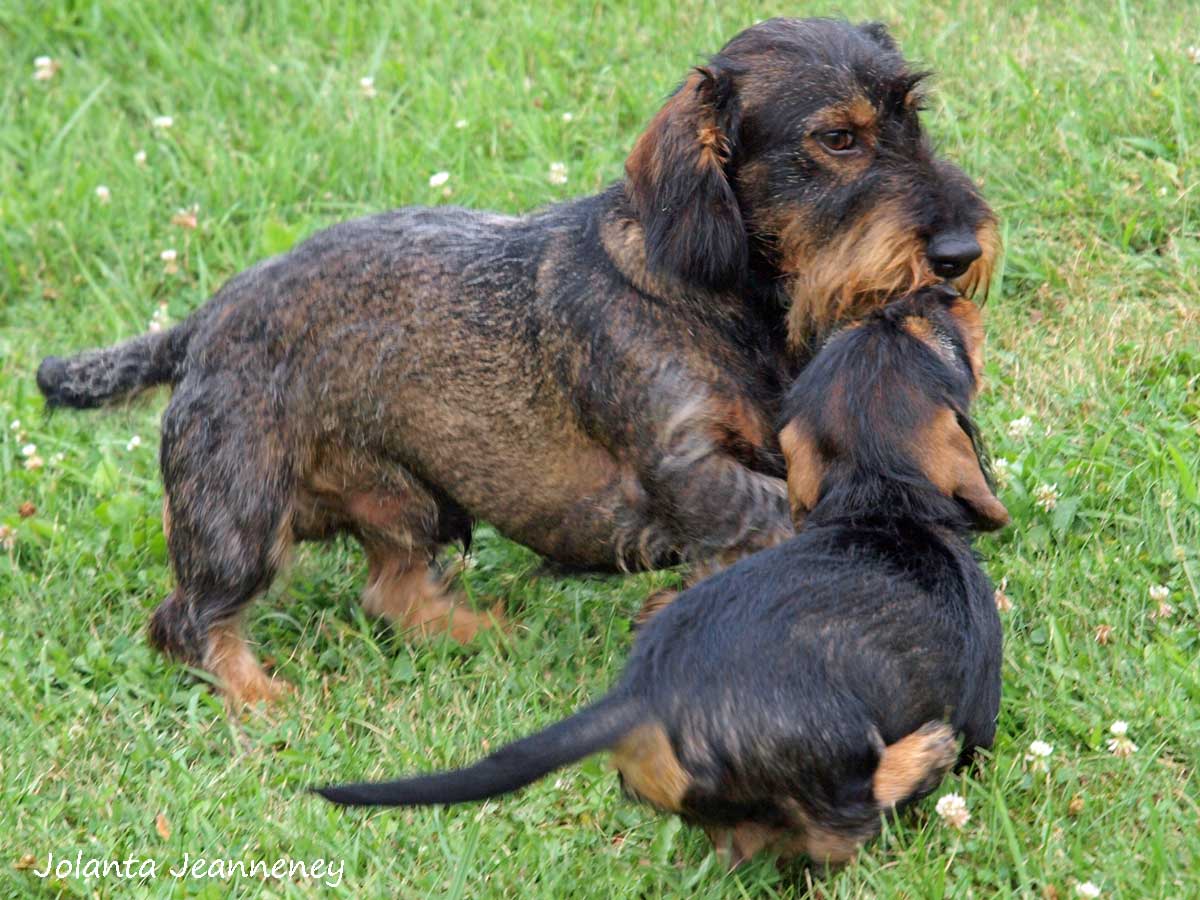
Let's start with some pictures taken several weeks ago. What do you think? Is Bernie (he is the one with a short coat and no collar) a vicious and aggressive dog who attacked Tommy (with blue collar)? Look closely and decide.


The truth is it was all play. Bernie (a five-year-old neutered male) is a friendly and outgoing dog who has never been in a dog fight...ever. He is one of the most stable dogs we have had. For the lack of a better term, I'll say that he expresses himself with his mouth and teeth (which we can see easily as he does not have a beard). When Bernie rests on a sofa he has to have a piece of blanket or fleece in his mouth, and he sucks on it. He does not destroy it, just puts it in his mouth. He is a very playful dog, and  a great playmate for young dogs of both genders.

Tommy, who is almost three years old, is pretty much at the bottom of our pack. He submits to Joeri and Paika, also young dogs. He loves to play with other dogs but sometimes he pesters them too much and often this is a case with Bernie. It is Tommy who starts the interaction, but after a while Bernie has enough and usually puts him in his place. No harm done, they are friends at the end of the playfighting.

To the outsider the whole situation (which lasted at least 15 minutes) might seem risky and explosive. Bernie exposes and uses his teeth and growls a lot, pounces on Tommy, who finally rolls over. I think that Tommy learns something during these sessions. I have never noticed him having his teeth out when he plays with Bernie, but I have seen him doing it with Quenotte, the only dog here that he is dominant over.

Few years ago I attended a workshop with Susan Clothier, where she talked a lot about observing canine body language. I remember her saying that sometimes it is very hard to say when dogs are just playful versus when they are starting a fight. According to her the difference in the body language can be very subtle - as long as dogs are willing to make themselves vulnerable and "self-handicap themselves" all is good.