Search This Blog

Showing posts with label puppy training. Show all posts

Sunday, January 28, 2018

John's last training line

by John Jeanneney

You young trackers  have many good years ahead of you, but eventually things wind down. As old tracker, I can give you a preview of what is coming eventually. First I had to give up taking calls to find deer. I just couldn't navigate steep slopes and thick cover due to poor balance and lack of leg strength. But at least I had the comfort of knowing that I could still train puppies on easier terrain. I could still work with my dogs.

At the end of January there was a break in the winter weather and the ground was bare. I took out Odin, age five and a half months, on a 22 hour line, 375 yards long.  Odin's is a puppy from Germany, and he had not had much training in tracking before the snow came. Odin was doing amazingly good work on the old line with its six right angle turns. Then I fell down in the flat, easy  woods and lost my grip on the plastic clothes line that I use as a tracking leash with half-grown puppies. What a nuisance it is to be 82 years old and semi-competent!

Odin took off, as I struggled to crawl to a tree and  pull myself back up on my feet. When I hobbled ahead to the last turn I could see Odin a 150 yards ahead. He had followed the blood line around the last turn and was "baying" at the deer skin. He didn't quite know what to do with it, but he knew that it was the treasure at the end of the track, and that this was important.

My instability in the woods, falling down and all, forced me to admit to myself that even training  puppies to track was now beyond my capability; this sad day  was softened by Odin's brilliant work at a young age. I will live on in the memory and spirit of my dogs.


Thursday, November 7, 2013

First season of training and tracking for this promising Bavarian puppy from Germany

Matt Wilkes from Georgia shared these pictures with us:

In anticipation of the arrival of my new BGS pup, I read John's book Tracking Dogs for Finding Wounded Deer several times. Ken Parker brought Beyla back from Germany on September 11, while he was over there training as an apprentice judge. Once she got settled in to her new home I began training her with John's techniques. The Georgia archery season started the following weekend. I was able to kill two does, both of which died in site of my stand. I let Beyla track both deer for practice and she made quick work of both lines.


Tuesday, September 10, 2013

First natural training line for Addi, a seven-month-old wirehaired dachshund puppy


Andy Bensing shared with us his recent experience with Addi, a puppy who is sired by Chuck Collier's Moose (FC Nurmi von Moosbach-Zuzelek). Moose is a talented and accomplished tracker in his own right, but over the last few years he has proved to be an exceptional producer.

Here's Addi, a 7-month-old granddaughter of my Eibe on her first natural training line track.  The deer had traveled 100 yards after the double lung shot but left absolutely no blood trail.  Unfortunately the hunters were unaware of the availability of tracking dogs when this buck was shot and it took well into the next day for the hunters to locate the buck in the thick cover that it ran into.  The deer was left lay due to spoilage after it was found by grid searching the next day.  I was on the property 2 days later with my experienced dog, Eibe, for a different deer and when that track was over I used the opportunity to try giving my young pup a little field experience.  Although Addi had previously been on about 20 training lines with tracking shoes and blood, I doubted she would be able to do anything with a 40 hour old bloodless line but I figured I had nothing to lose by giving it a shot.  Well to my wonderful surprise when I put her down on a bloodless start at the hit site she figured it out very quickly.  Very slowly and methodically she picked her way down the bloodless 100 yards through thick cover right to the carcass.  Conditions were perfect for training; the uncleaned arrow was available to lie on the ground at the exact known spot the deer was standing when shot, the wind was at our back and the deer was still in the woods at a known location. 


This is the kind of dog that is being bred here in the United States on an ever increasing frequency.  Not all dogs start out so well at such a young age and many of those slower starters still turn out great later in life but when you get a quick starter and combine it with some good initial young dog training you can get results like this.  If it sounds like I am bragging, I am!  I could not be happier today if I had hit the lottery!

Monday, July 22, 2013

This smart puppy has stayed on a right track


Ray Holohan, a United Blood Trackers member from Illinois, shared with us his recent experience. Here it is in his own words:

I thought I would drop you a line to share this peculiar training track I experienced this last weekend.

Saturday about 3:00 pm I decided to lay a short training track in my home timber for my new pup Ruffle "Ruff", early the next morning .  The track was 15 hrs. old and about  1/8 of a mile. We started down the trail, all was well, she was doing a good job when I looked up ahead and spotted what looked like a dead deer right on the blood trail. As I got closer it became quite clear that's what it was.

I thought to my self how should I handle this. I decided to let her find it and congratulate her with all the praise I usually do. To my surprise she walked up to the deer sniffed it. then sniffed her way around it and continued down the blood trail and found the hide and reward at the end.

At first I took this reaction as a negative but the more I thought about it, I think she knew that it wasn't the thing she was looking for, thus ignoring it and moved on. What do you think about this? After finding the hide I went and got my camera phone, took her back and let her back trail to the deer.

She seemed a little frighten, of the deer this time so I took a stick and got some of its blood from a damaged antler and let her lick and smell it, and she became quite comfortable with it. I wanted to make this a positive experience. The deer at first looked like a limb had fallen on it, it was wedged underneath it, but after a closer look I think it may had been struck by a car, probably on the highway about a 1/2 mile away and got that far before it died. I got a recovery tag from the DNR and was able to recover the blood and hoofs. Has anything like this ever happened to you or John?

------------------

Well, I thought that Ray handled the whole situations really well. Obviously he has a very smart and talented puppy, which was staying on a right track and knew that the deer did not "belong" there. She was intimidated by the deer, but that's completely normal for a young pup. 

Something similar happened quite a few years ago when John and I tracked a deer with two dogs, Alec and Sabina. John wrote about it in his book Tracking Dogs for Finding Wounded Deer.

"Staying  on the right  line, no matter what, is usually the most difficult skill that a tracking dog must learn. My old Sabina demonstrated how reliable an experienced dog can become:

My wife and I  tracked a buck together. On the phone it sounded like an easy one so we took one of our young wire males, Alec, who had  training but no natural experience. My wife handled  Alec and I handled Sabina behind as a backup in case the young dog had trouble. Alec did a pretty good job, trailed out past the hunter's point of loss and went on for another quarter mile without help.

Then came misfortune. Young Alec tracked right into a fresh gut pile, still warm. Alec thought the guts were better than nothing and he munched a bit. The hunters and the handlers were down-hearted for sure. They had called us and we had driven a long way; now it was all for nothing. Someone else had finished off their deer and dragged him out.

Then I  thought of something. There had been some grains of corn in the track on the way to the gut pile. They had leaked out of the deer. It was funny that there was no corn in the gut pile that we were standing  over. I took Sabina back on the trail about 50 yards and let her work the line; she tracked right past the gut pile, never looking at it. All concentration, she worked another 50 yards into some thick bush and there he was, the original buck, corn, guts and all."

Monday, October 15, 2012

Easy natural lines are the best tool for training a young tracking dog: Cliff Shrader and his longhaired dachshund Tasha

Cliff Shrader is a new United Blood Trackers member, and he is has been working with a young standard longhaired dachshund Tasha. Tasha was born on May 27, 2012, in Denmark. He has been updating me about Tasha's training, and I asked him to write about how he got involved in blood tracking, dachshunds and how he went about importing a puppy from Europe. Thank you Cliff!

I was born and raised in South Louisiana. We were a family of duck and deer hunters, and we did our hunting in a swamp called the Atchafalaya Basin (this is the same area where Swamp People is filmed).  We used Walker hounds to run deer and we used Labrador retrievers for duck hunting. If someone had told me that I would grow up to own and love Dachshunds, I would have laughed at them.

I ended up with two dachshunds, Boudreaux and Thibodeaux. They were just pets until I brought home a deer to clean. When I showed the deer to my hounds, they went crazy. Their prey drive was very high, and they didn't want to let me have my deer back. This is when I first thought about Dachshunds as tracking dogs. In the south, people would laugh at you if you said anything about dachshunds being fieldworthy.

 My idea of actually training dachshunds laid dormant for quite a few years. Two years ago, I needed a tracking dog several times to trail wounded deer but there were none around. I pride myself on my tracking abilities but even after long and hard tracks, I lost two deer. Last year I started doing research on tracking dogs. John and you Jolanta had several things that I read and a friend of mine loaned me his book...Tracking Dogs for Finding Wounded Deer.

I contacted Patt Nance after visiting her website. Timing was very good because Patt and Tina Knoll  were just considering breeding Owl to Tina's dog Babe. I was lucky enough to be able to attend an AKC tracking trial that Laura and Tina Knoll were bringing three of the girls to. After that I was hooked. I waited several months for the mating of Babe and Owl to happen. Finally, all the stars were aligned and the mating took place. Unfortunately, it didn't result in a pregnancy. Patt Nance and I spoke several times and she told me of two litters in Europe. It was during this time that my favorite dog Thibodeaux passed away.

Patt Nance contacted several of her friends and they helped me find The Right Dog, not just a dog. I was very fortunate that Lise-Lotte Schultz at Tranevang Kennels in Denmark had a puppy left. Diane Webb of Doxifun and her husband checked out this litter of puppies when they were around four weeks old. She liked what she saw. When it was time, Marie Gadolin administered the Volhard puppy test. Tasha scored mostly 2 and 3s which indicated that she would be a good dog for an experienced trainer. Patt Nance had been studying the possibility of getting a puppy from this litter for herself. She loved the bloodline and Lise-Lotte provided information on all the hounds in that line.

When Patt bought a puppy (Taya) from the litter she was very impressed with her. From everything that I knew, Taya's sister Tasha was the right dog for me. Tasha was shipped from Copenhagen to Chicago on a direct flight. I was nervous as I waited in the rain at the airport. When they brought Tasha out and I saw her peering through the crate, I fell in love.

I have enjoyed getting to know Tasha. Training has been a bonding experience for us. John Jeanneny's book has been my bible. Your blogs and YouTube videos have helped tremendously. I started Tasha out on very short tracks......tracks that she couldn't fail. It only took a few of these and she started to realize what her job was. Tasha started really well in tracking but these were only training tracks, practice tracks...at home tracks. When we headed to Illinois for the season opening week long bow hunting trip I was very hopeful but still unsure of how Tasha would perform in the field.

On Monday it rained almost all day. Monday afternoon, my friend sent me a text that he had shot and killed a 9 point. He had already located the deer but would I like for him to leave it where Tasha could track it. I headed over there as soon as my hunt was over. The deer was shot in a field with a crossbow about 25 yards away.  The arrow struck the deer pretty far back through the guts. The deer ran 40 yards in chest high grass and laid down. After an hour, he approached the deer. The buck stood up and he shot it again. We decided to start the track where he had made the initial shot. Tasha was able to find guts on the vegetation and she found his arrow, something that he had not been able to do. Tasha fumbled around on this track having  problems getting a good read on it. I picked her up and placed her where he had made the second shot. This time she took off bouncing through the tall grass. She ran her track straight to the buck. When she ran upon the buck laying dead in the tall grass it scared her half to death. It took a couple of minutes with me kneeling beside the deer to get her over the initial shock. After this she was fine with it.

Tasha's next track, her first true track was over five hundred yards on another gut shot deer. Most of this track was without any blood. I have never been so impressed with a puppy.

I left Illinois Sunday morning heading home. One hour into the trip, I got a page from my hunting buddy Jerry. Jerry told me that two does were shot and one hit was questionable. I turned around and
headed back. We decided to put Tasha on the questionable shot first. The shot was made at 28 yards with a vortex broad head. The arrow struck the shoulder blade and very little if any penetration was achieved.

We started out on the track and Tasha showed us blood. The blood was bight red and was up on vegetation as well as the ground. The trail was steady and led to a wound bed about 75 yards away. The blood stopped but Tasha never slowed down. We proceeded to track another 100 yards with no blood but Tasha was pulling hard. We came upon something that I never encountered while tracking before...the property line. This neighbor would not allow any tracking upon his land. It was also understood that trespassers will be arrested.

We took Tasha to last blood and she tracked the identical track again. She was on this deer but we had to pull her off the track. I do not think that this deer was mortally wounded but I really wanted the chance to complete this track.

The next track we brought Tasha on was a deer shot at less than 20 yards with a 2 inch cut Grim Reaper head. This track was extremely easy to follow. You could see a wide heavy blood trail for
quite a way. Tasha ran this track as fast as I could go and there was the deer as expected 80 yards away. This may be the easiest track that she will ever get! It is amazing that this deer could travel that far after a shot like that. It was nice to end our week long hunting trip with an easy track like this.

During the week in Illinois Tasha ran six tracks making five recoveries. Tasha was fortunate to have a group of hunters that lent a helping hand in her training. They called us on nearly every shot, both good and bad, even though two of the deer could have been recovered without a dog. The lines were all pretty fresh. The averaged about two hours old with the longest being about 4 hours old.

This is the best on the job training I could every hope for.
 
 
Cliff with Tasha

Tuesday, July 10, 2012

Claudia and Razen: a future blood tracking team from Ashkum, Illinois

Some owners of tracking dogs never seem to be able to find time for dog training. And there are some handlers like Ray Holohan and his wife Claudia from Ashkum, Il, who are very serious about it and make it their priority. When a puppy with right genetics is given a proper training, the sky is a limit. Read this short report from Ray:
 
 
Hi Jolanta, hope all is well with you and John. Just thought I would give you a update on our new pup, Razen Kane, Rosco's daughter. I have been working with her since she was 10 weeks old, trying to lay a track once a week . She is about 7 months old now and shows great promise as a tracker. She has been successful on about every track that I have laid for her. My wife Claudia is her main handler but she will also track for me. We have done nighttime tracks, woodland tracks, prairie grass tracks, wetland tracks, and tracks in the rain. Most tracks are at least 24 hrs old, and range from a 1/2 to 3/4 mile long, using minimal blood, 2 to 3 oz. on most tracks. Her longest track has been 51 hours old, and she had no problem with it. She is a great little tracker.
 
I'm sending a picture of Razen and Claudia after their first blind track, which was a 1/2 mile long and only 6 hours old. I laid it and told them where the beginning was and to go and bring me the hide. It was a great training exercise for the both of them. They had to truly work as a team to pull it off. We have also ran both dogs on the same track at the same time letting Razen lead the way so that we can try it this season. Claudia will do daytime tracks alone but night time, I will have to go with her. We are both looking forward to a great tracking season this fall.
 
Best wishes and good luck,
Ray, Claudia, Rosco, and Razen Kane


Claudia Holohan with Razen after a successful completion of a training line.

Saturday, July 7, 2012

Blood tracking puppy training: an overnight blood line for a three-month-old dachshund Theo

Another report from Darren Doran from New Jersey who is working with his new puppy Theo. Theo is a son of Moose (FC Nurmi von Moosbach-Zuzelek) and Paika (FC Paika von Moosbach-Zuzelek SW). He turned three months old yesterday.
Rich Stolery called and wanted to do some training this Saturday and meet Theo for the first time. Rich is on the New Jersey tracking permit and owns November, a three and a half year old smooth dachshund our of wirehaired parents. Ember for short, is a sister to my other dog Karl. The heat has been unbearable and Saturday was going to be nasty. We put out two lines by Rich's house at 7:30 pm Friday and we were going to meet at 6 am to try to beat the heat.

Theo's line was very similar to the last one. It was somewhat longer at about 125 yds with two left 90-degree turns. It was made with tracking shoes with doe feet. I scuffed up the dirt at the turns the best I could and added extra blood.The line would end at a deer skin. The area was a ridge top with mature oak and cedar. The soil is what's called red shale around here, and it was dry and baked as hard as cement. There were a few small cedar dead falls, not much underbrush or leaves, and the weeds were burned brown and brittle. I didn't know if the shoes would leave much scent in these conditions. This area also has a high number of deer, and we pushed out a couple sets of does and fawns while putting out the lines.

I'm still trying to learn Theo's working style and ability level with these early training lines. It's important for a young dog to be successful on the training line. Because of the conditions I decided that I would squirt more blood on the ground and bloody the hoofs more while putting out the line. I used 4 oz of blood on this training line. I also had the small pieces of raw deer meat with me that I could toss over his head to re-focus him if needed.
The goal of this exercise was to expand on our last exercise and add a new variable. We were going to drive to a new place, walk in on a lead, track with the collar and tracking leash, go through our starting routine and add the new variable, Rich. Rich was going to be the hunter and accompany us on the line. I also wanted to see if Theo would be affected by meeting a new dog or if the hunter tagging along would impact his focus on the line.

Theo was going first, and it was already 75 degrees. The line was 11 hours old. We walked out Rich's backyard to the training line. Ember was whimpering in the yard by the fence, and Theo left with us and didn't pay any attention to her. We got to the hit site and I tied up Theo. Rich and I pretended to looked over the site. I put out some water for Theo and got out his tracking gear and hooked him up. I picked up Theo and put him down at the hit site.

Theo sniffed around a little and took the line immediately. He tracked to the first turn and right before he got there, I tossed a piece of meat ahead of him. Theo found the meat, but tracked past the turn anyway. He went about 8 feet and turned around, lifted his head and looked at me. I said ''where did he go?'' He started tracking back to the turn, past it and back the way we came. He went about 6 feet backwards, turned around and went to the turn and took the right direction. This was the only time he picked up his head and those were the only words I spoke to him on this line. Theo tracked to the second turn and I tossed the meat. He missed the meat but took the turn perfectly. He tracked the home stretch great and corrected himself a couple of times along the line. I was working hard behind him to keep his leash from snagging. It did get hung up briefly a couple of times, but it wasn't enough to  affect Theo. When Theo got to the skin, he was concentrating on the line so hard it surprised him. I started to praise him, and he got hold of the skin and started chewing it up. He got the rest of the meat for a well deserved reward.

It took 10 minutes to do this line and the goals of the exercise were met. Theo was unaffected by the ''hunter'' with us or the other dog he met earlier. Every time I train with this dog, he impresses me. He has excellent line sense. His methodical and matter of fact working working style doesn't waste any energy or heat him up in this weather. This will be a benefit on a long early season track later. His ability to quickly recognize and correct himself when wrong at this age, I think is excellent. I'm satisfied with his ability to handle different variables and stimuli associated with the training line but not directly related to the line itself.

The last three training lines have been kept similar for a reason. Although called training lines I didn't conduct any real training on the lines themselves. They were simply for observation and they have provided me a road map to move forward with Theo's training. In the future I'll add more variables to the training line itself. Each line will have a specific goal and be evaluated. Theo is still a pup and I don't want to push him to hard. I want to challenge him, but I don't want to make it to hard that he fails.

Rich, the "Hunter" and Theo at the end of his line

Rich and Ember at the end of their line

Monday, July 2, 2012

Blood tracking training of a young puppy - Theo at 12 weeks

A week ago we posted Darren Doran's report from working a first blood line with his puppy Theo. This report was on our puppy blog. I decided to post his second report here as it shows so well how a seasoned tracker and trainer approaches blood tracking training with a young puppy. Theo will be three months old on July 6.

What I love about Darren's approach is that he has a plan and objectives for his training. It is obvious that a lot of thought based on his knowledge and experience have gone into this. His analysis and detailed written step-by-step description of Theo's tracking are first class. I think his reports can be of real help to novice trackers and handlers.
-------------------
In Darren's own words:

I wanted to train with Theo, but it's been so hot that the only good time to train is first light. I decided to put out a line on Saturday night about 7:30 pm.

I picked a spot that was heavily timbered with a full canopy of leaves. The sun hardly hits the ground in this area. The line was about 75yds with a left turn and a right turn, and it would finish at a half of deer skin with the tail. I used tracking shoes with doe feet. The line was similar to the first one except I didn't use any hair at the hit site. I marched with bloody hoofs close together and added blood to the line and blooded the hoofs frequently along the way. At the turns I scuffed the leaves and added blood.

The goal of this exercise was to expose Theo to different parts of the total tracking experience. Theo had never been to these woods. I had to load him in his crate and drive to the line which was about 8 minutes away. We were going to walk in on a lead, track on a tracking leash and I was going to introduce him to our starting routine.

It was 68 degrees when I parked the truck. There was no wind and it hadn't rained over night. By the time I got the skin placed and back to the truck to get Theo its was almost 6am. The line was 10 1/2 hours old. I wasn't concerned about the age of the line because it was put out right before dark in a shaded woods with no wind or rain overnight. A line put out like this doesn't age at the same rate as one put out in the daylight exposed to the sun or wind.

I got ready and walked Theo in on the lead. He walked out ahead of me on the trail in a confident manner. As we entered the woods he fell in behind and we proceeded to the hit site. Here is where I introduced him to our starting routine. This routine will evolve as our training progresses but for now I simply tie his lead to a tree near the hit site, get out his tracking collar and leash and hook him up. I leave him tied to the tree and walk over to the hit site and bend over and pretend to examine it. After about 10 or 15 seconds I go back to the dog, untie him and pick him up and place him at the hit site.

Theo sniffed around and took the line almost immediately. I'm not used to this kind of start with my other dog Karl and it was a welcomed change. I was going to incorporate a technique that Andy Bensing had showed me. If Theo was loosing focus or needed additional help on the line, I was going to toss a piece of raw deer meat ahead of him while he was tracking. This acts as an incentive and reward at the same time. When you do this you want the dog to be tracking and not be aware that you are throwing it.

Theo tracked to the first turn without incident. He tracked past the turn and started to check after about 8 ft. When I laid this line I tried to pick an area that was relatively brush free but the leash snagged and this broke his concentration. When I went over to unhook it, he came over to me. I coaxed him back to the turn saying ''where did he go, search here'' and let him work. He worked out the turn and when I was sure he was tracking I tossed a piece of meat over his head on the line. He tracked past it but then hit the breaks and started sniffing all around looking for this new scent. The meat was only there for a couple of seconds before he got there but was able to identify it and find it. This worked as planned and he seemed to work with more intensity. Theo came to the second turn and tracked past it as well. He corrected himself and as soon as he was tracking I tossed another piece of meat over his head. We were now on the home stretch and I tossed the meat a couple of more times. As we neared the end of the line Theo spotted the hide and was a little taken back. I started to praise him and he went over and started to chew it up. I gave him the rest of the meat. He does have the indication of being a possessive dog with the hide. He was growling at me when I went to take it away. I unhooked his tracking gear and we played with the hide on the way out of the woods. I would take it from him and throw it and he would run over and start chewing it up.This also allowed me to work on his possessiveness and by the time we got to the trail he was relinquishing the hide in a more civil manner.

At the trail I packed up the hide and hooked him back up to his lead and we walked back to the truck. It took Theo 13 minutes to do this line and I couldn't be happier with his work. I like his speed, his ability to correct himself, and his focus.The age of the line did not pose any problems. The next line will be about the same length. The age will depend on the weather and the temperature.The tracking leash didn't pose a real problem but it did break his concentration a couple of times. I'm going to walk him through the woods with his tracking leash on rather than the trail on our nightly walks. This should get him more familiar with the leash snagging brush. At the turns I'm going to add more blood and as we approach the turn, I'm going to toss a piece of meat over his head right at the turning point. This should focus his concentration at the turn and maybe he'll pick up the new direction easier. When Theo's tracking I don't talk to him at all. The sound of my voice has a tendency to break his concentration at this young age.

All in all a successful exercise and the goals set were achieved.

Theo at the end of his second training line.


Thursday, January 19, 2012

Young dachshund puppy's first blood tracking season

From a breeder's perspective - it does not get better than this. Matt and Jenny Willis from Missouri are owners of Moose and Paika's puppy called Dubya (Strut von Moosbach-Zuzelek), who was born on August 4, 2011. This is Matt's report describing the pup's first tracking season.

Jolanta,
I still can't believe it's been three and half months since our trip to meet Dubya for the first time. All of my hunting days have been spent running training lines with Dubya, I can't say John didn't warn me. I enjoy watching Dubya run the lines so I didn't mind much. Dubya did find his first deer and ran an amazing natural line, more on that later.

October 9, 2012: Jenny and Matt Willis in Berne, NY with their new puppy Strut aka Dubya
Dubya is maturing into a very handsome dachshund. His coat is exactly what I hoped it would be! He is incredibly popular every where we go. I really enjoy introducing him to people who own americanized dachshunds, their questions/reactions always make me smile. This past weekend we were out with Dubya and ran into a woman holding her dachshund with its long body, short small legs, and little tiny head, who looked at Dubya and said, "Uh is that a dachshund?" I replied, "yes it is." She looked at Dubya, looked back at me with a skeptical look, and said, "I have three other dachshunds." Lord knows what she was thinking but I am pretty sure she was trying to tell me I was wrong and Dubya couldn't possibly be a dachshund because he didn't have the same frail build as her dog. Jenny and I are really proud of him!

The big deer outing in my family is opening weekend of rifle season in Missouri. I couldn't imagine not bringing Dubya even though he was still a young puppy. I was trying to keep my expectations reasonable even though he had shown tremendous ability on our training lines. Going into the weekend I was hoping for a couple short natural lines we could use to give Dubya the experience of being on a real line.
 
The weather was horribly hot which made the hunting slow. After an opening morning with very little action and weather only getting warmer I was a little concerned getting Dubya on a line was not a certainty. Trying to tell myself it's still early in the hunt, I headed out for my afternoon hunt. As the minutes turned to hours unfortunately none of the shadows turned to real deer. I was really beginning to feel the pressure when I heard a shot; it had come from a ground blind where one of the other hunters in camp was sitting. I immediately began to hope the deer ran at least a few yards to offer Dubya some work.
 
I got back to camp soon after to get the scoop. The blind sits on the edge of a cut corn field with a creek a few yards behind. The deer had come in to 50 yards and was feeding in the cut corn. At this point I was thinking this may not be much of a track. The hunter said the deer had run past the blind and splashed into the creek, where he believe it had expired. I was pretty excited we would at least get a 60 yard natural line out of the deal, we got a little more than we bargained for!
 
Thinking this was going to be a very short track I was grossly unprepared. We got to the hit site with Dubya about 2 hours after the shot. There was some bright blood and Dubya was excited. He had a little trouble getting started but then locked in and off we went. It took Dubya little time to cover the roughly 60 yards to the creek bank, I shined my light in the creek and saw no deer. At this point I wasn't sure what we were in for. Dubya continued down the very steep creek bank to the edge of the water, I couldn't find any blood and wasn't sure he was still on the line until he stopped and smelled a leaf on the edge of the water with a blood drop on it.
 
 
The water was calf deep so we carried Dubya across to the other side where he promptly picked up the track again.
 
First crossing
 
We went about 50 more yards on the edge of the creek when Dubya started to head back down the bank to the waters edge. We carried him across the water again where he found blood on some rocks.
 
Second crossing
He took us up the other side of the creek and back out to the cut corn, we worked from the cut corn to some CRP and then to a hard wood ridge. At this point we had gone a couple hundred yards. Dubya worked up the steep ridge, overcoming being distracted by a dead mole, to take us to the top of the ridge. We were confirming his line with drops of blood and the occasional larger blood spot. After a detour to check out some osage oranges I asked Dubya, "where did he go?" Dubya responded by finding some more sign and leading us further along the ridge.
 
We realized the track was on a trail leading past a stand where my brother was sitting. He stayed on stand 40 minutes after the shot and never saw the deer come by. The blood has all been bright arterial blood but this new information in conjunction with the distance we had travelled at this point, we began to believe the deer may not be down. We continued along the track, which led us past my brothers stand through an opening in the barbed wire fence and into another CRP field.
 
We couldn't believe Dubya had stayed with it this long but were still finding blood spots and decided to continue. This is some very tall dense CRP, I wasn't sure how well Dubya could move let alone track through it, but off we went. Dubya was still very determined and continued to follow the track over, under, and around the grasses. Luckily most of the track was on a deer trail working through the CRP.
 
Dubya's view
I was in awe of this little dachshund at this point but this is where he really blew my mind. There were a lot of deer trails in the CRP field, any of which could've been used by the wounded deer. Every time I was pretty sure he had followed the wrong trail I would find a little blood spot confirming he was still on the right track. I can't even imagine how much different scent he had to sort through to follow this specific deer but somehow at 13 weeks of age he was doing it.
 
After 800 yards and a flashlight battery change and still on the trail we decided the deer wasn't down. Reluctantly I decided to abandon the search for the night. I really wanted to find this deer, Dubya deserved it! After the next morning's hunt I decided to give Dubya a shot at closing the deal. The track now 17 hours old we headed back to the CRP and picked up the track. Dubya continued to the track another 400 yards to the property line, where we couldn't get permission to continue so we were forced to stop. Right on the fence line we found a spot of blood about the size of a nickel to confirm he had indeed taken us on the right track all the way. It was bitter sweet, I certainly couldn't over look the fantastic work Dubya did but at the same time I was very disappointed the track didn't end with a deer. We are pretty convinced the wound wasn't immediately fatal.
 
In total Dubya took the track 1200 yards! I never could've imagined that was possible for this 13 week old puppy! I believe this speaks to the quality not only of this litter but the quality of the breeding program you and John have established. I don't believe enough credit can be given. I can't thank you enough for all you've done! I have included pictures of different parts of this track. The "bloodsign" photo is an example of the average blood spot found during the track. The "dubyaview" photo is an example of the CRP Dubya tracked through. I hope the rest will be self explanatory.
 
End of track

The next night Dubya found his first real deer at the end of a 50 yard track. This track was 2 hours old and went across a creek with lots of blood. He had no trouble. He approached the deer cautiously, had a smell and was ready to move on. I have included a picture of this find.

Dubya's first deer

The final picture is of Dubya from yesterday. We hope all is well with the two of you and look forward to keeping up with the next couple litters!

Dubya at five months
Best,

Matt Willis
 
Thank you Matt and Jenny for such a great report and all the work you have been done with the pup!


Tuesday, November 8, 2011

Spider, a blue heeler pup, is showing a great potential for blood tracking

What a nice e-mail from Scott Frye. Thank you Scott!

John,
Some time back I bought your tracking book, as I was really interested in training one for my family. I purchased a blue heeler pup, and began to train him using your methods and guides. Spider is 11 months old now. He has found 5 deer for us this year. Truth told, the first three we really didn't need his help, but he needed the experience.  

Last night he completed his second night track, first one was several weeks ago, 300 yards on new ground, with very limited blood.  Last night's track was about 175, good blood for first 25 yards, then very limited for 100, then decent last 50. He is learning very quickly, made that track last night in about 20 minutes. He sure made the job a lot simpler.  

Thank you and Jolanta for your time and dedication to this sport, I would have really floundered without your book and wisdom given in it.  

I have found there is a lot I have to learn as a handler to make him better. Big difference in handling competitive field trial bird dogs and a tracking dog. I am learning from my mistakes, and really enjoy it.

 Hope your season continues to go well. My best to you and your bride.  

Just bought the Dead On! book. Looking forward to it as well.

Another successful track for Spider!
 

Sunday, April 3, 2011

Dachshunds on the rocks

by Andy Bensing

There are many more things to developing a great blood tracking dog than just the dog's ability to follow a blood line. One of those things is the dog's comfort in any environment. I had my seven-month-old Atlee out the other day for a walk in the woods, and I discovered that he had a little trouble psychologically with some large rocks. I climbed up and over some boulders on the way out of the woods Atlee seemed a little hesitant to climb up on them to follow me. He eventually did but he was not comfortable. With that in mind, it was a beautiful afternoon here today in Pennsylvania so off to the rockiest place I knew to get Atlee comfortable climbing on big rocks. I took my other young dachshund, six-month-old Buddy, along too. Buddy is as sure footed as a mountain goat so I figured he would help motivate Atlee as well.


Dachshunds on the Rocks from Andy Bensing on Vimeo.


Dachshunds on the Rocks- Cliff Climbing from Andy Bensing on Vimeo.

Teddy Moritz added a comment with a picture:

I agree that pups should experience many surfaces while they are young. Makes them more assured as adults when hunting. You know where I live so rocks and logs and hills and streams are constant challenges to my pups. I think scenting a live animal and blood tracking are the real 'variable surface tracking' tests. My dogs have to track a rabbit anywhere it goes...water, asphalt, rocks, woods, etc., just like a blood tracking dog. Balancing on rocks, climbing over them and going under them give a pup confidence and they learn to use their bodies.
Here's Garmin at four months learning to negotiate a rock pile where the rabbit ran.

Tuesday, February 15, 2011

Remi rocks! A video of blood tracking dachshund puppy in training

Justin Richins, an outfitter from Utah, has been working intensively with Remi, who is a littermate to Rilla and Ranger from the two previous posts.  The track in the video was 19.5 hrs old. It was 35F when Justin laid it out and 25F when he ran it. 

This video blew me away! This was a very difficult track; it would have been a difficult track even for a much older and experienced dog. I think that Remi's work for his age of 8.5 moths is just exceptional and  in my opinion Justin pushed him a little too hard. I really like the way he implemented the idea of cooperation and partnership where Remi had to rely on Justin's help with  getting over some obstacles.

John's comment to Justin was: "Justin, I think this video demonstrates that a hunting dachshund is something more than the cute little "wiener dog" that so many people laugh at. Remi has the drive and heart and body to carry him over many tough miles on a real track. This doesn't mean that you have to push him this hard at his age.

I like the way that you are allowing him to correct his own mistakes when possible. However, when Remi is working a check I think that it is best not to say "good dog" until he actually has the line again. An enthusiastic
"good dog" should be his reward for solving the problem and recovering the scent line.  The video shows that you have a great working relationship with your dog. This is a case where "a picture is worth a thousand words"...or even a book."


This is an example of the tracking/hunting dachshund bred according to the FCI standard, and when I watch the video I get goose bumps. This is so much better than watching dachshunds with exaggerated conformation at the Westminster Kennel Club Dog Show. Many thanks to Justin!  

Sunday, February 6, 2011

Puppy blood tracking training in the snow

Andy Bensing submitted this very interesting report from a recent training session with his two pups, Atlee and Buddy. Both pups were sired by our dogs - Atlee's dad is Joeri and Buddy's dad is Billy. Thanks Andy for sharing your experience with all of us!

With tracking season over it's time to start working on my young wire haired dachshunds Atlee, 4.5 months old, and Buddy, 3.5 months old.


Atlee has had minimal early conditioning. He had 2 liver drags before I got him at 11 weeks and I have done 3 short ones since bringing him home. I normally would have done more but I bought him during tracking season which of course takes most of my time. He also had some health issues that needed to be worked out that took potential time away from early training. With the worst of his health issues behind him and me getting the itch to start training, off we went.

I bought Buddy at 9 weeks of age during the tracking season as well. I bought buddy from a local breeder so I have been visiting him and doing some early conditioning work with him and the rest of the litter from the start. The breeder started blood tracking conditioning at 5 weeks of age with the whole litter. 2 or 3 times a week the breeder put Buddy on 6 or 8 foot "liver drags" on cardboard indoors. At around 6 weeks I started taking the pups outside twice a week to do 20 or 30 yard liver drags outside.

The GPS map below shows the layout of the lines I ran with both dogs. The terrain was a snow covered field that I had crisscrossed with tire tracks. I dripped blood in the tracks and made left and right turns where the tracks intersected so as to force the dogs to focus on the blood scent and not be able to just follow the tire tracks visually. The videos tell the rest of the story.

Click on the picture to enlarge it.


Wednesday, January 19, 2011

Remi on a Scent Shoe Track in Utah


Sometimes an exceptionally-gifted puppy and an inspired natural handler come together. This video is a good illustration of that combination. You will see that in this partnership Remi listens to his handler and Justin, the handler, “reads” his dog.

For most eight-month-old puppies this exercise would be too much to ask. Normally it takes an older dog to deal with the distractions of snow, freezing creeks and fresh deer tracks. Don’t force this on your own puppy. Wait until you are sure that he is ready.

Tuesday, January 11, 2011

Eight-week-old bloodhound puppy on her first blood track

Andy Bensing sent us a link to this video showing an eight-week-old bloodhound on her first track. It is well done, and the pup (Moonshine Grace's Benelli aka "Nelli") is incredibly cute.

Tuesday, November 30, 2010

Rosette and her training on real blood lines

It was great to hear from Lynn and Ann Pierce from Louisiana, owners of a six-montth-old Rosette, a daughter of Joeri and Gilda.
David Domangue shot this real nice eight point with a kicker out of the “number one box” late Friday afternoon in Woodville, MS at Gut-Buster’s hunting club and resort.

David called on the VHF and asked if I could bring Rosette to track the buck because the buck ran into the woods and David wanted the buck to sit a while so it wouldn’t spook if he tracked it right away. We waited about an hour. It was dark by the time we arrived at the food plot of the “number one box”. We found some blood on the edge of the food plot and I put Rosette on it and she took off immediately and made a real nice aggressive track right to the buck. She is starting to understand the prize at the end of the track (deer blood, pulling on the skin, and some liver at the skinning rack). Everyone at the camp site pats her, holds her and rewards her. She’s loving it.

It was about a 100 yard track through thick woods with a hard left and right turn going downhill all the time to a small creek. The blood trail was good, but we had several long stretches without any blood. I am sure we would have found the buck without Rosette’s help, but it was great experience for me and Rosette.

The next day, 18 hours later I took Rosette back to the site we tracked with my son in-law Jeremy (nick name) Jeremiah Johnson, and two grandsons. I put some liver where we found the buck for her reward. We started Rosette in the food plot where we first found the blood the evening before. Rosette tracked the blood trail like the night before and with the same intensity and aggressiveness. She loves to track and I was really pleased with her track 18 hours later. Rosette really enjoyed the liver I put out for her. My two grandsons, Jac-4 and Christian-2, helped us track the blood and when they found some, they yelled “hey Big Poppa blood over here”. Even though we had passed over it I told them great job, which really gave them a feeling of helping Rosette with the track. We are all having lots of fun with Rosette. Thanks Jolanta and John for getting her started.

Thanks David for allowing us to track your buck.

Rosette (Roulette von Moosbac-Zuzelek) with David Domangue and his deer


Big Poppa (Lynn), Rosette, and the boys, Jac and Christian, resting after a long track with Rosette in the woods.We sure had fun.

This is just an extra pic to show you the young boys we had over over the thanksgiving weekend.
They had a blast and we did to. They look like some real characters and they are...

Sunday, November 28, 2010

Tracking wounded deer with Bill and Mya

We received a nice report from Bill Brown from Ohio who has been working with Mya (Quanta von Moosbach-Zuzelek), a six-month-old daughter of Joeri and Keena.

Mya has been very busy and doing extremely well, she has had 8 searches and 3 recoveries. I been even more impressed with the way she has worked on the ones we didn't find. She had a 3 hour track through the woods, over a fence, crossing a corn field, over another fence, and in another woods with brush so thick a rabbit couldn't go. We had to crawl on all fours for 150 yards, but nobody said it would be easy. During the time she had 4 or 5 self checks that she worked out on her own. We finally determined this could go on all night and this probably wasn't a mortal hit. Two more of the no finds were seen by same hunters the next day doing fine.We have had 5 more calls that we were unable to take. The need for tracking dogs in Ohio is great as the other trackers in Ohio can attest to.

I really enjoyed seeing Rex and Dave teaming up for a successful track. Next week is gun season here in Ohio so we expect plenty of work, last weekend was youth season. Mya is a true believer in the saying "finders keepers losers weepers" she makes a claim on her finds with the hunters, she hasn't been that way with me though. Just something we need to work on. Enclosed are some pictures of my son Wylie during the youth hunt with Mya and "her" doe.

Wylie during the youth hunt with Mya and "her" doe
Bill with Mya

Wednesday, November 3, 2010

A good training track for Rilla who finds a great buck at the end of line

It was great to hear from Stan Kite, who owns a 2010 Joeri/Gilda puppy "Rilla"

Hi folks!

Just wanted to let you know that last Thursday evening, my older son shot a half decent 9 pt buck in our woods. He knew he made a good shot, but didn't pursue the deer until I got there with Rilla. It took her a minute at the hit sight to get started (we never did find his arrow), but once on the trail, she did really well. She previously did a nighttime track in a hayfield, but never in the woods, so this was new to her. There were no well-defined deer trails, and it was very thick and briar-laden, so things were hitting her in the face, etc. She was a little aprehensive at times with all the obstacles. The total track was less than 100 yds, and she worked one check especially well, a hard left turn that wasn't obvious at all. Once again, I was extremely proud of our little pup!


Tuesday, October 5, 2010

Puppy work and early conditioning

by John Jeanneney

This is a somewhat edited version of article that John wrote for Full Cry.

We are receiving some interesting feedback from folks who purchased our puppies last summer. I’d like to share some of it with you, but please don’t take this as an attempt to get puppy advertising on the cheap. We don’t have any puppies for sale.

The puppies we sold last summer were part of our project of conditioning pups at a very young age as a means of expanding their capacity to track later on. We used deer blood, deer liver drags and deer gland scents. I’ve written about this in a recent Full Cry article, “Nature and Nurture”, and I hope that our experiences will encourage some other breeders and owners of young puppies to try early conditioning. We’ll come back to the theory of puppy conditioning later. First, I want to get on with the stories, which are fun even if they’re not very “scientific”.

We sold a “conditioned” puppy at the age of 12 weeks to Justin Richins, an outfitter in Utah. Last August Justin flew all the way out from Salt Lake City to New York State to pick up Remy, his wirehaired puppy. Justin never told me that his friends thought he was nuts, but I suspect that something similar might have passed through their minds.

Remy was supposed to be “just a puppy”, but when Justin’s clients began to hunt this fall there came a need for a tracking dog. Puppy Remy was all Justin had. Within three weeks, Remy had found three elk in Utah, a Shiras moose in Wyoming… and an easy antelope that didn’t really need tracking. I guess that Justin was worried that Remy might get bored just tracking elk.


The three elk, and later the moose, were the big challenges. Now I really don’t understand why this worked so well. If Justin had consulted me in advance, I would have said “No, the pup is still too young for anything but short easy tracks.” One day Justin did call me on his cell in the middle of a track. “ We have tracked this wounded elk a half mile from the hit site”, he said, “and then we jumped him. This elk will go a couple hundred yards and then bed down . When Remy tracks up to him, he takes off again before we can see him in the thick stuff. We’ve gone ¾ of a mile. What should I do?” My answer was, “Give Remy a rest and a drink . You’ll get the elk if he keeps bedding like that.” And they did get the elk.

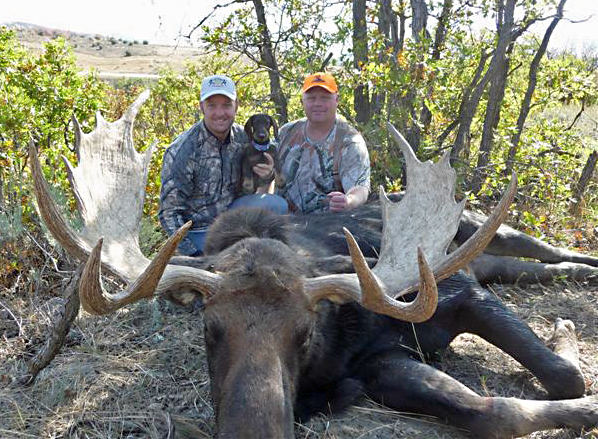
Remy was instrumental in recovering this record-sized moose
The moose in the photo did not go as far as that elk, but after the start there was no blood to work with. Justin and Remy had to track him through thick pines to move him out to where the hunter could get a finishing shot. Once the moose was dead there was a little trouble because Remy thought the animal was HIS and would not let the hunter approach. This is normal, especially for young males, but they have to learn to share.
Remy at the age of four months
The theory behind the early conditioning that Remy received is that very early stimulation of the rapidly growing mammal brain increases the density of neuron circuitry that is later used in mental activity. It has been scientifically proven, though extensive and expensive MRI research that this does work in human infants. This has not been scientifically proven in dogs; it is only a “probability”. There is interesting research, performed by Peter Hepper at Queen's University Belfast that seems to prove that very young puppies can be trained to recognize and like something, such as anise oil taste and smell, at a very early age. I admit that it’s a stretch to go from that to tracking wounded game.

Experimenting with the early conditioning theory probably isn’t practical for the breeder who has a litter of coonhound pups and is holding down a fulltime job. It’s too time-consuming. For a retired person, with more time and a special need to develop pups to their maximum potential, it may make sense. Certainly, it’s not the only way to develop an outstanding dog, but it’s worth thinking about. For developing dogs to do a specific task, like tracking, it has promise.

Below is a video of Remy tracking a fresh deer liver drag when he was ten weeks old.

Thursday, September 9, 2010

Blood tracking training: setting objectives and record keeping

One of the puppies that we raised this summer was Rilla von Moosbach-Zuzelek, a Joeri/Gilda daughter, who is now 15 weeks old. Her new owner Stan Kite has been in frequent communication with us and has been sending us updates on the pup and her training. Stan is the kind of owner that a breeder hopes for!

I have been most impressed with Stan's training records and would like to share them as they might help other handlers. Training records are very important as memory can fade quickly and can't be relied on. I asked Stan where he got the idea for his system, and it was Darren Doran who shared with him his own records, which he set up this way. Note that Stan has objectives for every training line that he does with the pup.

So here we go and we will start with Rilla's first training line:

Rilla--Training Line #1 --Age 11 weeks

8/10/10 Our back yard
Wind SSW 5 mph dry conditions Temp near 80, humidity 79%
Set line @ 7:00 am, run line @ 8 am.
I will try 100 yds w/2 turns, using blood & liver blood, sponge and whipping stick w/sponge, occasionally touching liver to ground for short distances .
Age will be 1 hour.

OBJECTIVE: merely to get pup to the end. If this is accomplished, I will praise her LAVISHLY, let her eat a bite of liver and play with hide for at least 10 mins or so.

RESULTS: Set line at 7:30, ran at 8:30, exactly 100 yds, about 6oz blood, drug liver intermittently first 70 yds, then blood only for last 30 yds. Performance was near perfect. I really don’t think she was challenged at all. Had a small piece of liver, which she ate, in the 1 ft piece of hide. Let her play with hide while praising her, then put her in pen with hide, which she chewed for another 10-15 minutes until she grew tired of it. Very successful first outing! Lee videoed the entire sequence.


Rilla-Training Line #2

8/14/10 Freas’ Alfafa Field
Wind East 5 mph Temp 73 humidity 65%
Set line at 8 AM, run at 10 AM
Two hour aging, 150 yds with 4 turns
Squirt bottle, 4 oz blood, liver drag intermittent
(Ran out of blood the last 20 yds—dragged liver—I’m learning, too!)

OBJECTIVE: Challenge pup to longer, older line with less blood, observe to see if line should continue to get more difficult, stay the same, or back up a little. Also add the distraction of a large piece of farm machinery (hay rake) and much higher grass (hay field).

RESULTS: Very good performance once again! I had to assist some at a couple checks, but others she worked perfectly. Once I guided her back, she hit the line running, with great enthusiasm. The hay in this field is almost a foot high, and she worked very hard to get through it, but showed awesome drive, right to the end. The hay rake was a great distraction—line ran literally underneath one side of the rake, with briars on the other side. She was a bit timid at first, but worked right through it after a few seconds. On the second turn, she did not even go three feet past, corrected herself and went on. I am totally amazed at the ability this pup is showing at her young age! She loves the liver at the end much more than the hide; I will leave more for her to eat, and chew on the next time.

Rilla-Training Line #3


8/21/10
12 ½ weeks old (1 week since last line)
Wind NE 5mph Temp 75 humidity 62%
Freas’ alfalfa field
Set at 8:30 AM Ran at 12:30 PM
4 hour aging, 300 yds w/ 3 turns
~6oz Blood w/hooves clamped to pipe

OBJECTIVE: Move up to 4hr old line, add simulated tracking shoes (2 hooves hose-clamped to a long pipe to be used like a walking stick), much less liver scent, Double length to 300 yds. Will add a couple liver bits along line to help enthusiasm on longer line, also more chunks at end. Add tail at end along with hide to see if different scent sparks more possessiveness.

RESULTS: Once again, a very solid performance. Hoof/pipe rig didn’t work as intended—hooves slid up pipe…but I was still able to use it. Only used liver blood (<1 oz) at the beginning; no liver dragging at all. She was very enthusiastic. Worked close sometimes, fast other times. Had to be helped at first check(left turn); I suspect deer had walked through there this morning, since this turn was at an opening between alfalfa and soy bean fields. She went the wrong way, but appeared to be scenting something. After correction, she followed the line well, and worked the next check (right turn) perfectly, only overshooting by a few feet before correcting herself. Last check (left turn), she went too far and I helped her again. This leg of track went directly into the alfalfa (first, second and third legs were along trail/field edge). Alfalfa 12-18” high—she had to hop to get through it, and did so with GREAT DESIRE! Wind was at her back, but it was like she knew she was nearing the end. She laid down at the hide/tail as if to guard them. I petted and praised her with no growling. Ate liver bits after I exposed them from inside the hide. She really didn’t want to play tug of war with the hide or tail, but growled when I reached to pet her again—told her “Yes, that’s YOURS, isn’t it”, and petted her anyway. No more growling. Dragged the tail as we left, with Rilla biting and playing with it for about a 100 yds or so when she lost interest.

This seems to be great work for a pup of this age; love the drive and enthusiasm. I hope my assistance at checks, when needed, will show her that when she loses the scent and circles back, good things happen. When the scent is strong and in a straight line, she likes to run. I like the desire, but I may need to encourage her to stay slow and steady to decrease the odds of missing a check in the real world. She did not act any differently on this 4 hour old line; reacted just as she has on the fresher lines. Two interesting distractions this time--first was several overturned white bleach bottles stuck in ground hog holes by landowner. She approached with interest, but I told her NO and she returned to the line. Second was a small butterfly right in front of her face. Normally she would chase and attempt to catch--this time she just looked at it and quickly went back to the task at hand.


Training Line #4


8/27/20
13.5 wks old
Reading, Pa

Took Rilla to Andy Bensing’s to attempt a UBT-I Test. Three other dogs went first. Line was 7 hrs old by the time we got on it. (UBT-I says at least 2 hrs) Conditions were hot and dry ~85 degrees. Andy said he laid the line at 6:30 AM; we were tracking at 1:30 PM.

Rilla, once started, did well for the first 50-60 yds. The track was up a loooong hill in a hay field. She had to be coaxed back on the line several times, and began to lose interest, sitting down and looking up at me. Andy advised calling it off, so we did.

I couldn’t help but be a little disappointed, but shouldn’t have been. She will be more prepared next time, and I predict it won’t be long before she can NAIL this test. The stress of the 2 hr ride, the long wait to be tested, many strangers in close proximity, riding in the back of a pickup with strangers, the long hill, and the building heat were all factors that contributed to this young pup's problems today.

Training Line #5

9/4/10
14.5 wks old
320 yds, 3 hrs old, 3 turns
Our woods in Carney’s Point

OBJECTIVE: This will be Rilla’s first track in a woods setting vs. a field. This will make several new challenges for her—different terrain, patches of tall weeds, etc.

RESULTS: Changed the aging to about 3 hours due to windy (15-25 mph gusts) and severely dry conditions. (Originally I was going to age 4 hrs) Started trail on main logging road, made a left at first skidder trail, then a right turn into the woods which led to another skidder trail, which ended back on the main logging road with a slight left. 320 yds total, 5 oz blood, and a makeshift “tracking pipe” (inserted one leg into pipe this time, and another on the outside of the pipe, with an array of hose clamps). This one worked fine, but the motion of continuously moving it to make tracks was not comfortable on the arms. Tracking shoes will be purchased ASAP!

If I didn’t know this was the same pup that couldn’t do a UBT-I a week ago, I would swear it was a different dog. She started strong on dry leaves, then onto patches of packed dirt, through high weeds for about 70 yds to the first turn. She was on her game, making it look effortless. Worked very slowly with nose to the ground. Overshot the first turn, corrected herself, found the line, then veered off again just as I was about to praise her. She wandered about 10 ft before swinging back, hit the line and continued her nice slow pace down the skidder trail. At the right turn, she overshot again and I put a little tension on the lead as she neared the end of it. She swung around quickly and found the turn. (Note—Next time out, I’m considering dropping the lead when she overshoots to see what she’ll do with absolutely no influence from me). Now we were in undisturbed woods, with broken sticks, branches and other obstacles everywhere. She continued, up, over, under or around whatever was in her way with ease and great drive. We went through the woods for about a hundred yards, and she worked very well. As we hit another skidder trail, the track veered left, and she followed perfectly. This trail led back to the main logging road, which at this point contains 2-3 foot high weeds. She stayed under the growth, tracking wonderfully. I dropped the lead so it could drag on the ground behind her without hanging up. All went well right to the skin.

One other nice feature of tracking in our woods is the nearby gun club—there was a lot of shooting going on as we tracked. The range is several hundred yards from our location, but that was good. Rilla never paid any attention the gunfire.

This was a very uplifting experience for me after last week’s mild disappointment. I was a little skeptical of how she would perform due to the wind and extreme dry conditions, but as soon as I set her down, it was obvious I had nothing to worry about. It’s just amazing to watch this normally playful pup get into a totally different zone when she’s working. She rarely even looks back at us, which shows she’s concentrating on the task, and isn’t distracted easily.

Lee videoed again, and commented that she “made it look easy”. This track took her 16 minutes, with the extra time needed due to the conditions. An antsy dog would have had a tough time, IMO, but she kept the slow steady pace, which really impresses me!