Search This Blog

Showing posts with label minis. Show all posts

Sunday, May 19, 2013

Two Trackers

by Teddy Moritz

I witnessed an interesting animal interaction event today while running my pup, July, in one of my rabbit spots. July is ten months old and I like to run her alone in order to make her less dependent on the hawk and older dogs. She worked rabbits all winter and is very keen to track them, but she also knew to watch for the hawk in order to find the fresh scent, or she would hark into the older dogs. Now I wanted her to do her own work. The field I ran her in today is huge, an old farm field bordered by a parking lot on one side, a vast open weed field ending eventually in a railroad line. The place I park has two long sections of very tall, thick blackberry canes. This is where the rabbits harbor, then when pushed by the dogs they run out into the field, which has weeds just tall enough to hide the rabbit from the hawk's eyes. It's a great place for long runs on rabbits as they will leave the briars and make huge laps around the weed field.

I let July out and she promptly hit the briars, looking for rabbits. She's been in this spot before so she knows where to search. She busted a rabbit out and took off after it as it ran into the big field. I stood still and listened to her run. She is fairly vocal and I could hear her a good distance away. She circled this rabbit and brought it back to the briars. She ran it out again and off they went. This time the rabbit must have gone a slightly different route because July's voice drifted toward a tree line. In the meantime three other rabbits came sneaking out of the weeds and into the briars. The place holds a good number of cottontails. Suddenly July started barking, a varmint bark, not a rabbit bark. She was in one spot, barking at something. I listened for a bit, then called her. I know red fox live in the far end of the field, but so do deer, woodchucks and sometimes a feral cat. The barking stopped and pretty soon I could see July heading my way. She saw me and took a ninety degree turn into a strip of weeds leading to a berm of dirt and sand. She just wanted to see me and then keep hunting. She seemed to hit a rabbit line and took it up along the berm and out onto a big dry sandy area. She worked a long time trying to figure out the line, drifting back and forth, re-starting, working and working, though silently.

As I stood and watched her I saw some movement in the weeds, along the first part of the berm. As I thought, it was the red fox. It was watching July track. When the dog disappeared up the berm and into the weeds, the fox started tracking her. It would sniff where she ran, look, listen and watch for her. I don't believe this was a predatory kind of tracking, I think the fox was curious about the dog and where it was going. I'm fairly certain the fox has a den in some piles of cement slabs nearby as I had found a lot of fox sign there this past winter. The fox could have easily overtaken the little dog if it wanted to catch her. I was glad it wasn't a coyote. I would have interfered right away.

July kept working on the rabbit track, going back and forth, going backwards and re-working the scent line. The fox stayed on slightly lower ground, nose to the ground, tracking July. The dog had gone silent so the fox wasn't sure where she was. It continued to track and listen and look. It was interesting to watch. The fox tracked without wagging its tail like a dog does. It simply put its nose down and followed July's scent. It didn't quarter or drift the track, it seemed very accurate.

Being a wild animal, the fox was very aware of its surroundings and since I was standing in the open, it eventually saw me, did sort of a double take, then turned around and took off. July never did know the fox was behind her. Just as well. I wouldn't want her chasing it out to a road. There's always something interesting to watch when running a hound.

Wednesday, January 30, 2013

Winter hawking with Teddy Moritz: multispecies interaction

This picture of Teddy's Harris hawk was taken at field trials in New Jersey in October 2012. It was enhanced to show the maximum of details and vibrancy of colors.

The below excerpt from Teddy's recent e-mail is particularly interesting to me as it speaks about interaction between her hawk and mini dachshunds.
 
Hawking has been good particularly since the weather has been open and fairly mild till this cold snap. There's been no excuse not to go out.

This Harris's doesn't take the cold as well as my others did. I don't know why but he starts shivering when the temps hit the low 30's. I used to fly my other birds down to the teens, if only for an hour. The wind is a factor here in Delaware also, making the cold harder on the bird. I've even brought him into the garage these last few nights. Carl keeps the garage at just above freezing to keep the water pipes, paint, etc. from the cold.

Anyway, the hawk is doing well. He is very gamey, meaning he hunts hard, watches the dogs like a hawk, shall we say, and the best part is he leaves the dogs alone. The last two birds I had would hit the dogs in frustration if we weren't putting up game. That is something I find hard to tolerate. The dogs aren't seriously hurt but it demoralizes them. They don't understand why they are being punished. After a few hits they'll just follow me through the fields, watching the hawk and not hunting. Fortunately this bird is very keyed to the dogs, more so than to me. If I yell ho ho ho when a rabbit gets up he may or may not look at me. If the dogs put up a rabbit he's right over them and after the rabbit. I can deal with that.

He's also decided my red stud dog, Bane, is the one to watch. He shadows Bane as Bane hunts. Sometimes Bane works out further than the other dogs. If I lose track of the bird I'll call Bane in and when he comes, so does the bird. When Bane is on a rabbit the hawk stays right with him, rather than looking at the other dogs. It's not that the bird doesn't watch the rest of the dogs if I don't take Bane, but if Bane is out, the hawk is with him. My previous female hawk eventually did the same thing, figuring Bane was the one to be near. Bane is a good dog but so are some of my others, particularly Fitz, the little one. And to my surprise, Bane, at 5 and a half, recently started running in on the hawk when the hawk caught a rabbit. The squeals of the rabbit are very enticing but my dogs are punished early for trying to take the rabbit from the bird. It's one thing when they simply anchor the other end of the rabbit, which some of them do, but it's another thing when they grab the rabbit and take it away from the hawk. Bane did that three hunts in a row. One time he got the rabbit and held it, one time the rabbit got away, and one time I managed to corral the rabbit when the hawk and Bane lost it. I was rather unhappy with Bane so he got to wear an e-collar for the next few hunts and I was able to remind him of his manners. I don't know what his thought process was as he hasn't run in on a bird since he was a pup. He's a rock solid, reliable hunter and produces plenty of game, but he has to leave the bird alone.

I'm out almost every day with the hawk and dogs so we've been having good sport. I like finding new spots especially and only take one or two reliable dogs when I check out a new area. Delaware cover is thicker than in north Jersey, vines being the biggest challenge. The little dogs can snake through the tunnels under the vines, just as the rabbit does, but the hawk can't always see the rabbit in the vines and it often moves way ahead, losing the hawk. Then the dogs make it move again and we start over. Much of Delaware is ditched or there are old tire tracks in the woodlots. That much of a dip in the ground is enough to give the rabbits a runway, then when the vines, greenbriar, Japanese honeysuckle, poison ivy, trumpet vine, etc. grow over the tire track or ditch, the chase becomes one of tunnel running. And because the weather tends to be milder, the vines don't get pushed down by snow or ice and they continue to provide cover. The honeysuckle really doesn't even lose its leaves so it almost always provides a hiding spot. Sometimes when I put the dogs down they disappear completely under the variety of vines and briars and I don't know where they are until one opens and the hawk takes off after the rabbit. And a dog has to face water to hawk here as many ditches, deep and shallow, have water in them.
 
There are also woodchuck holes to contend with. In these hedgerows the dens can be very tight, despite the sandy soil. The tunnels go through the maze of roots and the dogs sometimes can't get as tight as the rabbit. I don't usually bother to dig because I'd spend more time cutting roots than actually digging. However, my smallest dog, Fitz, at barely 6 pounds, can almost always make a rabbit vacate a den. She's provided many a chase for the bird this winter. She's nine and a half and I hope I can breed or find as small a dog to replace her.
Enough about me....I always look forward to reading your blog and enjoy seeing all the deer the trackers have recovered. Andy has good stories with plenty of detail. I know you work hard on the blog, so thanks!


Wednesday, January 23, 2013

Ike, a mini longhaired dachshund, proved his versatility at a quail hunt

A big thank you to Tina Hinckley who shared pictures of the recent hunt with her mini longhaired dachshund  FC Wingover I Like Ike ML.

The pictures were taken January 20, 2013 at the Treasure Coast Hunting and Fishing Club in Palm City FL. Bob Hinckley and two friend hunted  with a pointer, a griffon and Ike. Ike got more than his share of the birds and "cleaned up" all the cripples. A good time was had by all. All dogs cooperated, and Bob's friends were quite impressed with his 11 pound hunting dog.


Thursday, October 18, 2012

First successful deer recovery of the season for Sam Allen from North Carolina and her mini dachshund Ollie

Samantha Allen, a United Blood Trackers member from North Carolina shared with us her first tracking experience of the season. This was a tough line and the recovery was made possible only by the partnership of the handler and and her dog. Great job Sam and Ollie!

The hunting still seems a little slow here in North Carolina but I received my first call of the year Tuesday October 9th. The call came in about 9:00 on Tuesday night from a hunter that had shot a buck that afternoon with his crossbow at 35 yards. The property he was hunting is about 1 hour 15 minutes from my home. The hunter had found blood at the hit sight but lost it after tracking the deer about 80 yards. He was unsure of the shot and legally in NC I can not track past 11:00 PM so I encouraged him to wait until I could get off work at 12:00 on Wednesday and I would head to the property with him. The temperature both days had been around 72 degrees and Tuesday night dropped to around 45 degrees with light winds.

We arrived at the property at around 1:30 PM on Wednesday, and I chose to take Ollie with me as she has more experience and this was going to be a tough line. We started the line at 18 hours old, and Ollie took off with no problem tracking to the point of loss. Then she seemed to have trouble finding anything from that point. After learning from the hunter they had walked the area the night before a good bit in search of blood. I patiently waited for her to find something and it seemed she had picked the line back up. We made our way through the dense briar thicket circling left from that last point of blood but in a matter of ten minutes we arrived back at the hunters ATV! After about 5 rounds of doing the same thing I figured that the hunters the night before most likely had blood from the buck on their boots and when they decided to pull out they set a false line right back to the starting point. Poor Ollie seemed confused by this endless circle!

I decided to move her about 75 yards in front of the point of loss to see if we could pick up the real line. The cover was VERY dense and mostly briars so we were now about 2 hours into this track. As we were tracking up the hill the hunter stumbled across a nice size area of blood. I restarted Ollie at this point and she began to track. In about 75 yards we hit a nice hardwood opening, but we have not seen a drop of blood since the last restart. In the opening Ollie made a dead left and headed back into the thicket. The hunter and his friend did not believe the deer went that way so they decided to search the hardwood tract. I of course followed Ollie, I trust her greatly. In about 50 yards I was down on my hands and knees in the thicket crawling behind her, she seemed very set on this line. We hit the top of the hill in the thicket and she began to go down the other side with increasing speed. Finally we popped out of the briars into a hardwood bottom with grass and cane plants. Ollie headed straight and in 75 yards she had found the buck!


The deer had been gut shot and I feel that he had not died until that morning if not later. I had to contact the hunter by cell phone and direct him to our point. After about 15 minutes he arrived at his trophy with a big smile on his face. He claimed Ollie as his new girlfriend! This track lasted about 4 hours and estimated 800 to 1000 yards and Ollie and I both were exhausted. We got the buck back to the hunter's truck, and I don't think he could have been happier. Ollie and I headed home, her asleep in my lap and me thinking "what could be any better than this!"
 
Happy Tracking,
Samantha Allen
TimberRidge Tracker

Thursday, October 4, 2012

Garmin's outings: Development of a young hunting dachshund

I know, I know, just when you expected a report from another blood tracking adventure we have something different here, this time from Teddy Moritz. It is an article about how she goes about developing a young hunting dachshund Garmin and how she adjusts her training methods according to the young dog's temperament. Well worth reading as it has broad applications.

On the other note, a big THANK YOU for all the submissions for the blog. We really appreciate them. This is a very busy time of the year, and our hands are full. We will be posting as quickly as we can, but sometimes there will be a delay, and sometimes there will be 2-3 articles/reports posted on the same day. Above all we want the blog to be educational and interesting, so we always welcome reports that allow all of us to learn something new. Also because of the time constraints, the less editing I have to do, the faster the post will appear on the blog. If I have to pull info from various sources, like Facebook and several e-mails, that usually takes more time.


Garmin's Outings by Teddy Moritz


Garmin is a two year old miniature longhaired dachshund, about eight pounds with a 13 inch chest. She runs rabbits for me in the winter, and trees squirrels as well. She's a pretty good hole dog but lacks a certain amount of confidence, which I believe is an inherited trait. I know her sire and dam, and both are dogs who are happier when told what to do rather than think independently. Those traits are not a bad thing, all around, making the dogs very voice-controlled and obedient but also less likely to be the ones out and about finding game. Despite raising Garmin from about 9 weeks, she shows her sire's "please give me instructions" attitude. Not always, but enough that I have started taking her out alone, even leaving the lurcher home. If he's along she'll look to him for game. She does hunt out and knows where to find game but isn't quite the A-team.

In hunting her by herself I have seen an improvement in her earthwork. She's fine on rabbits, she just needed some confidence doing earthwork on harder quarry. Last spring she did confront and bolt a vixen in a natal den, taking a bite and coming out looking surprised. She went back in and moved the fox till it bolted. Garmin is by no means a hard dog but she'll stay with her quarry if it is in front of her. However, when I used her to dig groundhogs she would give up if the chuck back-filled  a lot before I could dig to her. With this hot dry summer the ground was very hard and I sometimes just couldn't get there.

Recently Garmin and her kennel mate Bane got into a quarry under a pile of very long, thick telephone poles. Bane moved it more than Garmin even though there seemed to be several tunnel openings. I heard Bane growl Garmin off a few times, which did nothing for her confidence. Finally Bane cornered the quarry under a buried telephone pole, which was weighted down by several more poles. I wasn't able to dig to the quarry nor was I able to bar the poles off the area. The quarry was apparently in the back of a slightly wider portion of the den so the two dogs could work side by side. From the growling I knew we had a possum. It had been awhile since the dogs had seen any earth quarry so I let them work  it. It was good to hear the dogs in a confrontation. The lurcher was with us and he lay nearby waiting for some action.

After awhile I cleared the dusty, sandy soil away from the entrance and could see Bane working the possum. I could hear Garmin but didn't know quite where she was in the den. That precluded any thoughts of shooting Ol Smiley, which I really didn't want to do. It wasn't doing any harm to crops where it was and I don't like killing something I can't use for meat for the dogs. I cut through some roots and then ran my trowel next to Bane. When I touched the possum both dogs grabbed hold and began pulling. I think Garmin was pulling against Bane so not much happened except the possum kept growling. Eventually I could see the possum's foot and helped Bane pull it. By then it had 'sulled' and there was no fight or growling. When I slowly pulled the possum out Garmin was attached to it as well. I think this work was good for her as I let her work and Bane didn't keep her away. Sometimes if Garmin doesn't stick with her quarry I'll pull her out and let Bane work it. That surely isn't good for her confidence but I am always anxious to get to the quarry.

Next time out Garmin bayed a groundhog I saw run in. This den is a difficult one because it is under a heavily trafficked farm road, basically compacted clay. The road drops off about ten feet to a railroad track. The ground under the clay is very light sand and there is one den opening at the bottom of the slope. The groundhog also had an entrance at the edge of the road. It was a tight opening because someone had shoved a big limb into the hole. Garmin squeezed her way past the wooden obstacle and began barking. I let her work because I've lost chucks in this den before. Her barking moved to the middle of the road but at two feet. I thought I ought to be able to dig that much. I started to dig and bar met very, very hard clay. Meanwhile my noise moved the groundhog a few feet further along, and Garmin's bark and the locator collar indicated her whereabouts under ground. Then she shifted to the bottom den opening and I alerted the lurcher, who was resting in the shade of the car, the day being very sunny and hot. He went down to the hole, sniffed and came back up. I heard Garmin bark near the hole but then her barking receded back up the slope. No bolt today.

I found her again and pounded and dug and pounded and dug, feeling as if I was making no progress at all. Very frustrating. Garmin came out once or twice, coated in yellow sand. She would sniff the hole down the slope then re-enter the top hole. I got the feeling the groundhog was walling her off or going deep, burying itself in the sand. After awhile I took a break to get some water and Garmin came out again. I let her wander around and gave her water also. The she went down the slope. I waited awhile and didn't hear her bark so I got out the locator. I couldn't get a signal so  presumed the groundhog had indeed gone quite deep, off the box. I turned the box to search mode and still couldn't find the dog. I looked along the rest of the slope thinking perhaps the chuck had bolted and she was in a different hole. I walked along the edge of the roadway and used the locator but got no signal. Had the battery gone dead in the collar?

Suddenly I heard a yip from across the railroad tracks, in a thick bit of brush, trees and briars. I saw Garmin come out, her tail wagging and her nose down. She trailed back into the briars, gave some more yips. I knew then she'd given up on the woodchuck and was running a rabbit. At first I was disappointed but since the digging was so difficult and I was making no progress, I had to laugh. Garmin knew we weren't going to get the varmint and since she likes to run rabbits she left me to my worthless efforts and went and found herself some quarry that ran and left a nice track. I let her run for awhile as hawking season is approaching and she needs practice on cottontails.

On another day I took Garmin to a big woodlot bordered by peach orchards on one side and a river on the other. Squirrel season is open and I know Garmin will tree the bushytails. The leaves are still thick on the trees so seeing a treed squirrel isn't easy. Basically I just wanted to again work Garmin alone. She did a good job of hunting out through the trees and swamp and barked tree once but the tree was full of holes so no squirrel was on the outside. We even bumped a deer but Garmin is so soft I yelled at her and told her no and she came off the deer right  then. Running deer will just get a dog killed as the deer often go right to a road.

As we came out of the woods there appeared a three hole den right at the edge of the woods. Hello! Garmin indicated one hole and barked into it. Good enough. I called her off and walked her to the car. I drove back to the den and let her go in. She soon was barking and digging. I located her and the den seemed to curve right back to one of the openings. I quickly shoveled it full of sand since I only had the shotgun and not the lurcher. If the chuck had bolted it would have been gone to another den. I dug to Garmin after I cut away greenbriar and shrubs. There were lots of roots to cut away as I dug into the soft sand. Garmin kept going each time I opened to her and each time I cleaned away the roots. The last time she moved up I heard a lot of growling from the quarry. I thought I was digging to another possum. However, Garmin kept moving sand back, as if something was backfilling. After one time I opened to her there was a wall of sand and roots ahead of her. She came out and wandered off, as if she felt she had lost the quarry. I let her go and waited. When she came back I encouraged her to re-enter and she did. I had cleared the den while she was off thinking and she smelled her quarry and began digging and barking again. It was as if she decided she could do this with my help.

The den went a big deeper, running under one of the exits so I had more digging to do just to get to the the den. I barred and found it, then opened to it, cutting roots and using the post hole digger to clear the sand. I guess I got to the quarry because Garmin forced her way up the tunnel and really began barking. The growling continued. I decided to shoot the quarry rather than dig another hole. I put the .22 to use and the growling stopped. Garmin slid up the tunnel, barked a few times then began tugging. She pulled and yanked and bounced up and down in her efforts. I let her work, feeling she had earned this reward by staying with the quarry after all. I then saw the back toes of the critter and I took hold too. It was a big groundhog and it wasn't quite dead so Garmin and I pulled it slowly out and I administered some more lead. Then I let Garmin pull it all the way out. It was a very fat, heavily furred groundhog. I let Garmin chew on it a bit and of course took a hero shot with the camera. I was pleased that she stayed with the quarry after one mental setback. I think she will continued to stay at back-filled walls know that she better knows I will help her and that she can succeed.

Monday, July 16, 2012

When They'll Swim...

A big thank you to Teddy Moritz for this story about her mini dachshund Fitz.

My smallest dachshund, Fitz, is a good and willing swimmer, like her dam, Gavia was. And Fitz purely loves to chase Canada Geese. I once did some control work on a private lake and was allowed to shoot the geese. I let Fitz try to retrieve them to the canoe but she usually ended up using them as a life raft while I paddled to her. Once she was in the canoe with the dead goose she'd pluck as many feathers out of it as she could.

Where I live now the geese are often in the peach orchard or in the soybeans, both of which are bordered by a lake with heavy vegetation around the shores. It's a fairly big lake. Today when I was driving one of the dirt roads I noticed there were about fifty geese in the soybeans. I let Fitz out and she could see them even though the soybeans are almost taller than she is, which isn't very tall. She immediately ran through the field chasing the geese, who acted confused about this tiny predator but they took to the air anyway. The guys picking tomatoes in the next field cheered Fitz on. She came back tongue lolling and eyes bright.

We continued around the bend to the peach orchard, the lake on our left. I saw a big flock of geese on the ground amongst the peach trees. Being flushed with victory, I let Fitz out to chase them. She willingly participated and raced after the geese. Many of the geese were flightless goslings and molting adults, so this group. also about fifty or sixty birds, ran for the lake. They have one trail down through the greenbriar and trees so there was a bit of a bottle neck at the opening. Fitz thought that was great but the birds got through to the water with Fitz after them. I figured she'd bark from the edge of the lake, as she often does when she sees swimming geese. I waited a bit for her, then called her. No Fitz, and she's very voice obedient. After about five minutes I began to be worried about her. I didn't hear any thrashing and squawking in the bushes so I knew she hadn't caught a gosling. I made my way down the path and called and called. The geese were half way across the lake, in a big group, still gabbling about the chase. I kept calling but Fitz didn't come. This was not good. I saw an old dock further down the lake, behind a house.  I went out on the dock so I could see the entire lake. Well, I finally saw Fitz. She had swum after the geese and they had her surrounded, or she had them on the run, one or the other. She was still swimming after the geese and they just paddled out of her way, which made her more determined to catch one. Remember this dachshund weighs six pounds on a fat day, and she just turned nine years old.

I called and called and I guess Fitz finally got tired because she turned and swam back to me. All I could see was her tiny head above water and an entire flock of geese following her, presumably to make sure she was truly leaving. When she got to the dock I hauled her out and she immediately turned around and began barking at the geese. As they came closer she was ready to jump in again but I picked her up. She squirmed and cried to get back at the birds but I held onto her. I wish I had my camera when I saw her out in the middle of the lake surrounded by geese.

When they'll swim, dachshunds can hardly be stopped.


Teddy Moritz

I found this picture in my archives. It shows Fitz retrieving from water.

Sunday, June 24, 2012

Summer training in retrieving for the two mini trackers from North Carolina

It was very good to hear from Samantha Allen who wrote recently:
I would like to give you a short update on the mini trackers (Ollie and Cabela). The weather here in North Carolina is starting to warm up pretty quickly. We are running practice tracks every few weeks to keep Ollie and Cabela in shape and in good practice for the up and coming hunting season. They both are doing very well with their training lines and they both have decided since the warm weather has hit that creek crossings are the best things ever now.
 
Cabela has been a little cautious of water since I got her in November but now that it is consistently around 85 degrees she quickly changed her opinion on getting wet. She does swim more like an otter than a dog and sometimes she worries me a little because she will actually twist and go under water. I am not sure if she is just a poor swimmer or this is her swimming method. I am pretty sure Ollie has fins on her somewhere! If there is a puddle Ollie is going to get in it. I find this very interesting seeing how they are both from the same litter but have such different personalities. I enjoy watching them and at some times find it funny how they react differently to the same situation.
 
In between tracking I decided to teach the girls a little about retrieving. I have purchased a few books and educated myself on retriever training. It is going pretty well and they really enjoy it. Just maybe I will have me some mini retrievers for dove season in September! We still have a lot of training if we are going to get to that point. Well I better get back to work!


Monday, May 28, 2012

Patience on the track

June 1, 2012
Update with pics:
Teddy wrote - The only photo I have of Lisa is attached. I've also sent a body shot of Lisa's dam, Tar. Lisa has the same body shape but with more hair. I'll try to get a better photo of Lisa when I get back from the western Pa. field trials.
Bane weighs eight pounds, Lisa weighs seven.
 
Bane

Lisa


Tar

*******

Teddy Moritz shared this story with us a week ago or so. Thank you Teddy!

Thought I'd write up this tracking event the dogs had today. I was patient and let the two dogs work at their own pace. I could have pushed them, called them in or gone on but I was curious as to what they were tracking:

I ran three miniature longhaired dachshunds at a beagle club grounds today. The weather was sunny, warm and windy. The grounds has many small sections of very thick cover, interspersed with mowed paths. I had Fitz, who is eight, with me, as well as Bane, who is 4 and Lisa, who is 14 months. Fitz and Bane are experienced hunters and well know how to track a rabbit. Lisa is all eagerness and tends to run over the scent line, but she has a good nose and will correct herself, even if it takes a few minutes. Today I saw a great deal of persistence as well as patience on her part.

Lisa found a fresh scent going into a very thick bit of briars, tall grass, vines, etc. She was very intent about the smell and jumped right in. Bane soon followed. Fitz took a sniff and stayed with me, which I found quite odd as she is by far the best rabbit tracker of the three. Fitz actually sat in the shade with me rather than joining the other two. I wondered if she didn't feel well. Lisa opened once or twice, Bane never did, then all was quiet. I waited as I usually do, letting the dogs work out the line. Lisa yipped once but then was quiet. I waited and waited, as did Fitz. The two dogs didn't come back and there was no barking, which I found odd. I walked around the square and saw the two of them working very diligently and very slowly, over a piece of ground that is mowed blackberry canes. The dogs seemed to have trouble with the line but Lisa kept moving ahead. Bane would join her, go back and check himself, then come up again. Lisa worked her way into another briar patch where there were locust trees. She came out about twenty feet further and seemed to hit a hot line. Her body language became animated and she seemed to have a good scent. Oddly, her tail wasn't wagging like most scent hounds' tails do when they are hot on a rabbit scent. Bane confirmed her line. Fitz joined for a few feet, then came back to me. I was beginning to worry the little dog was ill.

Lisa took the line across another path and into a brush pile in the woods. She worked ever so slowly, which, again, isn't like her. Bane and even Fitz checked the brush pile and the surrounding area but it was Lisa who took it back across a path and into a small copse of trees. I couldn't understand why it was taking them so long to get up on a rabbit. I thought perhaps it as a young rabbit with little smell, but we'd come several hundred yards, in a circle, and that seemed too great a distance for an immature rabbit. We were going in a circle, so I still presumed the dogs were working out a rabbit track. The brush is thick and high and rank so I wondered if the vegetation was hiding the smell. Most of the time I couldn't see Lisa or Bane because the cover is so high. I heard Lisa yip again and thought she'd found her rabbit. She came out of the trees and headed into another thickly vegetated square. She and Bane ever so slowly worked the line from there through a stand of milkweed and other weeds. They seemed to weave around a good bit, not quite being able to move the line. In my mind they acted as if they were working a feeding track, such as coon hounds do at night when a coon wanders all over the woods looking for food. And not only were they sniffing the ground, they occasionally scented up a plant stem as if their quarry's scent was higher up. Odd.

I've never seen the dogs work this thoroughly and diligently. It was as if the scent was spotty and not in a direct line like a fleeing rabbit would make. Again I waited and watched rather than calling the dogs to a different spot. They seemed intent but not hasty. Their nose work was great to watch. Bane threads his way here and there, making sure he has the line before he moves up. He often checks himself. Lisa, in her youthful enthusiasm, bustles around and jumps in the air now and then hoping to see her quarry. She works and re-works the line, but with more haste than Bane. By now about fifteen to twenty minutes had passed and I was really curious as to what they were tracking. Fitz still stayed with me, appearing uninterested. How could that be?

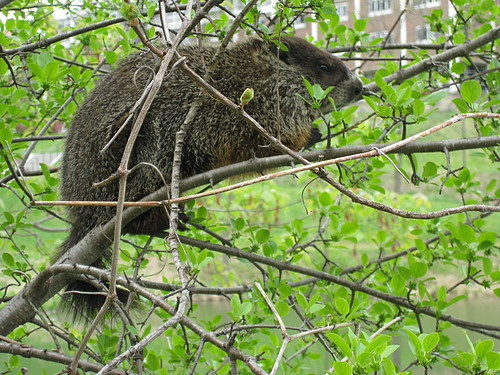
The two younger dogs soon worked their way to one more patch of weeds, this one with a multi-trunk cherry tree in the middle of it. Fitz and I stayed on a mowed path and watched and listened. I began thinking the dogs would never bump this rabbit, or whatever it was, despite their hard work. As I stood there, enjoying the scenery on a beautiful day, I happened to look up into the cherry tree. And there sat a groundhog, about twenty feet off the ground, settled in a crotch of branches. Pretty soon Bane and Lisa arrived at the tree. I could see them tracking around the base of the tree, where there was less cover. Lisa stood on her back legs and put her front feet on the tree. Bane did the same. So that was what they had been tracking! I would bet it was a feeding trail after all. The groundhog was probably foraging around the different small patches of brush, trees, etc. and was unaware of the dogs on his track. They hadn't opened and the brush is high so the rodent couldn't hear or see them coming. But when he did feel threatened somehow, he took the quickest route to safety, up a tree. Groundhogs easily climb trees and will use them to escape ground predators if no hole is available.

Fitz has worked groundhogs over the years but they are too large and aggressive for her. She only weighs six pounds and her head is too small to do any damage to a groundhog, but a groundhog can hurt her plenty if she closes with it. I don't encourage her to work them, and call her off if she finds one in a hole. Apparently today she agreed and let her kennel mates do the work. However, when I shot the groundhog out of the tree, Fitz was right there with Lisa and Bane, tugging at it.

I really enjoyed being able to watch those two hounds work out the complicated line of the feeding groundhog. They stuck with it, figured it out, and got their game.

Source of the picture: http://apps.carleton.edu/reason_package/reason_4.0/www/images/627713.jpg

Sunday, April 15, 2012

Moby, a mini longhaired dachshund extraordinaire

A year ago a longhaired miniature dachshund Moby won Deer Search Blood Tracking Competition, but today we are reporting on one of his recoveries that made a real impact.

Chester, Moby's owner and handler, shared with us this e-mail he had received from Caryn Prouty, a young deer huntress, on November 5, 2011. To read Caryn's story you have to go to the link provided at the end of her e-mail. It is a very interesting read.

"Hi Chester,
I want to take a minute to sincerely thank you for what you do and what you did for me on November 4th. I can't stop thinking about yesterday and I don't think I will stop for a long while and it was all thanks to you and your extraordinary dog Moby. I hope I am spelling that right? The service that you and Deer Search provide to the community is amazing. The fact that you volunteer your time to come help strangers find their deer amazes me. You must truly have a love of the sport that runs deep in order to do this. Watching Moby work was a treat. I had no idea that dachshunds had such a great nose and it was awesome to see how happy he is doing his job!

In the end, Moby's kisses warmed my heart and the joy I felt seeing my buck for the first time are irreplaceable. We couldn't have done it without you!

I have attached some pictures. I do a little bit of photography on the side and have a photography blog. You and Moby are featured on it at this link - click here!

Thank you again, I truly appreciate what you do!"


Caryn Prouty and Chester Swierk with Moby

Moby, a mini longhaired dachshund, is an excellent blood tracker.

Thursday, March 15, 2012

Garmin's first chucks


A big thank you to Teddy Moritz for sharing the story
Garmin was a young dog during her first hawking season. She did well on rabbits and learned to find them in thick brush and to run them. She was bred by Bob and Connie LaRosa of Long Island, NY, out of my stud dog Navarre by their Sandy, who is a sister to Pete and Bonnie Mercier's Trooper and Odie. I didn't get Garmin into hard quarry that first summer because she was so young. She showed a lot of interest in holes but I kept her on rabbits. She finished her AKC Field Champion title in four trials last fall. She came into heat in November so I bred her and she whelped four nice pups in January. Now that the pups are weaned I have started taking Garmin out for harder quarry, mainly groundhogs. She is a small, stocky dog, built for hole work with a nice small chest.

On her first day out I took the lurcher and just Garmin as a hole dog. I wanted her to learn by herself and to depend only on her own ideas about hard quarry. The lurcher marked a hole at the edge of a farm field. Garmin checked the hole and showed interest. She had to dig her way in because the hole was full of leaves and twigs. After she disappeared it took a few moments for her to find the groundhog, then she began baying. She came out once to see if I was still topside. Then she went to work in earnest it seemed. I could hear her baying but she sounded deep. I located her via her transmitter collar at six to eight feet. She had to have her quarry in a hibernating den. I let her work for several minutes and listened to her steady barking. Meanwhile, the lurcher heard something down the slope, in the briars, by the base of a big tree. I thought a squirrel might have moved. Garmin had gone quiet so I walked to the base of the tree. I saw a groundhog looking out of a hole at the base of the tree. I backed off and the lurcher found his way through the briars and nabbed the groundhog as it ran into the woods. I waited and then called Garmin. She eventually came out the original hole, covered with sand. I think the groundhog had gone very deep, then come up a tunnel to his escape hole in the tree. Nice work by Garmin.
 
Next hole was in a big mound of dirt and looked like it could be a fox den. Garmin took a long time deciding to go into the hole. I waited for her to make up her own mind, not encouraging her. She has to learn to think for herself. She finally went in. After a few moments she gave a sharp bark, then a yip and she came shooting out a far hole. That made me pretty sure it was a vixen in the den, probably with cubs. Garmin circled the den. Again I didn't say anything to her. I wanted her to decide about hard quarry on her own. She hadn't taken a bite but I believe the fox took her by surprise. Garmin walked around a little, then went back into the hole she'd first gone in. This time she began baying very strongly and moved deeper into the den. Suddenly the fox shot out a hole in the far side of the mound, running through the thick greenbriar. The lurcher gave chase but he couldn't maneuver through the heavy thorns and the fox disappeared. Garmin came out all in a huff and tracked the fox. I called her back after awhile and we left the fox. This gave Garmin the confidence to face harder quarry, given the choice.
 
On the way out of the farm I saw a big groundhog run into the woods. The lurcher, who had been trotting ahead of the car, marked the den, a two-holer under a fallen tree. I had dug this den with Bane last year. The shallow holes I had dug for him were still in evidence, though filled with leaves. Garmin again had to dig to get into the den. I thought she'd head toward the far hole, which was freshly dug. This groundhog chose to go to the old den. I cleaned out two holes with he post hole diggers and could hear Garmin moving through the tunnel, barking. The lurcher showed interest in the furthest hole so I used the digging bar and dropped it between Garmin and the chuck. When I pulled the bar out the chuck tried to go toward Garmin but her barking became louder and faster and she kept him in the tunnel. Eventually he backed up to the far hole and the big dog pulled him out.
 
Thus Garmin met three adversaries in one morning's hunt and faced them all without taking a bite. So far so good for a young dog, although once she gets bitten then I'll know what she's made of.

Saturday, January 28, 2012

The picture says it all - mini longhaired hunting puppies


I absolutely love this picture, which we received from Teddy Moritz, a falconer and breeder of mini longhaired dachshunds for hunting.  She wrote: My bitch Garmin whelped these four pups a week ago.  Their sire is a dynamic little hunter named Rhett who is out of my Bane and Lorraine Simmons' Darter. All the pups, two males, two females, are going to falconers. They ought to be pretty good hunters. Thought you'd enjoy the picture.
 
Congratulations Teddy on such a fine litter and thank you for the outstanding picture. Good luck with the pups!
 

Friday, January 27, 2012

Two mini dachshund trackers for Samantha Allen from Salisbury, North Carolina

We wrote about Samantha Allen from Salisbury, North Carolina before. As it turned out Cabela, Ollie's sister, became avialable, and she joined Sam's four-legged family. Sam wrote:

I am so happy with Ollie and her progress this year I figured if I could get a puppy close to her I would be happy. She has found 10 deer so far this season and she is almost 1 year old. I drove 4 hours to pick her sister up for our trial run to see if we liked her. It is now one month later and she is a keeper! I have named her Cabela and we are currently up to about 300 yard lines aged at 4 hours with 3 ounces of blood and track shoes. She is a little different from Ollie as she tracks slower and with great concentration, she does not overshoot her lines very far at all!  Two young dogs keep me pretty busy with laying practice lines and also taking "adventures" to different places for hiking, playing etc. to get them comfortable with all types of settings and people.

Oh, and for Christmas I received tracking shoes, a blender for churning my tracking blood, new cabinets in my garage for all my tracking items and some camo clothing!! Not too many wives would have been happy about that but I was ecstatic!!

Samantha Allen with Ollie
Cabela


Thanks Samantha for sharing the gorgeous pictures of Ollie and Cabela!

Monday, November 7, 2011

A new blood tracking team in the Capital Region, NY

We wrote about Eli Clement last summer when he was training his mini longhaired puppy Shyla. Eli passed a DEC exam for his tracking license, and this is his first tracking season. We got some good news from Eli!

His first find was a bobcat that he shot himself:


The 15lb Bobcat was shot at 25 yds and it ran 40' disappearing into very heavy wild rose. I knew the shot was good from the arrow. The blood trail was fairly good, but being color blind I was not able to follow it completely. So I got Shyla, our longhaired mini dachshund. She was not put off by the predator blood smell. She followed it along then into the heavy brush, taking almost all the clothes line into it. When she stopped pulling line I shone my light into the bush until I could see her. She was sitting and licking the ground. 3' above her head was the dead cat where it had climbed/perished into the huge rose bush. I was relieved she had not encountered a wounded cat!

Eli's second recovery was of his own doe:

The doe was shot at 4:15 pm. I thought my shot a little high. I got a fellow hunter to aid me in tracking. We found the arrow with blood on it. But no blood at the hit sight and none in the area. So I got Shyla. She found the first blood quickly on an over-turned leaf, 15' from the hit site. Then she tracked the general area clearly following the deer for 100 yds.

She seemingly lost the trail after this. She then crossed a road into a swamp. There she found the trailing quite easy, and even my color blind eye could pick out blood when ever Shyla stopped to sniff grass or leaves or brush. After 1/2 a mile she led me to the dead doe. Her first deer! She was all over it, tugging and happy as ever. A great start to her tracking season indeed. The arrow had passed through one lung and the liver.

And then another e-mail arrived with this wonderful picture:

Eli Clement is holding Shyla, a mini longhair.
Shyla has found another buck! The deer was shot at about 4:30pm. The hunter was unsure of the exact shot placement, but thought it has hit vitals from the blood on the arrow. So we gave the buck time. Four hours later I went out with Shyla. She was on the blood trail quickly; 400yds and we found the deer, in an opposite direction from where the hunter had though the animal had run. Chris the hunter was overjoyed, his first buck ever and first deer of the season.


Congratulations to Eli and Shyla!

Wednesday, July 20, 2011

Teddy Moritz's narrow-chested minis for rabbit hawking

by Teddy Moritz
Because I breed small miniature longhairs for rabbit hawking, I need leggy but narrow dogs. I have seen and admire other miniature longhairs with this build which are bred in Germany. Some people comment the dogs look weedy and too thin. Well, in my experience, a rabbit being a three pound animal, a rabbit dachshund also needs to be small and narrow in order to consistently get to the rabbit when it harbors in a tight spot. Also, when I sell a pup to a falconer or gun hunter, I tell them pointedly that a miniature with the right build can get out of a three inch gap in a fence. Most people don't believe me until their dachshund is found on the outside of their fenced yard.
 
We reconfigured our chain link kennels today and used a door panel that had a rather large gap between the door and its support pipe. I knew the opening would allow some of the dachshunds to get out so I used this door panel for the lurcher. On a whim, I let all the dachshunds out to explore the new kennel set up. It took Tar less than two minutes to find the gap in the door panel and to get out. I decided to take a photo of her escaping to show how she did it. I put her back in the kennel and waited with the camera. She obliged me by getting out again. Tar is a three year old female, has had one litter and weighs 7 pounds, so her body is mature. The tape measure proves the gap is three inches wide. And yes, it will be blocked off so Tar doesn't get into the lurcher's run and escape. (And to prove she's feeling better, Fitz tried to get into the kennel through the same gap to be with her kennel mates. She is smaller than Tar so I know she'd easily slip into or out of this gap).

Tape measure showing the width of the gap, three inches which is 7.62 cm)

Tar with her head and neck through the opening.


Narrow shoulders allow Tar to get her front legs out.

Narrow shoulders allow Tar to get her front legs out.

Saturday, July 16, 2011

Teddy's lurcher injures a mini dachshund by mistake

I have to admit that I needed two attempts to finish reading Teddy Moritz's e-mail, which describes how her mini longhair Fitz was injured. Accidents happen. Teddy has had lurchers since 1984 and has never had one grab a dog before. Anyway...proceed with caution.

Early yesterday morning several of my dachshunds got into a big coon. The lurcher of course joined in the fracas. I don't like having five dachshunds on one bad quarry because the big dog can't get a good grip right away as he tries to avoid the little dogs, nor can he shake the coon and kill it quickly when the dachshunds are hanging off it. The lurcher weighs 65 pounds so when he shakes something he does some damage. Well, unfortunately this time when he grabbed the coon, it bit him on the nose and he dropped it then immediately bent down to grab it again. Instead he grabbed my smallest dachshund, Fitz, who weighs six pounds. The lurcher shook her once and dropped her, realizing his mistake. The coon made a break for the fence line, the other dachshunds after it. The lurcher caught up with them and this time finished off the coon.

When the lurcher had dropped Fitz I ran to her as she was squalling. I looked and saw her intestines were hanging out her side. Not a pretty sight. I grabbed her up, carefully as she tried to bite me in her distress. I got a towel around her to keep her insides from coming out any further and put her in a crate in the car. I grabbed the other dogs and put them in their kennels and drove to the veterinarian. This vet opens at 7:30 a.m., a blessing since the wreck happened at 7. The vet looked at the injury and told me what he had to do. I left Fitz there till 4 then picked her up, all bandaged and drugged. The vet said none of the inner organs had been punctured, which is very fortunate as infection is a real threat if the intestines are perforated. Fitz also had a broken rib.

I took Fitz home, crated her and sat with her for awhile. She groaned on and off during the night but seemed alright. Early this morning I took her out to pee. She sat in the sun a few minutes, then walked to the area where the initial coon fight had been. She sniffed all over the area, then tracked the scent line to the fence where the coon had expired. I had moved its carcase way out to a front field for the vultures, who were glad to have it. Fitz seemed to very much want to find the coon so I carried her to the carcase. She sniffed it then peed copiously on it, walked a few steps away, and defecated on some coon fur. I guess Fitz wanted to find that coon and give it a final insult. The lurcher had accompanied us but Fitz showed no fear of him. In the fracas she might have thought the coon was the assailant. I'm just glad the wreck wasn't any worse.

Teddy Moritz's Fitz with her fancy yellow bandage
Needless to say we wish Fitz a quick and full recovery!

Sunday, May 8, 2011

Mini Longhaired Dachshunds for Blood Tracking

by John Jeanneney for Full Cry June 2011

Mini-longhair dachshunds are making a name for themselves as tracking dogs, and as a “BIG” dachshund (20-23 lbs.) man, I have to admit that I’m surprised. I don’t think that they are going to entirely replace the standard dachshund, wire and smooth, as a tracking dog, but they certainly have some things going for them.

For one thing the mini dachshund has escaped the ravages of American show/pet breeding much better than the standard size, which in the North American show ring can range up to 35 pounds. The American show judges decided, in their wisdom, that if the original dachshund from Germany was a comparatively short-legged, long dog, then the ideal “improvement” would be to exaggerate these characteristics. Check out the big show winners in dog magazines to observe what passes for the most desirable show dachshund today. The exaggerations are most extreme in the smooth-coated dachshunds. Perhaps they are fine lawn cruisers, but with less than two inches of ground clearance, they would be in big trouble if they had to hoist their long heavy body over a 12 inch fallen long.

Fortunately these exaggerations do not occur very frequently in minis in any of the coat varieties. Of course some American mini breeders are working hard to make them a proportionately smaller version of the standards. In any case the lighter body weight of the mini (11 lbs or less) allows for greater agility. It’s somewhat like comparing a grey squirrel and a ground hog. They both have pretty short legs, but the squirrel jumps a whole lot better than the ground hog five times his weight.

Speaking in broad generalities the American minis have an agility advantage over the American standards, but this is just the beginning. For some reason that I can’t explain, the American minis have retained their hunting desire through 15 plus generations of show/pet breeding much more successfully than their American standard counterparts. In dachshund field trials across the country they are a small minority, but they are ranked much higher than their numbers would suggest.

Teddy Moritz, who writes the Working Dachshunds column in Full Cry, uses primarily American-bred, mini-longs in her falconry and ground hog work; they are excellent. She began with mini-wires but shifted to mini-longs because it is difficult to get decent percentage of good hard coats in the wires. A hard wire coat is excellent in briars, burrs and snow, but the soft, fluffy “wires”, which frequently occur, are a nightmare. A moderate longhair coat is a practical compromise.

Quite independently of the dachshund field trialers, falconers and groundhog diggers, a number of wounded deer trackers have arrived at similar conclusions about the value of mini-dachshunds as tracking dogs. I’ve met or corresponded with a number of them around the country over the past several years.

A representative example of this is Dave Seeley in Campbell, NY. Dave and his wife Veronica, put me up at their house last month when I judged the Deer Search Blood Tracking Competition described below. They had both been active competitive coon hunters, a very good background for trackers, but then they had eased out of this as the hills warped more steeply upward as the years passed. Dave kept up his deer hunting, and when he couldn’t find a nice 12 pointer he called his good friend Chester Swierk who had some sort of a tracking dog. Chester showed up with Moby, a mini-longhair dachshund, who calmly and methodically found his deer. Dave was hooked. When I arrived at the Seeley place there were three little mini trackers to greet me.

Most of the mini-trackers I’ve met didn’t seem to know one another. At this point there doesn’t seem to be an information network such as my wife Jolanta has established for standard wires. People like Charlette Curtis in New York and Rob Miller in Michigan simply had the eye to recognize the natural tracking desire in these little dogs. The rest came naturally.

Today I worked with a color-blind bowhunter who, at my advice, just bought a mini-long hair for his own personal use and to help out a few friends. He lives in the City of Albany and a small dog make a lot of sense for him. We started the puppy on a 50 foot blood line with piece of deer skin and bit of deer liver at the end. Puppy Shyla said, “I like this.”

For someone who wants a dog as a family companion and for personal tracking use, the mini is a good choice. If you are tracking almost every day, as I do in season, the mini will obviously wear out faster than the European standard wires that I use.

In wet, cold conditions, as in a freezing beaver swamp, the reduced body mass of the mini will chill faster. Sometimes, we track a line under four or five inches of wet snow and that’s not good either. These conditions don’t occur every day. For the moderate, normal hunter/tracker, who is not a fanatic, a mini-longhair makes a lot of sense.

Charlette Curtis and her mini Jenna

Tuesday, March 15, 2011

Dachshund (teckel) puppies bred for blood tracking and hunting

Today I can really see that spring is just around the corner! It also means that it is time to start thinking about breeding. I have created two stand alone pages, which are listed in the right column of the blog. These pages will be updated on a regular basis.

First page gives info on our breeding plans for 2011: 
http://borntotracknews.blogspot.com/p/our-2011-breeding-plans-first-litter.html

The second page lists puppies bred out of hunting lines by other breeders:
http://borntotracknews.blogspot.com/p/upcoming-dachshund-puppies-out-of.html

Hopefully this info will help connect hunters with breeders of working dachshund puppies. I listed only the breeders who expect litters in the next few months.

Our 2010 puppies at the age of 9 days.

Thursday, February 17, 2011

Can dachshunds climb trees?

In the previous post we saw Remi tracking though the rocky terrain, and this time we got a picture of a mini longhair dachshund climbing trees. This one came from Teddy Moritz, and it has this caption:

Gripper (Harris Hawk) and the dogs were pursuing a squirrel today and Bane took it upon himself to try to help Gripper. I couldn't get the camera out quick enough to catch him all the way out to the end of that trunk, I just got him coming back. Gripper did get the squirrel.


Thursday, January 20, 2011

A good learning experience for a young mini dachshund Garmin

Teddy Moritz from New Jersey has described her hawking with dachshunds in one of her older articles:

I hawk rabbits with a Harris Hawk and miniature longhair dachshunds. I hawk small woodlots and waste fields behind industrial parks, housing developments, etc. I need a small flushing dog with a good nose, lots of line sense yet enough obedience to be called up to a fresh line, and the ability to go to ground. Without the dachshunds the hawking would be much less successful and the number of slips or opportunities for the hawk would be much diminished. The hawk is an opportunist and will use the dachshunds to provide those chances at rabbits. The hawk will follow the dachshunds from tree to tree as they search the briars for rabbits. When the rabbit flees from the dogs the hawk goes after it. If the rabbit goes into a hole, the dachshunds run it out again. We are an inter-species team. Rabbits are abundant, easy to find but not always easy to catch. There are days we catch one out of six rabbits and there are days we catch every rabbit we put up. If I were to hawk without a dachshund I would have to do a lot more brush beating myself. I would not see as many of the flights as I do now and my hawk would have to constantly chase fresh rabbits, rather than staying on one rabbit and making it count, with the help of the dachshunds.

I hawk where there are no gun hunters so I am not taking game from other hunters. I am licensed both by the Federal and State government to own and use the hawk. The team either brings a rabbit to bag or the rabbit escapes cleanly; there are no cripples left in the field. The rabbits are used for hawk, dog and people food. And even if I take a number of rabbits out of one small area, the remaining population will now reproduce to fill that void.


Today Teddy wrote about an outing with her dogs, and I found her pack's dynamics very interesting:

Had a good day's hawking today. There was a crust on the snow so the dogs and rabbits could run instead of flounder. We saw three rabbits and got three rabbits. Two for the hawk, one for the dogs.

The photos are of Garmin, a Navarre pup I got from Connie LaRosa out in Long Island. Garmin is six months old. Today she got to learn about dead rabbits in holes. My smallest dachshund, Fitz, is happy to slay rabbits who don't bolt, but it is beneath her dignity to pull them out. If Navarre can reach the rabbit he'll pull it, but he's a good bit bigger in the chest and can't always get to the rabbit. When Fitz came out of the hole with fur in her mouth I knew she'd had her way with the rabbit. Navarre tried but couldn't get past some roots. I asked Garmin to go in but she was hesitant because both Navarre and Fitz are dominant over her. She would look in the hole, then come out and wriggle in Navarre's face and lick his mouth. I held Fitz and she just glared at Garmin, which was enough to keep Garmin away from the hole.

However, by clamping my hand over Fitz's face, Garmin eventually slid down into the hole. She could certainly smell the rabbit although it was a good six feet away from her in the tunnel. She disappeared a few times, then came out and went back in. Then she began barking, which is not unusual for a pup when it first encounters an animal in a hole. After a bit she got up her courage and disappeared completely into the den. I waited and held the other two back. After a few moments she backed out, pulling the dead rabbit with her. Good learning experience for her, and game in the bag.


Good girl Garmin!