Search This Blog

Showing posts with label NATC. Show all posts

Friday, June 28, 2013

Hit Site Evaluation Seminars for Deer Hunters

By John Jeanneney and Andy Bensing

The Hit Site Evaluation Seminar is a new idea for the United States.  The goal of the Seminar is to educate hunters to better interpret sign at the point of impact and along the ensuing wounded deer trail. It’s important as an effective means of showing hunters how to interpret and deal with deer that have been shot outside of the quick kill target zone. Traditional hunter training programs don’t dwell on this subject, but in the real world deer do move just as the shot is taken. And bullets and arrows have been known to deviate from their intended course.

The center piece of the hit site seminar is a hanging road-killed deer. The idea originally came  to North America from France, and John Jeanneney first witnessed it in Quebec, Canada, where two of his French friends led a seminar on finding wounded deer. In June of 2013 Andy Bensing and John tried out an expanded version of this hit site evaluation at the annual United Blood Trackers Trackfest  at Arena, Wisconsin and then two weeks later at a North American Teckel Club event in Pennsylvania to which non-member deer hunters were invited. In both states the reception was enthusiastic. The seminar was certainly a departure from the usual presentation on the subject, and the practical applications of the new information were easy to understand.. Those who attended actively participated in the evaluations, and of course this is the best way to learn.

In both seminars a road-killed deer in good condition was used. Acquiring a road-killed deer is not difficult, but local game laws regulations should be consulted, and it must be kept in a suitable cooler or freezer before the event. The deer was  hooked up, in a standing position, suspended by a rope stretched between two trees. A plastic sheet was hung up about five yards behind the deer and extended forward  under the suspended deer. Its purpose was to catch hair, flesh and bone fragments  blown out of the deer by strategically placed  shots. Shots were taken with  bow and arrow, shotgun slugs and high caliber rifle bullets.

The hanging deer carcass was the centerpiece of the seminar.
After each shot the instructor and hunters together inspected the hit site and the hanging plastic sheet behind it to evaluate the results. The first thing that most of us have learned from the hit site evaluation is that we hunters miss a great deal if we inspect only the ground right where the deer was standing.

After the shots we found “sign” on the plastic sheet well behind the deer that  probably would have been missed by most hunters in a real deer hunting situation. It seems likely that many American hunters are not inspecting a broad enough area behind the hit sites as they look for the sign that will tell them where they have hit the deer and how they should deal with the situation.

One of the many things  hunters learn at the hit site is that flat sections of bone usually come from the legs; they are not “pieces of rib” as is often reported. They learn the difference in the amount of hair that comes from a grazing hit as compared to a solid, more straight-on shot. The physical results of high back shots can be shown and the identification of types of hair can reveal where the animal was hit.

Additionally bowhunters learn how the sloping surfaces of the rib cage can deflect broadheads so  that there is no effective penetration into the chest cavity and vital organs. They also  realize that the real kill zone is considerably smaller than what is presented  on 3-D Tournament targets.

The bowhunter demonstrates the risks of a head-on shot
The shot analysis outdoors on the hanging deer was even more effective because it was preceded by an indoor PowerPoint  presentation priming the attendees’ consciousness for what they were about to see outside.  Photos were shown revealing such “unexpected” information as the location of part of the stomach and liver within the rib cage. Other anatomical photos, showed the  kidneys lying quite far forward, just back of the ribs.  The indoor segment also discussed recovery strategies for deer wounded in different ways and under different environmental circumstances such as bad weather and predator competition.

The PowerPoint introduction to the seminar
The hit site program is effective because it is simple, graphic and deals with a real deer. It was so realistic in Pennsylvania that a young turkey vulture landed to check things out during  the introductory PowerPoint session.

Andy demonstrates shot placement
 The hit site evaluation seminar concluded with a “Walk in the Woods”.   Nine stations were set up to simulate wounded deer sign both at a hit site and along the trail. Seminar participants were asked to identify and interpret wounded deer sign such as splayed hoof prints, blood smears, bone fragments, and arrows covered with different types of body fluids and tissue.

The Hit Site Evaluation Seminars have great potential as an interesting half day event. No doubt the seminars would improve hunter effectiveness in recovering the deer that they shoot. For more information about the seminar contact Andy Bensing, abensing@pbkennels.com.
 
 Hunters who attended the seminar sponsored by the NATC.

Many thanks to the NATC, Kirk Vaughan and Joe Kopcok for the pictures!


Tuesday, June 18, 2013

Von Moosbach-Zuzelek dachshunds at the NATC Zuchtschau

I have only few minutes to write this post so I know that we will probably have several more posts about North American Teckel Club events, which took place on June 13-16 in Reading, PA. This one is about Sunday Zuchtschau, which was judged by a Wolfgang Trumpfheller, a conformation and hunting judge from Germany. "Von Moosbach-Zuzelek" dachshunds were represented by two 14-month-old litter mates Theo and Tuesday.

The two pictures below show Theo who is owned by Darren Doran from New Jersey. We have written about Darren and Theo several times already. At this early age he is already an accomplished dog. Few weeks ago he passed a Deer Search 20-hour blood tracking test with Prize I performance. On Saturday he passed a gun-shyness test and Water Test. And on Sunday he received "Excellent" rating at the Zuchtschau. Judge Trumpfheller gave him quite a few compliments. Congratulations Darren, we are so grateful for everything you have done with Theo.


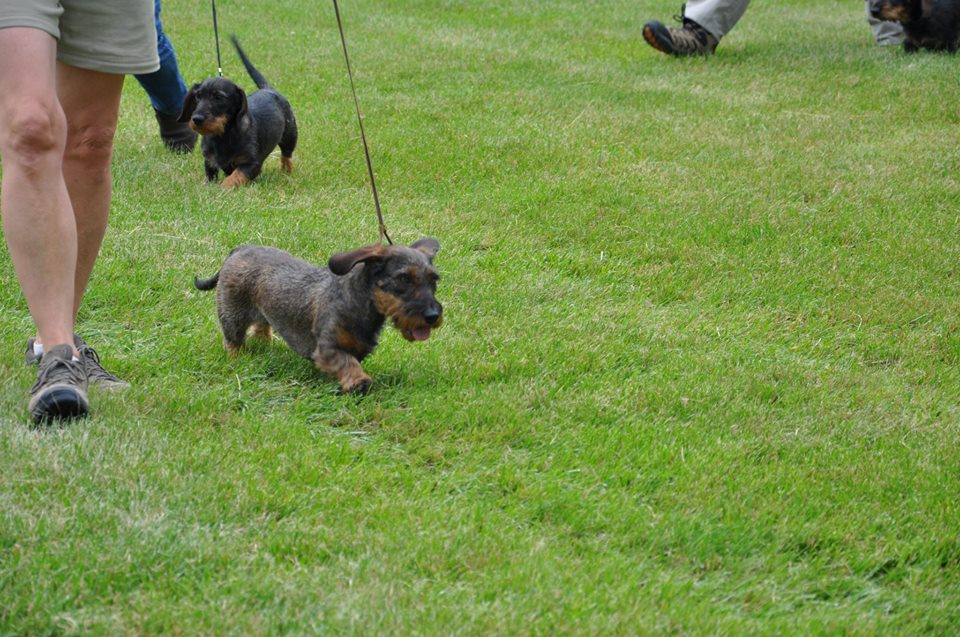
I showed Tuesday, and I did not handle her too well. Her gait in the pretty high grass was not that great. In spite of this she also received "Excellent" rating. In my opinion her weakness is in her somewhat roached topline, so I was surprised to read on her evaluation form the judge's comment "straight topline". The picture below shows Tuesday when she was in the ring with other "excellent" wires at the end of the show. She is the second dog on the left.


A big thank you to Patt Nance for taking pictures of Tuesday at the Zuchtschau!
Jolanta (me) handling Tuesday in the show ring.

For those unfamiliar with the FCI system of dogs shows and evaluations, this is a certificate I received for Tuesday at the end of show.

The evaluation form shows her weight 7.9 kg (17.4 lbs) and chest circumference 39 cm (14.4 inches). It also shows other traits that a judge evaluates.
Since Tuesday and Theo's brother Sky was "Excellent" and Best in Zuchtschau last year, it looks so far like the breeding of Paika (FC Paika v Moosbach-Zuzelek SW) to Moose (FC Nurmi von Moosbach-Zuzelek) produced some really nice looking dogs for the field.

To be continued....

Wednesday, April 3, 2013

Upcoming North American Teckel Club events

Dates: Thursday, June 13th - Sunday, June 16th

Judge: Wolfgang Trumpfheller, hunting and conformation judge from Germany

Location: 1411 Cross Keys Road, Reading and Weiser Forest, Hamburg, Pennsylvania
  • June 13: 12 pm JGHV Judges Seminar (required for all hunting judges and great tool to understand FCI hunting tests)June 14: 8 am Gun Shyness Test (blood tracking participants only), Blood Tracking Test 40 hours
  • June 15: 9 am Hit Site Evaluation Seminar, Gun Shyness Test, BHP (DTK Companion Dog Test), Water Test
  • June 16: 9 am Zuchtschau (DTK Conformation show), dogs will get a written evaluation according to FCI Standard #148
Blood tracking training lines will be available upon request only for Thursday morning, Friday late afternoon or Sunday before/after the Zuchtschau. Contact Andy Bensing for more info abensing@pbkennels.com.

Entry forms can be found at www.teckelclub.org, for more info e-mail Alexandra Weber, NATC Secretary dbarw@dejazzd.com.


Pictures from previous NATC events can be viewed at http://jola.smugmug.com/NATC

Wednesday, November 7, 2012

Sky von Moosbach-Zuzelek becomes a new Field Champion and goes Best in Zuchtschau on the same weekend

It does not get any better! On Thursday, November 1, our 15-month-old Sky von Moosbach-Zuzelek passed a gun-shyness and NATC Small Game Hunting tests. On Friday his conformation was rated "excellent" by a German judge Monika Wittkamp. He was also her pick as Best in Zuchtschau. On Saturday he was 1st in an OAAD stake of 14, went Best of Open, and became a new Field Champion.

At the conclusion of Zuchtschau on November 2: Sky was selected Best in Show by Judge Monika Wittkamp

Sky with his ribbons for 1st in OAAD stake, Best in Open and new Field Champion

Sky is a very charming and full of character dog.

Monday, June 11, 2012

FC Tom vom Linteler-Forst and his perfect score on the DTK blood tracking test

On Saturday it was Bella's birthday, and on the same day her sire "Tommy" FC Tom vom Linteler-Forst scored 100 points and Prize I on the DTK/NATC blood tracking test held at Maricourt, Quebec. Judges were Stefan Stefik from Slovakia, Andy Bensing and Carrie Hamilton from Pennsylvania. It took Tommy an hour and seven minutes to complete over 1000 meter long track. Everything went right, and John was thrilled with Tommy's flawless performance. All in all there were eight tests given over two days, and four dachshunds passed. Tommy's score was the highest.
From left: Stefan Stefik, Carrie Hamilton, John Jeanneney with Tommy, and Andy Bensing.

Tommy is four years old now, and thanks to him we learned a couple of new things. As readers of our two blogs know, a lot of our puppies are very precocious when it comes to their tracking and hunting ability. We start to work with our puppies early, and when we sell pups at the age of 10-12 weeks, they usually can track fresh liver drags or blood lines with several turns in them. When we see this level of performance in the pups, it reassures us that they are good blood tracking prospects. But not all puppies are precocious, and Tommy was not precocious either.

Four years ago we imported two male puppies at the same time - Joeri and Tommy. Joeri was 14 weeks old at the time and Tommy just eight. While Joeri was a super-achieving puppy, Tommy was not. Joeri tracked blood, hunted rabbits, retrieved from the pond, and Tommy could not do any of these things... for a long time. We never put pressure on him, and just let him develop at his own pace. Only when Tommy turned one year old, his hunting and tracking instinct really kicked in. Now at four, the only area that Joeri surpasses him is retrieving from the water. Tommy turned out to be a better rabbit dog with better line control and voice, and on artificial lines he is a better tracker too. On natural lines they are probably on the same level.

So what have we learned here? Well, it is nice to have a precocious puppy, but sometimes patience gets rewarded in a big way. What counts ultimately is the quality of mature dog, and I don't think anybody would argue with this statement.

Tommy at the end of successful track.

There is one more thing, which is different about Tommy. Our dachshunds usually show the same working style on deer blood and on wild rabbits. For example, Sabina was a slow, deliberate worker on both. Billy is fast on rabbits and he is fast while tracking wounded deer too. Tommy, who is a high-energy excitable dog has very different speeds and modes depending on what he tracks. On rabbits Tommy is extremely fast (and he voices strongly). On artificial blood lines his working style is completely different - he is slow and meticulous. On natural lines, he has a moderate speed. In my experience he is the first dog that has completely different working speeds on different scent lines.

Congratulations to John and Tommy!

Saturday, March 17, 2012

Happy 90th Birthday Martina!

I don't remember when exctly Martina Quellmann contacted me for the first time. As far as I can recall she read one of my articles in the Dachshund Club of America newsletter, and it must have been around 16 years ago or so. Over the years we have kept in touch mainly through snail mail, e-mail, by phone. She was a strong supporter of John and me when we co-founded the North American Teckel Club in 2000.

Martina is German, and she knows teckels. I love her quick and sharp mind, no nonsense attitude, no drama. I feel in her a kindred spirit. Today Martina is turning 90 years old, and it is a good occasion to reminisce a little.

In 2003 I wrote a short article for the NATC Teckel Talk about my first dachshund, and Martina replied: 

"Hello, Jolanta, the last Teckel Talk has been sitting on my desk since its arrival. It is unreal how many similarities I saw in your "Down The Memory Lane" and part of my life. I simply felt I had to share it with you.I got my first own dog, a mix, from my friends toy poodle's love affair. She jumped out of a first floor window to meet her beau, an all country mix. My friend had gone to one of the islands to not be bothered with male dogs. Little did she know. Somehow at that time one did not think or believe in spaying and neutering. That was 1946. When we ever have a chance to meet I will tell you my adventures trip to pick Pitti up. My friend and I had Pitti, much beloved, till we immigrated to the USA. As I learned that dogs had to be in quarantine for 6 month I made the painful decision to have him put to sleep. He never was separated from us except a few days here and there to stay with my parents. He was 13 at that time. The strange food, kennel live, strange voices....all would he been too much for him.

In New York German people living in our apartment building ask us to keep their dachsie for the time they went to Germany. Knuckles, short haired, badly overweight, skeptical of everything, it took him 14 days to trust me. He got an infected tooth and I had to bring him to a vet. That in the Bronx, to find a cab to take a dog, then pay him to wait so we could get home. All that with my meager money. In spite of or maybe because of I fell in love with dachshunds. I often took Knuckles for walks after his owners came back. I was very unhappy in New York and planed to go back home. Well, obviously, I did not. We moved to Vermont, an old farm house with 100 acres of land. We rented with the option to buy. My friend knew how much I wanted a dog and now we had room. The first Christmas there was a little dachshund, Hummel. He was an offspring of a dog a soldier brought back from Germany. Papers.....what did I know, even cared about it.

Once I joined our all bred dog club my interest for the technicality rose. I imported my wirehaired minis from Germany, but I never had the time to do to much with them. Hunting is not my line anyhow. But I showed in breed and bred some nice litters, always looking for loving pet homes. I never bred until I had at least 6 clients waiting, knowing I would barely have 6 pups, that allowed me to choose the new owners. And I always visited after 3 or so month. My contract stated I was entitled to take the dogs back if their care did not meet my standards. Neither did I cash the checks till then. It gave me the reputation of one of those German. But my pups were  my responsibility. With working full time as a nurse, running a riding stable, there was not much time to be away from the farm for shows. And the judges did not appreciate the smaller size I bred. I also am not at the least competitive. I was happy having all my dogs around, 5 dachsies, 1 great Dane, and time to take them all for a walk. And yes, they hunted on their own. How many woodchucks did they bring home and I had to bury them. Their instincts were there, but I did not work with it."

 In 2003 Martina wrote an article about her mini wire Kirby:

"Kirby’s registered name is Ch. Rose Farm Box Office Hit. He was born November 11th  1995.

As I had the last dog from my own kennel put to sleep, I thought I could do without a dog. Talking to squirrels, birds, petting other people’s dog showed me I could not. I called Dee Hutchinson whether she would help me to find a mini, preferably a male and wild boar, between 5 and 7 years, color and sex negotiable. And, I still can't get over it - Dee had Kirby for me. From the minute I had him in my car we were the best of friends. Kirby was used much as a stud and I anticipated some difficulties.  

An active stud and mostly a kennel dog, How would he adjust to being a house dog ? No problems. The one and only time he tried to mark his new territory I shouted, without even thinking; Oh No. He stopped immediately, run to the door and that was it. After several weeks working with him on come and sit [that still does not work, mostly I cannot see whether he sits or only pretends] we started our walks without leash. A happy hound running through the woods or across pastures. His delight to go in and out of culverts, mostly dry. He makes friends with each dogs after giving a warning growl when they are too bouncy. People are his great friends. In all the dogs I raised from my own kennel I never had such an outgoing little fellow. He greets everyone with a wag of his tail. Also, he is the most affectionate dog I ever had. He adjusted to being the only dog, bed dog, lap dog without any difficulties.  I make sure he has, at least once a day his freedom walk, meaning off leash. And yes, I bribe him to come when I call. Once we met a fox, while I looked for a stick to chase it away, Kirby hightailed back to me. He knew he was no match. Rodents, when he gets them, are taken care of, proudly presented to me.

Kirby
You may have received my snail mail already about our attack by a rabid skunk. It was frightening.  Four minutes behind our house, a walkway used by dog owners, jokers, bikers. 11am, sunshine. I was bending down to unleash Kirby as I saw it, a giant skunk, beautiful, shiny. A grandfather of a skunk. I picked up the dog and went into the bushes, hoping it would pass me with out spraying. It passed by, as I got ready to move it returned, passed by me again,  me ready to move again and back it came It waddled right in my hiding space, first bit in my pant leg, then without any provocation in my leg, first one, then the other, over and over again. The whole situation made clear that it was rabid. After about 15 minutes, I managed to step on it, then, as it came back again to kick it like a football. Thereafter it took off. In all that, fight Kirby slipped out of my arm and the critter got his left hindquarter. He screamed, he was still partly on my arm, I pulled him and the skunk up, it did not let go. I hit it with my fist; it dropped but bit me in my hand.

I was so shaky, I was unable to use my cell phone to call the police and walked home. From there I called, they kept me on the line until an ambulance was at my door. Kirby had hit in one of his corners, I had no time to check him. Called the Vet from the emergency room, was told I have a 6 hour leave way for him to be seen. The process in the emergency room made clear I would never make it out in time. Plus my Vet is an hour away. I called a friend who brought Kirby to the Vet. They came home 45 minutes after me. Kirby had no injuries, all the vet found was mushy fur on his left rear, not even a puncture wound. But he deskunked him for me. Also send home some of the solution to help with the odor in my home. And Kirby got a booster for his rabies vaccine. That's almost 2 weeks ago now. I am still receiving my shots, the last 12/22. All is well that ends well. But it may be of interest to all of your hunting friends. No, the skunk was not found in spite of 3 police officers who scanned the area. I assume he is dead by now. I still get a bit shaky when I think about it."

When Kirby passed in 2006 I could not stand a thought that Martina would be without a dachshund so we offered to give her our Gela. We imported Gela von Rauhenstein from Germany in 2000 when she was around a year old. A very good looking teckel, talented in the field, she found her niche in field trials. We bred her twice, but both times she had to have a C-section. After her second litter we decided to spay her. Gela was craving an individual attention and her dream must have been to have a human lap just to herself. It sounded like Martina and Gela would be a good match. So in August 2006 John and I drove to Hanover, NH, to bring Gela to her new home. It was a right decision, and Gela does not leave Martina's lap too often. Now she is almost 13.
Gela in 2008

Martina and Gela in 2011

Martina and Gela visited us in September 2007, and it was so good to see both of them. Gela was thriving.

September 2007: Gela and her old buddy Asko.

John and Martina at our place


I wish we lived closer to Martina so could see her more often. She always has interesting stories and insights to share. I cherish our friendship and think of her often; I feel that she knows me even without exchanging too many words.

Martina, Happy 90th Birthday! I am so glad that our life paths have crossed!

Saturday, March 10, 2012

Upcoming blood tracking events

3rd Annual Eastern Lacy Fun Day (ELF day)
March 16-17, 2012, 9:00 AM till we get tired!!

 1900 Youngs Mill Road, LaGrange, GA

Come share the fun with a great group of Lacy enthusiasts and our dogs. Activities will include introductory, intermediate, and advanced blood tracking and training, evaluation for United Blood Tracker certifications, working cattle and more. Silent auction on Saturday with proceeds to benefit the TLGDA.

Entry to grounds - $5 per person, or $10 per carload. $5 per activity entered per dog. Super Special!! $20 for admittance and access to all training events for one handler and a group of dogs. UBT evaluations will begin on Friday, March 16. UBT evaluation fees are: UBT 1 - $50; UBT 2 - $75 Pre-registration and payment required for evaluations so that we can prepare the lines in advance. Please contact Rebecca for registration forms and info.

Thursday afternoon, March 15 is the set up day; Friday will be UBT testing; Saturday will be cattle herding; introductory, intermediate and advanced blood track training. Sunday is clean up and head home. If you can come early to help, or socialize, we will be glad to have you. Breakfast will be provided on Friday and Saturday, if you’re up and around early. Potluck dinner on Friday night for early arrivals. Please bring something to share. Cookout on Saturday night. Bring something to throw on the grill!!!

Limited overnight accommodations are available for $10/night per person in the cabin (kids are free). Please register early if you plan to stay overnight. Please bring your cooler full of some favorite non-alcoholic beverages and lawn chairs.

All dogs must be under direct control of their owners at all times. Please bring a leash and crate along. A tie out might also be handy. No dogs in heat, and no alcohol allowed on premises!!
For more information please call Rebecca Ferrell at 850-508-6981, email at rebeccaferrell@comcast.net or go to www.lacydog.com and look for the ELF day thread.


Deer Search Blood Tracking Competition
April 21 and 22, 2012
Location: 1202 West Hill Rd., Town of Ellington, NY.

Application Fee:  $25 per entry
Applications will be first come, first serve. There will be a limit of 5 lines per day. All applicants and dogs must be pretested. Certified dogs will run first. All applications must be received by April 3, 2012.
Free lodging available onsite. Free camping available onsite. Other lodging options available upon request.

For more information contact  Gary Katta   (716) 785-5580,  9231 Spoden Rd., Fredonia, NY 14063

North American Teckel Club (NATC) events
Dates: June 7-10 2012
Place: Maricourt, Quebec, Canada

Judge: Stefan Stefik from Slovakia
Training and testing will be offered for blood tracking, obedience, gun steadiness and water retrieval.
A Zuchtschau (conformation show), where dachshunds can receive written critiques from an FCI judge, will be held on Sunday.
Registration fee all four days* -
$75.00 non-NATC members ($50.00 for NATC members)
Registration fee per day* (no registration fee for Sunday) -
$40.00 non-NATC members ($30.00 for NATC members)
* Submission of an NATC membership application, will qualify the participant for the club rate.
Test and Show fees (Fees are preliminary and may be subject to change):

DTK/NATC 20-hour blood tracking test fee is $100.00. Dogs/handlers must meet certain preconditions**.
Advance entry is $5.00 for Gun steadiness, $10.00 for Water test and $10.00 for each companion dog test. Gate Entries are $10.00, $20.00, and $20.00, respectively.
Zuchtschau advance entries: first adult dog $25.00
Gate entries (day of event): first adult dog $30.00
Each additional dog/same owner: $20.00
For Exhibition Only (FEO) and Puppies (<9 months): $15.00
Advance Entry / Closing Date for Zuchtschau and Tests is June 1, 2012 – Register early as space for certain activities may be limited.
Due to the required set-up, No Gate Entry is Allowed for the Blood Tracking Test.

 
** Handlers who have already obtained a JGHV/DTK/NATC blood tracking title on one of their dogs may enter other dogs in the blood tracking test. For novice handlers who have not put a title on a dog, the following are ways to demonstrate that you and your dog have reached a basic level of proficiency: 1) passing an NATC 500 meter test, 2) having a certification for your dog from another acceptable organization such as the United Blood Trackers (UBT) or Deer Search Inc (DSI), and 3) arranging individually for an NATC judge to observe and attest to your dog’s preparedness.

More information available from Carrie Hamilton Hamiltce@juno.com

Sunday, June 26, 2011

Spring 2011 Blood Tracking at the NATC - part 2

By Andy Bensing
Part 2

Saturday

After the Friday tests were over it was my responsibility to put the blood down on the three lines for Saturday morning. Claire Mancha, an NATC member who had flown in from Oregon for the workshop, assisted me and it barely took three hours to complete. Because of all the rain the night before, the ground was soft and moist and the deer feet on the tracking shoes stayed moist and sank into the ground the whole time the lines were being walked. I was expecting the Saturday morning Test to have much better conditions than we had on Friday morning but I ended up being quite wrong.

At 1:00AM Saturday morning a torrential thunderstorm came through and it poured for an hour and continued to rain hard for another hour after that. By morning it was anybody's guess how well the lines might have held up but I was not too optimistic. Just to make matters a little more interesting, it continued to drizzle on and off the rest of the day.

The judges for Saturday's test were Mme Agnes de France, Teddy Moritz and myself. The first dog up was from Canada. Steve Durocher's male wirehair Whiskey was raring to go at the start and took great interest in the hit site but unfortunately could not do much with the line. The smell of fresh tracks shortly after the start kept luring Whiskey away from the very faint scent left on the test line after the previous night's rain. Whiskey was called back for lack of progress after 30 minutes and shown the line. After another 10 minutes of working hard but not being able to make progress on the line the judges ended the test.

Steve Durocher (Canada) and Whiskey
The second dog up was John Jeanneney and his wirehair Joeri. Joeri also had quite a bit of trouble trying to lock in on the line but was able to very slowly pick his way along the first 150m of the line until he drifted off to the left and lost contact with it and eventually received a call back for being out of contact with the line for too long a distance. John at that point decided to withdraw his dog from the test. John reported that his dog had never really been able to lock into the line properly and after 20 minutes of trying he thought it would be a waste of everyone's time to continue trying.

John Jeanneney (NY) and Joeri
The third dog up was Steve Durocher again but this time with his female wirehair Flair. Flair took off like a shot right from the start and motored right down the first 115m of the line with no trouble whatsoever. The start of this line was even a little tricky and she had no problems with it. The line started on a logging road and went right up a steep hill and in the middle of the hill the logging road turned off to the right but the line went straight up the hill. Most dogs would have been a little sucked to the right at least for a few yards as the road arced right but Flair kept her nose to the ground and followed the line perfectly straight with excellent accuracy. I was really impressed with the dog's start and it looked like she was going to just ace the line but unfortunately for Flair at about 115m into the test she encountered some distracting cross scent in an area of ferns that started to give her trouble. This seemed to break her concentration for the blood line and things started going downhill from there. Steve was very good at reading his dog and knowing when she was tracking and when she was working hotter scent. He brought her back to the blood line several times but the easy, hot scent kept drawing her away. Eventually Steve just went with his dog and ended up with his first call back. The other judges and I showed Steve where the line was at for a restart but Flair went off again on the hot line and got a second call back.

Training note: I discussed with Steve later after the test what I thought would have been a better way to handle the situation with the hot line. Steve could read his dog very well and clearly knew when she was tracking hot and not on the blood line but he never actually stepped in and let her know firmly that taking the hot line was wrong. I would have given her a very firm "no" and perhaps a pretty good leash jerk for tracking hot. Especially when she went right back in the hot line's direction on the restart after the first call back. I asked Steve if perhaps Flair was a softer dog and could not have handled the correction and he said she was quite tough and easily could handle discipline on the line. I can only guess but I believe his dog could have passed the test if Steve had taken assertive action early on when his dog started to investigate the hot line.

After the second restart Flair seemed to settle in a little better but her concentration was clearly diminished from chasing all the hot scent. She was able to pick her way along the next 140m but as she approached the first turn she wavered off the line and ended up catching a piece of the second leg and bringing it back to the corner. She worked the check at the corner for quite some time and Steve could tell his dog was struggling and did not have the line so he would not let her go too far off from where she last had it. They circled a bunch of times and eventually the judges decided that the dog and handler needed to make progress or the test would be terminated. The handler was informed that he needed to make progress for the test to continue. At that point Steve gave Flair her head and just went with her. There really was no other choice. Unfortunately, she went off in the wrong direction and Steve and Flair received a third call back and the test was over.

It had been another tough day of conditions and the conditions had made it too difficult for any of the dogs to pass the test.

Part 3

Epilogue

And now for a funny story (depending on your perspective) and a little bragging. The NATC event was held at a Boy Scout camp in northern New Jersey. Most of the participants were staying in cabins right on the grounds. The night after the test, at 4 AM Sunday morning Eibe woke me up and kept standing on me. She wouldn't go back to sleep so I decided to let her out thinking she must have had to take a leak. Well as soon as I opened the cabin door all heck broke loose. She bolted out and around the door, and all I heard was a blood curdling scream that sounded like her guts were being ripped out. When I looked behind the door I saw something furry and two feet high fighting with my dog and the both of them disappearing off into the woods 10 yards away with my dog still screaming. I thought a coon or a coyote was dragging my dog off!

When I finally ran close and got my flashlight on all the commotion (bare foot and in my underwear no less) it turned out that it was a skunk! I don't know who had a hold of who at that point but I just reached in and grabbed Eibe by the back of the neck and when I picked her up the skunk came with. I gave the whole thing a shake and the skunk came loose and I ran for cover. Luckily I did not get a direct hit from the skunk but Eibe sure did! I tied her to a post while I surveyed all the damage. She continued to moan for another couple of minutes as I looked her over. Her chin and neck were solid yellow from the skunk spay and she had a bloody snout with a small hole in her nose but that was the only damage to her. I don't know how well the skunk faired but I did not go back to check. Luckily I had some Skunk Off in my first aid kit so we went right to the shower house and I washed her down. I thought it took pretty good care of the smell but when I got to breakfast that morning my friends thought differently!


Before the skunk incident Sunday morning I had planned to take Eibe out after breakfast to see if she could work one of the Tracking Shoe test lines at 40 hours that were not completed on Saturday at 20 hours. After her great performance on Friday under difficult conditions I thought she just might be able to do it and I knew it would be fun to try. After the skunk incident I thought at first the skunk in her face would prevent her from smelling anything but at the last minute I decided to give it a try anyway. I picked a line that had the last 600m, 2 wound beds and 2 marking points untouched and my plan was to get within 50 meters of the first wound bed using my GPS and then have Eibe do a search start to find it and begin the track from there.


Eibe's unofficial 40 hour line - click to enlarge
The search start was harder for Eibe than I expected but with a little guidance from me using the GPS she eventually found the wound bed I wanted to start from. During the search, we actually bumped the line two times and she indicated it but I wanted to be positive about the start so we kept searching for the wound bed. After finding the wound bed I started Eibe on the line. The first 120m were very difficult. The scent was so faint and there was so much other scent around that I think Eibe had a hard time figuring out which one she was supposed to follow. Eibe got off the line twice and I questioned her and she returned to searching and eventually got locked in on the line.

She went the next 240m slowly but with little trouble. As she tracked along out in front of me I could smell the skunk scent wafting off of her but it seemed not to give her any trouble. I had laid the line two days before so I thought I remembered exactly where it had been laid. At one point I thought she was off to the side 5 or 10m but right at that moment she stopped and stood solid and when I looked down she was standing over a marking point. Boy, was I proud of her!

We eventually got to a more open area where the canopy was not very dense. Part of the line was actually laid down a grassy logging trail and I knew for sure where it was but Eibe could not smell anything. I suspect the open canopy allowed the rain to hit the line harder in this area but for whatever reason this area was very difficult for Eibe. She spent a whole lot of time searching and trying to figure it out. I had to question her two times for taking heightened interest in cross trails, but I did not help her back to the line and just left her work. Hoping to blow through the difficult area I eventually I picked her up and restarted her back on part of the line where she clearly had it before but that did not work either. Finally I decided to cast her with a directed search wide around the difficult area. You can see from the GPS map how much trouble this area gave her. During the cast she picked up the line about 50m in front of the difficult area and she back tracked the line back to the edge of the difficult area and found the wound bed. When she reacquired the line after the search and found the wound bed I could tell she was smiling. I know I was!

Eibe over wound bed
At the wound bed I turned her around and pointed her in the right direction and she motored down the 50m she had just back tracked. The next 100m or so there was apparently not much scent and she slowly picked her way along. At one point she seemed to be stuck in a small 10 foot diameter area and just kept searching very hard and deep with her nose even under the leaves. I thought she was maybe after mice until I looked at my GPS and I realized that this was the area where there had been a marking point. The marking point was no longer there but it must have left a lot of scent or at least the critter that carried it away did. I encouraged her to continue on and the last 100m or so went pretty easy. All in all it took us 1 hour and 50 minutes to cover 600m of difficult 40-hour-old tracking shoe line. Eibe found and indicated the one wound bed and one of the two marking points and likely the second marking point as well.


Training note: On my ride home from New Jersey I was contemplating the weekend's tracking activity and my dog's  performance (on both tracks). This was the fourth time in a year that Eibe was in a test where she was able to do quite well even under difficult conditions and all or most of the other dogs in the test either struggled or could not finish. I think the reason she does so well can be attributed to two main abilities that she has, and neither one has to do with her having a great nose. Actually, I am coming to believe that her ability to smell is really just average. I think Eibe's most valuable natural ability is her ability to concentrate and stay focused for long periods of time. That's what seems to get her through the tough times. Secondly, she is very trainable and easily absorbs the training exercises I set up for her to learn new skills or unlearn bad tendencies. I believe that the combination of these two abilities and a strong hunting drive has enabled her to accomplish as much as she has already at barely 4 years of age. I really look forward to the next 6 or 8.

Saturday, June 25, 2011

Spring 2011 Blood Tracking at the NATC - part 1

By Andy Bensing
Part 1

On June 9 through 12, 2011 the North American Teckel Club held its Spring Hunting Workshop and Conformation Show. As part of that event, John Jeanneney, Darren Doran and I were responsible for laying out and organizing the DTK sanctioned Blood Tracking Tests. This year the blood tracking tests were 20- hour-old Tracking Shoe Tests. Each blood line was 1000 to 1200 meters long and was laid by the tracklayer walking with tracking shoes on and putting a squirt of blood on the ground every 10 meters or so after the first 50 meters where there was only blood at the hit site. Three and a half ounces of blood total were used for each line.

Tracking shoes

There were two 90-degree arching turns in each line. Two simulated wound beds and four marking points were dispersed along the line as well. For this test we used 3" diameter slices of birch wood soaked in blood as the marking points. We laid 1" cubes of deer lung on them when the line was laid but as usual, the lung was long gone by morning but the scented wood was still there for the dogs to find.

Marking points
Here's a poor quality but funny photo of John sharing his leg cramp magnesium supplements with Darren at the end of the day. Darren had flagged out three 1000m test lines and then went back and walked them again wearing the tracking shoes for the test the next day.

Darren is grimacing in leg cramp pain as John smiles happy to be able to help.
Since DTK sanctioned Blood Tracking tests are very hard to find here in the USA, the NATC set these tests up as actually two separate tests, one was held on Friday and another was held on Saturday. John Jeanneney and I both wanted to enter a dog so I entered my dog for Friday while John set those lines up, and I set up Saturday's test so John could enter that day.

To be honest, I did not feel properly prepared for entering my dog in this test. I had had a very busy spring and did not get the training time in that I would have preferred leading up to this Tracking Shoe Test. As I havd written about before I spent quite a bit of training time getting my dog ready for a 20 and 40 hour VSwP in February and the Deer Search competition in April which were both blood only, no tracking shoes, events. After the Deer Search Competition in April where we came in a very disappointing 3rd, when I went to switch back to tracking shoes for the NATC event, I noticed a little problem with Eibe's work and I was only able to get three training lines in to work on it. It had gotten better but not really yet to my full satisfaction. I don't like to enter any event that I do not feel fully prepared for but there was a low entry for the NATC event so against my better judgment I entered anyway.

Friday

There were two dogs entered for Friday's test. Eibe and I were up first. I knew already on Thursday when the lines were laid that the test conditions would be difficult on Friday. The forest floor was very dry as it did not rain for quite some time. With a "blood only line" I would not have worried but when a line is laid with tracking shoes and minimal blood I have had difficulty in the past. When the ground is hard and dry I do not think very much scent is transferred from the tracking shoe to the ground when the line is laid. In training I sometimes see my dog in these conditions actually do more of a search from blood spot to blood spot than actual tracking the scent from the shoes. To top off the dry conditions when laid, Thursday evening it rained several times quite hard. Again, with a blood line it would not be a concern but it has also been my experience that tracking shoe lines do not hold up to rain as well as blood does. I knew Eibe would be able to find some scent but I also knew it would be very hard.

Well as soon as I started Eibe on the line my suspicions were confirmed. It was going to be difficult. It took Eibe 13 minutes just to get started and go the first 50 meters including her circling back to the hit site twice until she finally locked in on the track. Eibe found and cleanly indicated a marking point about 60m after she finally got locked in and went another 200m without much trouble. From that point forward the next 500m of the line was a series of short runs of 20 or 30m that she could track relatively easily and then dead spots were there was apparently little or no scent so she had to basically search through the dead spots to find the next piece. When I looked at the gps map of our track afterwards I could see that in addition to the normal small, few second long checks that a dog normally makes when tracking, Eibe had 8 large checks along the way that were 5 to 15 minutes long each. Two times she was just stuck in those big checks in the dead areas and I did a directed search with her and cast her out around the dead spots and she was able to re-acquire the line.

Eibe found and solidly indicated both wound beds and 2 of the 4 marking points along the trail. Actually, the second marking point she found was a big help for her. She was working hard to find her way through one of the dead spots and the wind shifted a little and she caught wind of the marking point and went directly to it about 10m away from where she had been searching. She indicated it by standing over it rock solid and I think she was as proud of it as I was. From that marking point forward the last 150m of the line was a little easier and went relatively quickly compared to the rest. I found out later from the tracklayer that he had gone a little light on the blood on the first part of the track and had pretty much of the 3½ ounces left near the end so he put it down a little heavy to use it up by the end. That's probably why it got easier.

The whole line ended up taking us 1 hour and 58 minutes to complete. I was very grateful that the judges gave me that time, appreciated my dog's hard work and recognized her determined focus to keep working under the very difficult conditions. I was not really sure how much time I was going to be allowed to have to finish the track because the DTK rule as to time limit has changed several times back and forth over the years. The latest translation I had said a limit of 1½ hours but as with most things the judges always have some discretion. At 1 hour and 15 minutes into the test I knew I had at least 300m still to go so I asked the judges if I was under any time constraints. If I were then I would just push my dog along and hope for the best. When the judges said time was not a factor then I relaxed and let my dog continue on at her own pace.

When it was all over and the judges finished conferring, Eibe and I were awarded a score of 92 Prize I. The score is composed of 3 parts, Method, Accuracy, and Desire and my score reflected that the judges felt Eibe's method was excellent, accuracy was very good and her desire to track was excellent. I was very happy with the score and it was what I was expecting and what I thought my dog deserved after working so hard.

GPS map of Eibe's track - click to enlarge

Judges John Jeanneney (NY), Mme Agnes de France (France), and Teddy Moritz (NJ/DE) with Eibe and me after a successful 20 hour Tracking Shoe Test.
The second dog up on Friday was Patt Nance's young longhaired teckel, Viljo. I did not see this dog work so I can't report much about how things went. All I know is that he had some difficulty at the start and was not able to complete the line.

Patt Nance (OH) and Viljo

Wednesday, June 22, 2011

Importance of functional conformation in a working dachshund; NATC events - part 2

On Sunday, June 12, the North American Teckel Club held a Zuchtschau at Rockaway, NJ. A big thank you to Teddy and Carl Moritz who hosted the show at Winnebago Scout Reservation.

Zuchtschau is a conformation show where each dog is evaluated according to the FCI dachshund breed standard #148, and each dog receives a written evaluation from an FCI judge. This year the Zuchtachau was judged by  Mme Agnès de France, President of the French Teckel Club (Club des Ameteurs de Teckels). She judged for the NATC before, exactly two years ago.

What is the FCI and what is the FCI dachshund standard? The Fédération Cynologique Internationale (FCI) is an international federation of kennel clubs, and currently it has 86 members countries, with one member per country. You can see which countries follow the FCI rules by clicking here or here. Perhaps you will notice that the USA, Canada, UK and South Africa are not on the list...unfortunately. You can read more about the FCI on its website. The wikipedia states that "the aims of the F.C.I. are to encourage and promote breeding and use of purebred dogs whose functional health and physical features meet the standard set for each respective breed and which are capable of working and accomplishing functions in accordance with the specific characteristics of their breed; to protect the use, keeping and breeding of dogs in the member countries."

The North American Teckel Club is part of the DTK (Deutscher Teckelklub), which is in charge of the FCI standard of the dachshund breed as Germany is the country of the breed origin. The NATC holds two conformation shows per year and you can read about them on the NATC website.

Even though on paper the AKC and FCI standards of conformation are not that different, in reality as John says "the American show judges decided, in their wisdom, that if the original dachshund from Germany was a comparatively short-legged, long dog, then the ideal “improvement” would be to exaggerate these characteristics. Check out the big show winners in dog magazines to observe what passes for the most desirable show dachshund today. The exaggerations are most extreme in the smooth-coated  dachshunds. Perhaps they are fine lawn cruisers, but with less than two inches of ground clearance, they would be in big trouble if they had to hoist their long heavy body over a 12 inch fallen long." To download the text of the FCI standard for dachshund and commentary providing additional information go here.

The bottom line is that a hunting dachshund should be athletic and his built should be "especially suited for hunting game below ground, for beating the bush in search of game, and for trailing". So when you are thinking about acquiring your first dachshund for blood tracking, don't think about just his nose, tracking desire, intelligence and other hunting qualities, but pay attention to the parents' conformation too.

When I started to breed wirehaired dachshunds my first litter was a cross between a French working teckel (FC Fausto de la Grande Futaie) and American show dachshund (FC Rivendells Ruby Tuesday). Even though Ruby had a lot of hunt, her conformation was not extreme, and all the following generations of breeding involved FCI working dachshunds only, it was very difficult to get rid off the large- sized, low-stationed, long-bodied, deep-chested American show phenotype. When it comes to breeding, this type seems to be dominant over the lighter and more agile type with  better ground clearance and shorter body.

This picture shows Hansi (Teuffel von Moosbach-Zuzelek), who was Ruby and Fausto's grandson and was born in June 1995. He grew up to be 35 lbs, and he had extremely exaggerated conformation. Of course, we did not use him for breeding. This is not the conformation type you want in a working dachshund...or any dachshund. However, this is the type that you see very often an American show ring.

Hansi is an example of "wrong" conformation for a working dachshund. He was too large, too long and too low to the ground.
There is a reason why I am addressing this issue in my post. Recently I have realized that a number of American show wires have been imported to Europe, and to my surprise, in spite of the long and low stationed conformation, they have done very well in a show ring there. Some of them have done well in blood tracking tests too. Now American show breeders are starting to sell their pups to blood tracking homes. All I can say - do you research first and be an educated puppy buyer. Let's hope that the conformation of these dogs is going to withstand physical demands of blood tracking.

After this long introduction to conformation let's turn to the NATC Zuchtschau. The pictures are telling a story how a dachshund is evaluated according to the FCI standard.

Patt Nance with Viljo, who was rated "excellent".
First a dachshund is put on a scale and his weight is recorded. According to the FCI standard dachshunds come in three sizes. Standard Dachshund has circumference of chest 35 cm or more and its ideal upper weight limit is about 9 kg. Miniature Dachshund has circumference of chest from 30 to 35 cm measured when at least 15 months old. Rabbit Dachshund has chest circumference up to 30 cm measured when at least 15 months. Dachshunds weighing in at more than 10 kilos may not be awarded the “Excellent”.
Stephanie Marcoux is handling Whiskey, who received the "excellent" rating.
Mme Agnès de France is measuring this wirehaired dachshund's chest. As it turned out even though he was out of mini parents, his chest measurement above 35 cm determined that he is of a standard size.
Dog's bite is checked thoroughly.
And all his teeth are counted.
Mme Agnès de France showed us these drawing illustrating dachshund's teeth and jaw. The FCI standard considers absence of one or more canines and absence of one or more incisors as eliminating faults.The same goes for the lack of other premolars or molars with exceptions : the two PM1, one PM2 without consideration of M3.
A tail is checked for kinks. This was embarrassing, but as it turned out Quenotte has a kink at the very base of her tail. I have never noticed it as I was checking the tail further down. A kinky tail is an eliminating fault.

Once a dog is checked on the table, a judge observes how the dog moves.
 

Movement should be ground covering, flowing and energetic, with far reaching front strides without much lift, and strong rear drive movement should produce slightly springy transmission to top line. Tail should be carried in harmonious continuation of top line, slightly sloping. Front and hind legs have parallel movement.

Teddy Moritz with her longhaired mini Garmin who received "excellent" rating.
A dog's temperament is tested by observing his reaction to the loud noise.
All dogs are rated, and possible ratings are: Excellent, Very Good, Good, Sufficient, Disqualified and Without Evaluation. At the end of the show the best dog in each coat is selected, and the show closes with the selection of the best dog in show.

MmeAgnès de France Alexandra whose red mini longhaired Jesse James von Reblick was "Best in Show". CONGRATULATIONS to Alexandra and Jessie James!

For pictures from the NATC Zuchtschau click here