Search This Blog

Showing posts with label tracking style. Show all posts

Monday, June 11, 2012

FC Tom vom Linteler-Forst and his perfect score on the DTK blood tracking test

On Saturday it was Bella's birthday, and on the same day her sire "Tommy" FC Tom vom Linteler-Forst scored 100 points and Prize I on the DTK/NATC blood tracking test held at Maricourt, Quebec. Judges were Stefan Stefik from Slovakia, Andy Bensing and Carrie Hamilton from Pennsylvania. It took Tommy an hour and seven minutes to complete over 1000 meter long track. Everything went right, and John was thrilled with Tommy's flawless performance. All in all there were eight tests given over two days, and four dachshunds passed. Tommy's score was the highest.
From left: Stefan Stefik, Carrie Hamilton, John Jeanneney with Tommy, and Andy Bensing.

Tommy is four years old now, and thanks to him we learned a couple of new things. As readers of our two blogs know, a lot of our puppies are very precocious when it comes to their tracking and hunting ability. We start to work with our puppies early, and when we sell pups at the age of 10-12 weeks, they usually can track fresh liver drags or blood lines with several turns in them. When we see this level of performance in the pups, it reassures us that they are good blood tracking prospects. But not all puppies are precocious, and Tommy was not precocious either.

Four years ago we imported two male puppies at the same time - Joeri and Tommy. Joeri was 14 weeks old at the time and Tommy just eight. While Joeri was a super-achieving puppy, Tommy was not. Joeri tracked blood, hunted rabbits, retrieved from the pond, and Tommy could not do any of these things... for a long time. We never put pressure on him, and just let him develop at his own pace. Only when Tommy turned one year old, his hunting and tracking instinct really kicked in. Now at four, the only area that Joeri surpasses him is retrieving from the water. Tommy turned out to be a better rabbit dog with better line control and voice, and on artificial lines he is a better tracker too. On natural lines they are probably on the same level.

So what have we learned here? Well, it is nice to have a precocious puppy, but sometimes patience gets rewarded in a big way. What counts ultimately is the quality of mature dog, and I don't think anybody would argue with this statement.

Tommy at the end of successful track.

There is one more thing, which is different about Tommy. Our dachshunds usually show the same working style on deer blood and on wild rabbits. For example, Sabina was a slow, deliberate worker on both. Billy is fast on rabbits and he is fast while tracking wounded deer too. Tommy, who is a high-energy excitable dog has very different speeds and modes depending on what he tracks. On rabbits Tommy is extremely fast (and he voices strongly). On artificial blood lines his working style is completely different - he is slow and meticulous. On natural lines, he has a moderate speed. In my experience he is the first dog that has completely different working speeds on different scent lines.

Congratulations to John and Tommy!

Monday, May 28, 2012

Patience on the track

June 1, 2012
Update with pics:
Teddy wrote - The only photo I have of Lisa is attached. I've also sent a body shot of Lisa's dam, Tar. Lisa has the same body shape but with more hair. I'll try to get a better photo of Lisa when I get back from the western Pa. field trials.
Bane weighs eight pounds, Lisa weighs seven.
 
Bane

Lisa


Tar

*******

Teddy Moritz shared this story with us a week ago or so. Thank you Teddy!

Thought I'd write up this tracking event the dogs had today. I was patient and let the two dogs work at their own pace. I could have pushed them, called them in or gone on but I was curious as to what they were tracking:

I ran three miniature longhaired dachshunds at a beagle club grounds today. The weather was sunny, warm and windy. The grounds has many small sections of very thick cover, interspersed with mowed paths. I had Fitz, who is eight, with me, as well as Bane, who is 4 and Lisa, who is 14 months. Fitz and Bane are experienced hunters and well know how to track a rabbit. Lisa is all eagerness and tends to run over the scent line, but she has a good nose and will correct herself, even if it takes a few minutes. Today I saw a great deal of persistence as well as patience on her part.

Lisa found a fresh scent going into a very thick bit of briars, tall grass, vines, etc. She was very intent about the smell and jumped right in. Bane soon followed. Fitz took a sniff and stayed with me, which I found quite odd as she is by far the best rabbit tracker of the three. Fitz actually sat in the shade with me rather than joining the other two. I wondered if she didn't feel well. Lisa opened once or twice, Bane never did, then all was quiet. I waited as I usually do, letting the dogs work out the line. Lisa yipped once but then was quiet. I waited and waited, as did Fitz. The two dogs didn't come back and there was no barking, which I found odd. I walked around the square and saw the two of them working very diligently and very slowly, over a piece of ground that is mowed blackberry canes. The dogs seemed to have trouble with the line but Lisa kept moving ahead. Bane would join her, go back and check himself, then come up again. Lisa worked her way into another briar patch where there were locust trees. She came out about twenty feet further and seemed to hit a hot line. Her body language became animated and she seemed to have a good scent. Oddly, her tail wasn't wagging like most scent hounds' tails do when they are hot on a rabbit scent. Bane confirmed her line. Fitz joined for a few feet, then came back to me. I was beginning to worry the little dog was ill.

Lisa took the line across another path and into a brush pile in the woods. She worked ever so slowly, which, again, isn't like her. Bane and even Fitz checked the brush pile and the surrounding area but it was Lisa who took it back across a path and into a small copse of trees. I couldn't understand why it was taking them so long to get up on a rabbit. I thought perhaps it as a young rabbit with little smell, but we'd come several hundred yards, in a circle, and that seemed too great a distance for an immature rabbit. We were going in a circle, so I still presumed the dogs were working out a rabbit track. The brush is thick and high and rank so I wondered if the vegetation was hiding the smell. Most of the time I couldn't see Lisa or Bane because the cover is so high. I heard Lisa yip again and thought she'd found her rabbit. She came out of the trees and headed into another thickly vegetated square. She and Bane ever so slowly worked the line from there through a stand of milkweed and other weeds. They seemed to weave around a good bit, not quite being able to move the line. In my mind they acted as if they were working a feeding track, such as coon hounds do at night when a coon wanders all over the woods looking for food. And not only were they sniffing the ground, they occasionally scented up a plant stem as if their quarry's scent was higher up. Odd.

I've never seen the dogs work this thoroughly and diligently. It was as if the scent was spotty and not in a direct line like a fleeing rabbit would make. Again I waited and watched rather than calling the dogs to a different spot. They seemed intent but not hasty. Their nose work was great to watch. Bane threads his way here and there, making sure he has the line before he moves up. He often checks himself. Lisa, in her youthful enthusiasm, bustles around and jumps in the air now and then hoping to see her quarry. She works and re-works the line, but with more haste than Bane. By now about fifteen to twenty minutes had passed and I was really curious as to what they were tracking. Fitz still stayed with me, appearing uninterested. How could that be?

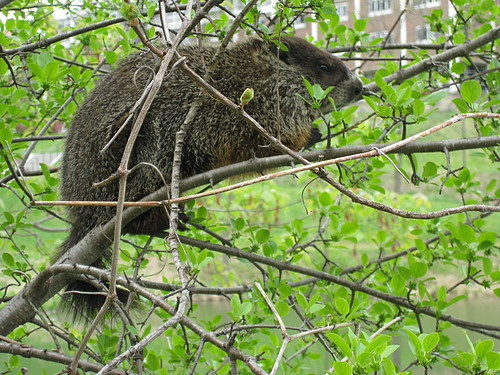
The two younger dogs soon worked their way to one more patch of weeds, this one with a multi-trunk cherry tree in the middle of it. Fitz and I stayed on a mowed path and watched and listened. I began thinking the dogs would never bump this rabbit, or whatever it was, despite their hard work. As I stood there, enjoying the scenery on a beautiful day, I happened to look up into the cherry tree. And there sat a groundhog, about twenty feet off the ground, settled in a crotch of branches. Pretty soon Bane and Lisa arrived at the tree. I could see them tracking around the base of the tree, where there was less cover. Lisa stood on her back legs and put her front feet on the tree. Bane did the same. So that was what they had been tracking! I would bet it was a feeding trail after all. The groundhog was probably foraging around the different small patches of brush, trees, etc. and was unaware of the dogs on his track. They hadn't opened and the brush is high so the rodent couldn't hear or see them coming. But when he did feel threatened somehow, he took the quickest route to safety, up a tree. Groundhogs easily climb trees and will use them to escape ground predators if no hole is available.

Fitz has worked groundhogs over the years but they are too large and aggressive for her. She only weighs six pounds and her head is too small to do any damage to a groundhog, but a groundhog can hurt her plenty if she closes with it. I don't encourage her to work them, and call her off if she finds one in a hole. Apparently today she agreed and let her kennel mates do the work. However, when I shot the groundhog out of the tree, Fitz was right there with Lisa and Bane, tugging at it.

I really enjoyed being able to watch those two hounds work out the complicated line of the feeding groundhog. They stuck with it, figured it out, and got their game.

Source of the picture: http://apps.carleton.edu/reason_package/reason_4.0/www/images/627713.jpg

Monday, January 18, 2010

Randy Vick, Lil' Brown and Annie - a tracking team from Georgia

Few weeks ago Randy Vick from Georgia sent us a nice letter along with pictures. We wrote about Randy before . His two tracking dogs are Lil' Brown, a Bavarian Mountain Bloodhound, and Annie, a Kemmer Stock Mountain Cur.

"Dear Mr. John and Ms. Jolanta,
Here are some pictures of Lil' Brown and Annie. They are both doing great, though they have completely different tracking styles. Brown is as laid back as they come, almost doesn't need a lead. He's pretty good in the water (lots of flooded timber and creeks here). At the age of 3, he has several 16-18 hr successful tracks.

My Kemmer Stock Mountain Cur, Annie, (Osteen's Yellow Anne) is 5 years old and is the star tracker now. She pulls hard on track and can handle 6-8 hour old tracks. She will wind a deer exceptionally well and when released will bay a live or dead deer and stay with it until you arrive.

The picture of Brown was a "practice" track that turned into a four hour adventure. We jumped the deer on an island in waist deep water and later found it floating in the river. It score 158+ B.+C. points. The guys were proud of Brown, who swam along and came out of the water right on the trail.

Lil' Brown with Randy Vick and Larry Williams (hunter)

The pictures of Annie (below) are from a six hour old track that was 1.25 mile of going down the creek and looping back across his own track (3 times), picking up another deer to run with (when the deer split up, Annie stayed with the right deer) across open fields and grown-up cut-overs, until finally we found the deer in this swampy area. Needless to say, Charlie thought Annie was the greatest.

Have taken about 50 calls so far and recovered 21 deer. I try to split calls between dogs and still have 2 weeks in Georgia and 2 months in Florida."

Charlie Hester with Randy Vick's Annie

Monday, November 24, 2008

The Nose Factor in Tracking Wounded Deer

This article was written by John Jeanneney in 2003, and even though it is somewhat outdated it still contains some good stuff.

“Nose” is one of those four letter words, but it is a lot more complicated than most of them. “Nose” is so complicated because we use it to refer to things that are really based in the brain, not just on the end of the muzzle. How a dog responds to scent, and how he uses his nose is even more important than the sensitivity of the nose itself. All these factors are so closely related that it is pretty hard to pick them apart.

The nose factor in tracking dogs for wounded deer probably has a lot in common with nose in cougar and bear dogs. We are often dealing with old, cold lines in both cases. In wounded deer work it’s called “blood tracking”, but as I have pointed out before there is usually little or no blood. If you have visible blood to track by, why do you need a dog?

Line Sense

Useful dogs need a brain wired to process scent so they know what to do with it. They have to have “line sense”, an instinctive awareness that scent leads from “A” to “B”. You would not expect or need this in an English pointer, but a scent hound or cur, which is going to track game, better have line sense. And it does not always happen.

Years ago I worked for about a year with a well-bred Leopard Cur. As you know the Leopards have a reputation of being the coldest nosed of the cur breeds and the most suitable cur for lion and bear work under tough conditions. I am sure that this reputation is well deserved, but this particular bitch was an exception, and she taught me something. We could go out on a couple of inches of snow, and I would show her a coon track from the night before. She would respond and her tail would swing with excitement. She could smell it very well, but she would not move with it. She lacked line sense and despite a lot of work, she never learned that a scent led somewhere. I never tried to use her for tracking wounded deer. She did not seem retarded in any other way, and I was lucky to have a friend who needed a yard dog.

Molly (picture taken in 1996) lacked a line sense required for blood tracking.

There are some dogs that can follow the line, sort of, but they lack focus and they will not gear down, dig for the scent and walk it slowly when necessary. They are smelling around all over the place. This is more a matter of temperament than a lack of nose.

Some hounds with good noses drift a track. They always seem to know where the scent line is, but they are not on it every yard of the way. These dogs are going to find wounded deer, but they are not going to show you all of the sign, blood smears and so forth, that you need to make your determination about how the deer is hit, and whether it is going to survive.

A few years ago I was tracking with a man who had a German shorthaired pointer. The GSPs were developed in Germany as a versatile hunting dog, and some American versions of the original breed have retained this; Bill and Buckshot found a lot of deer together and that GSP got better and better at it. This time I was tracking behind Buckshot with Clary, who was a very good wirehaired dachshund. Buckshot, out in front, was drifting the line pretty fast, not always right on it, but certainly following the cold track of the wounded deer. However, Buckshot completely missed a wound bed that Clary showed us because she was working closer. That wound bed told us something that we had not been able to determine before because we had not been able to start at the hit site. Blood and saliva, outside the perimeter of the bed showed that we were dealing with a jaw shot. These deer are doomed to die, but they remain strong for days and death comes slowly. You don’t have any chance to put them down unless you can get them out in the open for a shot. In the dense scrub oak and pine barrens where we were tracking, there was no hope of that. Clary showed us the sign that spared us from a lot of fruitless tracking.

I have seen individual bird dogs that stayed close to the line and were excellent trackers. But most spaniels and the various continental pointers do have a natural tendency to quarter back and forth on the scent line. There are various ways to train them out of this, but it is not simple. For a bird hunter who needs to track a wounded deer now and then, dogs that quarter or weave back and forth on the line can still be useful.

For the handler who puts finding wounded deer at the top of his priorities, tracking will be easier with a dog that works closer to the line. Particularly in bowhunting, you encounter many superficially wounded animals that are going to recover. Many miles of wild goose chase can be avoided, if the hunter can read the occasional drips and smears of blood over the first half mile. The dog will show the handler where the sign is, and then the chances of catching up to the deer must be evaluated.

A Cold Nose

A dog that has line sense does not necessarily have a “cold nose”, the ability to smell a very old or faint track. Every handler appreciates a dog with a great nose provided that this nose is used well. Still, in wounded game tracking too much emphasis can be placed on a super cold nose to the point that it outweighs everything else. In most wounded deer tracking situations you don’t need all that nose. To save a deer from spoilage or the coyotes, you generally have to get on the line before it is 24 hours old.

This winter I had to put down my old Southern Black Mouth Cur, who came as a pup from Howard Carnathan. Cleo did not have a great nose for ground scent, but she taught me that great intelligence can be more important than great nose when it comes to finding wounded deer. Cleo, with her cowdog smarts, was not distracted by the hot lines of healthy deer, which is the biggest problem for most dogs. She was just fine on deer lines up to four hours old, and she was an excellent wind scenter. She was the wounded deer finder of choice on days when the wind was roaring, and there was no ground scent. She was my deep swamp dog. Cleo had a warm nose by hound standards, but she would have been an excellent dog for a southern deer lease where wounded deer are usually tracked within a few hours.

Cleo was John's loyal hunting companion. She excelled at squirrel hunting but she also recovered a number of wounded deer. She did not have a cold nose but she was very intelligent and learned quickly to stay on a right line.


Size of the Nose; Size of the Dog

In beagling you hear the term “big nose”. A dog with a “big nose” is a dog that can recognize the rabbit line and move it while other hounds in the pack don’t even know that it’s there. As used the term has nothing to do with the physical size of the dog and his nose. Early in my tracking career it still seem logical to me that a large dog, with a large nose would have better scenting ability than a small dog. Later experience, and the scientific articles that I have read, both indicate that there are many other factors, in addition to the size of the nose, which determine scenting power. This doesn’t mean that a Chihuahua and a Bloodhound are equal is scenting power, but it seems that the relationship between size of the dog and his nose power is not as close as I once thought.

From what I have seen in competition beagles and in tracking dogs, there is little or not much relationship between size of the dog and scenting ability. In field trials beagles are separated by sex and into two size categories: either 13 inches and under or 13 to 15 inches. The two sizes seldom run together in brace or in a pack, but when they do, the larger hounds have no special advantage when it comes to nose. A good beagle, 12 inches at the shoulder seems to have just as much nose power, as a 15 incher, who weighs nearly twice as much.

Steve Nappe of Westerlo, NY has a miniature wirehaired dachshund, Zin, who weighs only nine pounds. He found three wounded deer last fall under tough circumstances, but no one expected what Zin did this April (2003) in the Annual Deer Search Blood Tracking competition. He more than held his own; he won the competition and the runner-up was a 70 pound Deutsch Drahthaar, the original German version of the German wirehaired pointer. Zin was very well handled by Steve, who contributed to the win, but it was clear that Zin’s “miniature” nose was not a handicap, and that his “miniature” brain processed the scent data just fine.

Steve Nappe's Zin is a very accomplished blood tracker. He is a dapple wirehaired miniature dachshund.


In 1996 two researchers, Laurie Issel-Tarver and Jasper Rine at the University of California, Berkeley published their research on the genetic basis for scenting ability. They compared the DNA of ten scent hounds, including American foxhounds, bluetick coon hounds, bloodhounds, beagles, bassets and dachshunds with that of 10 sight hound and 6 companion/toy breeds. They found that the genes controlling the scent receptor cells in the nose were surprisingly similar for all 26 breeds. This implied that differences in scenting ability were based upon other factors.

Issel-Tarver and Rine also pointed out that the size of the scent reception area in the nose of some breeds was 16 times greater than in others but that the size of this area, the olfactory epithelium, was “not simply a function of body size”. They cautiously concluded that the size of this olfactory epithelium and the number of nerve ending to be found there might influence scenting power. They also offered some other complex genetic possibilities that had not yet been researched. Folks, it ain’t simple!

Without getting hung up on this heavy scientific research, there are certain things that we can conclude:

1. You do need line sense in a tracking dog, so don’t select a breed that has been bred exclusively to quarter back and forth and scent birds on the wind.

2. Nose is necessary, but you don’t need the coldest nose for practical deer tracking. In my opinion brains and the ability to recognize and stay on the right line is even more important.

3. The biggest dog is not necessarily the best for tracking work, and it will not always have the best nose. Work with the size of dog that you are comfortable with. A man who has worked Walkers and blueticks all his life may feel a little bit ridiculous with a 20 pound standard dachshund or Jagdterrier. A man who lives in the suburbs may not want a 75 pound Catahoula as a family dog.