Search This Blog

Showing posts with label puppy conditioning. Show all posts

Friday, February 11, 2011

Not all puppies are destined to be blood trackers... and the lack of tracking ability might not be a reason

Ranger von Moosbach-Zuzelek aka Petey is an example of this kind of puppy. Ranger was born on May 25, 2010, and his parents were FC Joeri vom Nonnenschlag and FC Gilda v Moosbach-Zuzelek. This was a highly anticipated litter, and we had high hopes for the pups. Ranger was very handsome, and he had some striking features - strong, beautiful head and excellent harsh wiry coat.
Ranger at four weeks
Ranger at 12 weeks
We start to work with our puppies quite early and the below video shows how five-week-old pups reacted to the sound made by popping bubble wrap (the sound is similar to that of a cap pistol). Ranger did not like the sound at all and he tried to get away from it as far as possible. He is the one in the video who tries to hide under a crate and behind a dog bed.


Ranger used his nose well and his tracking ability was all right but his weakness was in his temperament. We could see that he was not a resilient, easy going pup that would take stress well so we decided that he would be better off in a pet home. He went to live with Gail and Vince Latella on Long Island, the couple who already have one dog from us - an eight-year-old Hannah. What a pair of good looking dachshunds they are!

Relaxed Ranger aka Petey in his new home
In the beginnig Hannah was not thrilled at all with the new puppy. In October we received a letter from Gail: Just a brief note to let you know how Ranger, now Petey, is doing. He is currently in puppy kindergarten where he is learning to play well with others. He is learning to be friendly and less snarly around puppies and little dogs that are over-active. He is becoming more secure and less skittish. Noises do not seem to bother him as much. He still has incidents of submissive peeing, buy we are getting that under control. I think he is getting the housebreaking because he has not had any accidents in about two weeks, so I am giving him more credit and me less.

He and Hannah are becoming companions, although he is still a big nuisance to her at times. He models her and she is very patient with him, although there are times when she will nip him. Usually, he dominates her when it comes to toys and chewies. Their play is quite wild and sounds very ferocious with a lot of wrestling and growling and snarling, but no one seems to be getting hurt. The yard provides a great place for chasing each other and squirrels. Petey has already caught a mole and a mouse and his nose is always to the ground. He is a very affectionate and funny little guy. They run in figure eights around our dining room table through the kitchen and into the living room. He has given Hannah a great opportunity to be in great shape for a dog who is eight years old. She is enjoying the fruits of her added activity because we do not worry so much when we give her extra treats and leftover protein from our dinner table. She looks trim and healthy.

Petey and Hannah
Hannah is a daughter of Drake v Moosbach-Zuzelek  "Jake" and FC Gela von Rauhenstein
In December we received the note:  Petey is as big as a Hannah.  He is a rip and as different from her as day and night.  He is a mischievous, funny puppy with loads of personality.  He is initially shy around new people, but warms quickly and soon becomes a bundle of wiggling happiness.  Hannah and he play together well, but she does request alone time with one of us when she has had enough of his antics.

Now six weeks later Gail wrote: Petey is quite the character. He is driving Hannah crazy because he is always trying to mount her, so there is lots of snarling and gnashing of teeth, but most of it is quite harmless. He is a good boy, but he is so different from Hannah. He is a big, big chewer. He is obsessed with balls of any size. He is crazed by squirrels, so this summer should be interesting. We will have to be careful. Thanks so much for allowing us to purchase two of your pups. They really are terrific dogs and they bring joy to our lives.

We are very happy to hear that Petey and Hannah play together well, and that Gail and Vincent are happy with them. Our responsibility as breeders is to do what's in the best interest of a puppy. Sometimes in spite of a long list of people waiting for a tracking puppy, the best home for a puppy with some weaknesses is a pet home. 

Tuesday, October 5, 2010

Puppy work and early conditioning

by John Jeanneney

This is a somewhat edited version of article that John wrote for Full Cry.

We are receiving some interesting feedback from folks who purchased our puppies last summer. I’d like to share some of it with you, but please don’t take this as an attempt to get puppy advertising on the cheap. We don’t have any puppies for sale.

The puppies we sold last summer were part of our project of conditioning pups at a very young age as a means of expanding their capacity to track later on. We used deer blood, deer liver drags and deer gland scents. I’ve written about this in a recent Full Cry article, “Nature and Nurture”, and I hope that our experiences will encourage some other breeders and owners of young puppies to try early conditioning. We’ll come back to the theory of puppy conditioning later. First, I want to get on with the stories, which are fun even if they’re not very “scientific”.

We sold a “conditioned” puppy at the age of 12 weeks to Justin Richins, an outfitter in Utah. Last August Justin flew all the way out from Salt Lake City to New York State to pick up Remy, his wirehaired puppy. Justin never told me that his friends thought he was nuts, but I suspect that something similar might have passed through their minds.

Remy was supposed to be “just a puppy”, but when Justin’s clients began to hunt this fall there came a need for a tracking dog. Puppy Remy was all Justin had. Within three weeks, Remy had found three elk in Utah, a Shiras moose in Wyoming… and an easy antelope that didn’t really need tracking. I guess that Justin was worried that Remy might get bored just tracking elk.


The three elk, and later the moose, were the big challenges. Now I really don’t understand why this worked so well. If Justin had consulted me in advance, I would have said “No, the pup is still too young for anything but short easy tracks.” One day Justin did call me on his cell in the middle of a track. “ We have tracked this wounded elk a half mile from the hit site”, he said, “and then we jumped him. This elk will go a couple hundred yards and then bed down . When Remy tracks up to him, he takes off again before we can see him in the thick stuff. We’ve gone ¾ of a mile. What should I do?” My answer was, “Give Remy a rest and a drink . You’ll get the elk if he keeps bedding like that.” And they did get the elk.

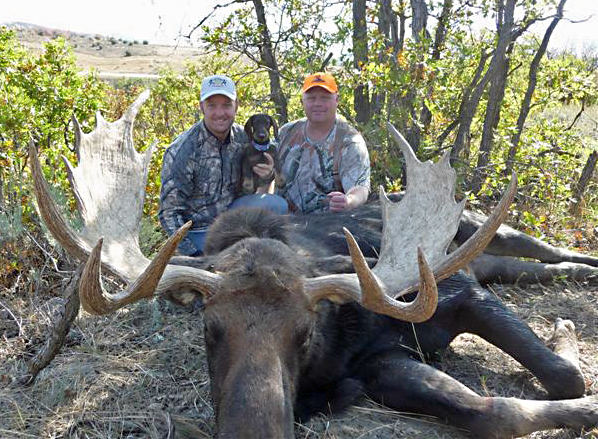
Remy was instrumental in recovering this record-sized moose
The moose in the photo did not go as far as that elk, but after the start there was no blood to work with. Justin and Remy had to track him through thick pines to move him out to where the hunter could get a finishing shot. Once the moose was dead there was a little trouble because Remy thought the animal was HIS and would not let the hunter approach. This is normal, especially for young males, but they have to learn to share.
Remy at the age of four months
The theory behind the early conditioning that Remy received is that very early stimulation of the rapidly growing mammal brain increases the density of neuron circuitry that is later used in mental activity. It has been scientifically proven, though extensive and expensive MRI research that this does work in human infants. This has not been scientifically proven in dogs; it is only a “probability”. There is interesting research, performed by Peter Hepper at Queen's University Belfast that seems to prove that very young puppies can be trained to recognize and like something, such as anise oil taste and smell, at a very early age. I admit that it’s a stretch to go from that to tracking wounded game.

Experimenting with the early conditioning theory probably isn’t practical for the breeder who has a litter of coonhound pups and is holding down a fulltime job. It’s too time-consuming. For a retired person, with more time and a special need to develop pups to their maximum potential, it may make sense. Certainly, it’s not the only way to develop an outstanding dog, but it’s worth thinking about. For developing dogs to do a specific task, like tracking, it has promise.

Below is a video of Remy tracking a fresh deer liver drag when he was ten weeks old.

Friday, September 17, 2010

A new litter of wirehaired dachshunds out of German hunting lines

On Tuesday, Sept 14, Melodie von Moosbach-Zuzelek "Greta" owned by Susie Gardner from Ohio whelped six puppies, five males and one female. Our FC Joeri vom Nonnenschlag is a sire of this litter.
Susie and Jody Gardner are outfitters and they have been using Greta for tracking wounded deer for the last three years. She is a very talented and accomplished blood tracker and proved her versatility in a number of tests. For more information about them and Greta click here. These are two pics showing newborn puppies.

If you are interested in a well bred puppy for blood tracking and hunting, Contact Susie directly at greta@buckeyeoutfittersofohio.com, 740-254-9156 or 330-260-7725. This is a very busy time of the year for the Gardners as their hunting season is already open.

A couple of weeks ago I received a very nice e-mail from Rosi and Anne Bauersachs from Germany. Rosi is Joeri's breeder. Last summer she repeated a breeding that produced Joeri, and we were happy to see his new sisters and brothers. I am going to include part of Rosi and Anne's e-mail here.

Our puppies are gone too – the last boy at the end of the last week. The names are Lotta, Luzie, Loisl, Lenz, Linus and Leopold.  Four of them live near to us. So they can visit every Monday “Welpenspiel” (= “playing time for puppies”) together. It is like an early education for the puppies and it has been organized by my mother for the last few years. They learn to socialize with other dogs (like larger dogs breeds) and people, and also learn to manage new environmental and social influences. It´s like a small agility park for the puppies. They have to go over different bottoms (wobbly, lattice-like, rough, slippy), they have to go through different tubes, over a seesaw and so on. The dogs who live in a hunting family are practiced in tracking. The puppies have also enough time to play together because they can use it as training for social handling. Our puppies are also very nose oriented like yours and we are very pleased with their excitement for tracking. All boys have two testicles and no puppy has a tooth displacement. All have short coat (but not too short) – the beard began to grow and they have enough hair between their pads of the feet and at the marginal part of the ears.
Joeri's brothers and siters from the 2010 litter.

Rosi Bauersachs with Jette, Joeri's littermate

Ilena vom Nonneschlag, Joeri's mom, is playing with her puppies.

Wednesday, August 11, 2010

How we evaluate dachshund puppies for blood tracking.

Recently a breeder who is raising his first litter asked me "Are there certain things you see in the pups that help lean the odds in your favor when picking a top quality pup?" Eight years ago I wrote an article on how we evaluate dachshund puppies for their potential in blood tracking - see http://www.born-to-track.com/our-writing/jola/evaluating-puppies.htm  I thought it might be useful to include a slightly modified section of this article here. The article is somewhat dated; now we start working with our puppies earlier. One thing has been constant though - we test our puppies at ten weeks and this way we can compare not only pups within a litter but also we can compare various litters.

A dachshund used for blood tracking has to have a good functional conformation, i.e. conformation that will allow it function well in the field and woods. The dog has to be able to track for several hours in a thick brush and briars and withstand the punishing cover well. The dog may have to go through streams and swamps, may be asked to track during rain or snow. Stamina and endurance go a long way. A good working coat is a big plus. The dog’s temperament is important because in many cases it has to track with a group of strangers (hunters) following. Other characteristics of great importance are desire to track, line sense, intelligence, concentration and focus, good nose, patience, courage, initiative and desire to please a handler. Tracking wounded deer is a team effort and a handler and his dog interact during tracking a lot. A handler may see some other signs that a wounded deer left behind (smears of blood left high on the shrubs) and when a dog is in doubt a handler will help the dog to figure out the track. Hence, a dog’s willingness to cooperate with a handler and its desire to please are not to be ignored.

It is our breeding goal to produce dachshunds that can function well in hands of hunters and trackers, but bear in mind that in a majority of tracking homes these dogs are also family pets. This is one of the great appeals of the dachshund to a hunter and handler – the dog can be so useful in the field and at the same time, it can be a cherished and beloved family companion.

Most dachshunds are very good with kids but there are some individuals with dominant and aggressive tendencies that should not be placed with families with young children. A responsible breeder will know his puppies and which ones are suitable to live with kids and which ones are not.
We start observing our puppies from their birth. All puppies have ribbons of different colors around their necks and this way we are never in doubt about “who is who”. At seven weeks, we perform the standard puppy aptitude test, which can predict temperamental tendencies quite well, but is not error-proof. We have had our share of surprises. We make sure that puppies are exposed to a wide variety of noises like a lawn mower, vacuum cleaner, hair dryer, blender, a whistle, TV etc. Once puppies are up and mobile, we take them for walks in the field and woods so they are exposed to a variety of natural scents. It is important that they are accustomed to heavy cover, wet grass, drizzle, and that they go outside when it is dark. A mild stress is beneficial at this stage.

We start to work our pups on deer blood early. Usually when we track for hunters, we end up with a freezer full of deer blood and deer organs (liver and heart). They are excellent for testing and training purposes.


Five-week-old puppies enjoying a deer liver
First, we thaw out the deer liver and we drag it across the lawn. The liver is placed at the end of line, which at the beginning is just about 20 yards long. We age the line for 15 minutes and then we test puppies individually. If you let all the pups come to the line in a group, there is just too much commotion, play and competitive racing. It takes time, but pups have to be tested individually. We score their performance on the scale from 0 to 10, with 10 being the best. We pay attention to such questions as:  
  • Is it nose oriented?
  • Does it concentrate or is it easily distracted?
  • What kind of line control does it show?
  • What working style does it demonstrate?
  • Can it finish the line without help?
  • How does it react to the liver or other deer parts at the end?
We do this kind of conditioning/testing around two-four times a week. Notes and records are kept on each puppy’s progress. The scent line gets longer and is aged more with every week. One can say a lot about the puppy by the time it is 12 weeks old, not just its natural tracking ability, but also its intelligence, focus, courage, sensitivity to noise, self control. At the end of the testing session we let all the puppies play with the deer hide and observe them as a group and how individual puppies interact within the group. We watch if the pup is possessive of the hide. Does it growl at other pups? Is it determined to claim the hide as its own or does it walk away from it under pressure from other puppies?

What kind of performance would we score as a ”10”? We would like to see an intense interest in the scent of deer blood. A puppy should be able to figure out pretty quickly that there is a line of scent i.e. scent leads from point A to point B, and be able to follow it. If a puppy gets off line, it should be able to correct itself and get back on it. We like a relatively calm and slow pup, not a speed demon that overruns its nose all the time. Focus and intensity are very important. A pup that gets very easily distracted by other things around and cannot focus on the track is a rather poor prospect. We like to see a pup showing interest and some aggressiveness towards the parts of deer left at the end of line. The pup that acts fearful or is turned off by them does not score very well. Not all good tracking dogs are intensely interested in the “find”. There are some that just love tracking and do not care much about what they find at the end of line, but they should not be afraid of a piece of deer hide.

Some pups are very precocious and at 9-12 weeks show an amazing aptitude. There are also some that, even though not precocious, show a steady progress. And then, occasionally, there are puppies that do not show any promise at all and in this case, we sell them as pets.

In a 2002 litter, one of the six pups was apprehensive when approaching the deer organs and hide, and even though he tried to follow the line, he was all over the place and was getting distracted very easily. At 14 weeks, we sold him as a pet and received a letter from the buyer few weeks later: "The last week with Gipper has been just great. He is eating well, playing boldly, and only showing occasional stubbornness on the leash. He takes to the water very well, and has seen and smelled his first deer. I think the only thing limiting his tracking ability is his concentration--he gets distracted very easily." Most likely, this lack of focus will stay with Gipper for a long time to come.

We keep in touch with the buyers and we get a lot of feedback on the dogs we have sold. This really helps to evaluate our breeding decisions. Since we, ourselves, can only work with few dogs at a time, we rely on what we hear back from the hunters. In many cases, we make a hard decision not to keep the best dog for ourselves because we know we would not be able to realize the full potential of the dog. Such a dog would be better off with a hunter, where it would be the only dog and would get a lot of work. In cases like this, we usually arrange to keep breeding rights on the dog and ask not to neuter/speay the pup.

The testing system described is not carved in stone; it evolves constantly. We have not invented it all by ourselves – it is derived from what we have learned from others plus our own experience. It has been serving us rather well. The records are also very helpful when it comes to planning future litters.

Related posts:
http://borntotracknews.blogspot.com/2010/06/liver-drags-for-puppies.html
http://borntotracknews.blogspot.com/2008/09/how-to-start-blood-tracking-puppy.html
http://borntotracknews.blogspot.com/2009/07/video-of-blood-tracking-wirehaired.html

Related videos:
http://jola.smugmug.com/Video-clips/Puppies-5-8-weeks-old
http://jola.smugmug.com/Video-clips/Puppy-training

Monday, August 2, 2010

Using deer liver drags for puppy training

Our puppies are now ten weeks old and soon will be going to their new homes. When the weather allows and it is not too hot, they get some preliminary training and testing on fresh deer liver drags. At the age of ten weeks pups are not ready yet for aged blood lines. It is difficult however to work them on the fresh blood as they stop and lick blood droplets or smears off the grass and ground. The advantage of deer liver is that it leaves a strong scent but no blood to lick.

Below is a video of Quentin taken yesterday. The scent line created by dragging deer liver was around 70 yards and had three turns. Quentin was very impressive - motivated and driven, close to the line, and very much interested in the liver. This is what we like to see.


To watch this video in a different resolution click here.