Search This Blog

Wednesday, July 24, 2013

Support the proposal to leaglize blood trailing dogs in East Texas

Reposted from kjas.com  (thank you Claire for the link)
by Steve W Stewart

The Texas Parks & Wildlife Department says they want public input on a proposal to bring back a currently illegal deer hunting practice of tracking wounded deer with dogs. The state agency says public hearings are planned, and if approved, tracking wounded deer with dogs could soon be brought back in 12 East Texas counties, something that has been illegal since 1990.

State officials say they will take the results of the public forums into an August 22nd meeting at TPWD Headquarters in Austin.

Currently, tracking wounded deer with dogs is illegal in 34 East Texas counties. Texas Parks & Wildlife says the rule was necessary because the department determined that dogs were being used unlawfully to hunt deer, which was causing depletion.

However, the state agency says that by 2000, they determined that the practice of using dogs to track wounded deer had declined to the point of being nonexistent in some of those counties, so they removed the restriction in 10 counties.

Texas Parks & Wildlife officials say they now believe the prohibition could potentially be lifted in Harris, Harrison, Houston, Jefferson, Liberty, Montgomery, Panola, Polk, Rusk, San Jacinto, Trinity, and Walker Counties.

The meetings will be held:

~ Tuesday, July 30th, 6:00 p.m., in Woodville at the Woodville Elementary School Community Room, 306 Kirby Drive.

~ Wednesday, July 31st, 6:00 p.m., in Lufkin at the Angelina County Courthouse District Courtroom, 215 East Lufkin Avenue.

~ Thursday, August 1st, 6:00 p.m., in Hemphill at the Sabine County Courthouse District Courtroom, 201 Main Street.

Officials also say details about the proposal, along with an opportunity to provide public comment, can be found online at

http://www.tpwd.state.tx.us/business/feedback/public_comment/proposals/201308_deer_dog.phtml

Comment may also be made in writing, and mailed to Robert Macdonald, TPWD Regulations Coordinator, 4200 Smith School Rd., Austin, TX 78744.

Lacy Dog is an official dog breed of Texas

Monday, July 22, 2013

This smart puppy has stayed on a right track


Ray Holohan, a United Blood Trackers member from Illinois, shared with us his recent experience. Here it is in his own words:

I thought I would drop you a line to share this peculiar training track I experienced this last weekend.

Saturday about 3:00 pm I decided to lay a short training track in my home timber for my new pup Ruffle "Ruff", early the next morning .  The track was 15 hrs. old and about  1/8 of a mile. We started down the trail, all was well, she was doing a good job when I looked up ahead and spotted what looked like a dead deer right on the blood trail. As I got closer it became quite clear that's what it was.

I thought to my self how should I handle this. I decided to let her find it and congratulate her with all the praise I usually do. To my surprise she walked up to the deer sniffed it. then sniffed her way around it and continued down the blood trail and found the hide and reward at the end.

At first I took this reaction as a negative but the more I thought about it, I think she knew that it wasn't the thing she was looking for, thus ignoring it and moved on. What do you think about this? After finding the hide I went and got my camera phone, took her back and let her back trail to the deer.

She seemed a little frighten, of the deer this time so I took a stick and got some of its blood from a damaged antler and let her lick and smell it, and she became quite comfortable with it. I wanted to make this a positive experience. The deer at first looked like a limb had fallen on it, it was wedged underneath it, but after a closer look I think it may had been struck by a car, probably on the highway about a 1/2 mile away and got that far before it died. I got a recovery tag from the DNR and was able to recover the blood and hoofs. Has anything like this ever happened to you or John?

------------------

Well, I thought that Ray handled the whole situations really well. Obviously he has a very smart and talented puppy, which was staying on a right track and knew that the deer did not "belong" there. She was intimidated by the deer, but that's completely normal for a young pup. 

Something similar happened quite a few years ago when John and I tracked a deer with two dogs, Alec and Sabina. John wrote about it in his book Tracking Dogs for Finding Wounded Deer.

"Staying  on the right  line, no matter what, is usually the most difficult skill that a tracking dog must learn. My old Sabina demonstrated how reliable an experienced dog can become:

My wife and I  tracked a buck together. On the phone it sounded like an easy one so we took one of our young wire males, Alec, who had  training but no natural experience. My wife handled  Alec and I handled Sabina behind as a backup in case the young dog had trouble. Alec did a pretty good job, trailed out past the hunter's point of loss and went on for another quarter mile without help.

Then came misfortune. Young Alec tracked right into a fresh gut pile, still warm. Alec thought the guts were better than nothing and he munched a bit. The hunters and the handlers were down-hearted for sure. They had called us and we had driven a long way; now it was all for nothing. Someone else had finished off their deer and dragged him out.

Then I  thought of something. There had been some grains of corn in the track on the way to the gut pile. They had leaked out of the deer. It was funny that there was no corn in the gut pile that we were standing  over. I took Sabina back on the trail about 50 yards and let her work the line; she tracked right past the gut pile, never looking at it. All concentration, she worked another 50 yards into some thick bush and there he was, the original buck, corn, guts and all."

Wednesday, July 17, 2013

Dog days of summer are here

What a hot and humid summer it has been! When we bought this piece of land 15 years ago we never anticipated that we would be using a small pond as much. Anyway, few days ago I read that so far we have had 10 days with temperatures above 90F (32C) so by now the number must be at least 12. And this is just a middle of July.

Joeri gets to the pond on a regular basis, and I thought that a short video would show his mobility 10.5 months after the incident with a herniated disc. He is not 100% yet, and he might never be, but for sure he moves around pretty well and he really enjoys himself. He has always been a a very special dog and it is deeply satisfying to see him living his life to the fullest.


Sunday, July 14, 2013

Summer days and sunsets, puppies, dogs, flowers, birds, moths and macrophotography

It has been a hot and humid summer so there is not much blood tracking training going on here right now. We have been working diligently with Mielikki's puppies, which turned 9 weeks old on Friday. Now 50 yard deer liver drags are too easy for them, and we will have to start working them on longer and more difficult scent lines. They are truly a great bunch and raising them have been a pure joy.

This picture of John mobbed by puppies was taken two weeks ago when our friend Dan came to play with the pups. I snapped the shot when John talked to Dan. It might be now my favorite picture of John ...ever.
When the days are so hot and humid we appreciate even more having a small pond not too far from the house. This picture was shot a week ago when we had a bunch of friends over and went to the pond around sunset.
Tuesday is now 15 months old. Last summer she did not show much interest in the pond. This year I took her there together with Bernie, who is a water-crazy dog. I thought that his enthusiasm might pull her in. I was right, she went in and now she learned that she can swim, and it is not a big deal. I don't think she will ever love the water the way Mielikki, Bernie and Joeri do, but now there is hope that she might actually get used to it. Every dog is different. Sky, Tuesday's brother, likes the pond and he has fun swimming and blowing bubbles through his nose.
I took this picture two days ago around sunset. Unfortunately this Mourning Dove had a reason to mourn as it lost its mate. The pair hang around the dog kennels for several weeks, and I thought that sooner or later we might have an accident. Well, it happened. I heard huge commotion, a lot of barking, and found one dove being munched on by Bernie. Bernie left just a few feathers. The remaining dove was sitting on the fence pole. I have not seen it since the incident, and I hope that it can find a new mate.
Summer sunsets in the Helderbergs can be stunning, like this one.
Yesterday I took a macro photography workshop organized by Capital Region Photography Meetup Group. I really enjoyed the outing and taking pictures at the grounds of Five Rivers Environmental Education Center.


I have never heard of Hummingbird Moth until yesterday. These are fascinating insects, they look like tiny humming birds, and their wings move so fast that they (the wings) appear, most of the time, invisible. This was a real challenge for my camera. I had to push ISO really high and then had to remove the "noise" in the picture. The flowers, called monarda/bee balm, were covered with bees and pollinating moths.

I hope you enjoy your summer as much as we do!


Monday, July 1, 2013

Videos of young dachshund puppies tracking fresh deer liver scent

By John Jeanneney


We use deer liver drags in our early puppy work, and we call it “early conditioning” rather than serious training. The scent lines produced by the fresh liver drags are easy for the puppies to follow and the puppies develop an enthusiasm to use their noses to find something good to chew on.


In early work on fresh, easy lines we prefer the liver drag to a fresh blood line. The liver leaves good scent but there is no fresh blood on the grass for the puppies to stop and lick instead of moving ahead. The pups also learn to identify the deer liver scent on the ground with the good chew on that same liver that we have left at the end of the line.

Deer livers are easy to collect during the hunting season. Most hunters seem ready to leave the liver for the coyotes, so I scoop it up, along with the heart, and carry it all home in a gallon Ziploc bag. I collect the blood at the same time for more advanced work.

There is some good scientific research to support this sort of early conditioning. When very young mammals, from human babies to baby mice, are stimulated in a certain way, the brain circuitry responding to that stimulation grows denser and more efficient. It’s possible, in theory at least, to improve future brain function beyond the level of simple genetic inheritance. This seems to work for us!


To see what our puppies have been up to go to our puppy journal at http://borntotrackpuppies.blogspot.com/

Friday, June 28, 2013

Hit Site Evaluation Seminars for Deer Hunters

By John Jeanneney and Andy Bensing

The Hit Site Evaluation Seminar is a new idea for the United States.  The goal of the Seminar is to educate hunters to better interpret sign at the point of impact and along the ensuing wounded deer trail. It’s important as an effective means of showing hunters how to interpret and deal with deer that have been shot outside of the quick kill target zone. Traditional hunter training programs don’t dwell on this subject, but in the real world deer do move just as the shot is taken. And bullets and arrows have been known to deviate from their intended course.

The center piece of the hit site seminar is a hanging road-killed deer. The idea originally came  to North America from France, and John Jeanneney first witnessed it in Quebec, Canada, where two of his French friends led a seminar on finding wounded deer. In June of 2013 Andy Bensing and John tried out an expanded version of this hit site evaluation at the annual United Blood Trackers Trackfest  at Arena, Wisconsin and then two weeks later at a North American Teckel Club event in Pennsylvania to which non-member deer hunters were invited. In both states the reception was enthusiastic. The seminar was certainly a departure from the usual presentation on the subject, and the practical applications of the new information were easy to understand.. Those who attended actively participated in the evaluations, and of course this is the best way to learn.

In both seminars a road-killed deer in good condition was used. Acquiring a road-killed deer is not difficult, but local game laws regulations should be consulted, and it must be kept in a suitable cooler or freezer before the event. The deer was  hooked up, in a standing position, suspended by a rope stretched between two trees. A plastic sheet was hung up about five yards behind the deer and extended forward  under the suspended deer. Its purpose was to catch hair, flesh and bone fragments  blown out of the deer by strategically placed  shots. Shots were taken with  bow and arrow, shotgun slugs and high caliber rifle bullets.

The hanging deer carcass was the centerpiece of the seminar.
After each shot the instructor and hunters together inspected the hit site and the hanging plastic sheet behind it to evaluate the results. The first thing that most of us have learned from the hit site evaluation is that we hunters miss a great deal if we inspect only the ground right where the deer was standing.

After the shots we found “sign” on the plastic sheet well behind the deer that  probably would have been missed by most hunters in a real deer hunting situation. It seems likely that many American hunters are not inspecting a broad enough area behind the hit sites as they look for the sign that will tell them where they have hit the deer and how they should deal with the situation.

One of the many things  hunters learn at the hit site is that flat sections of bone usually come from the legs; they are not “pieces of rib” as is often reported. They learn the difference in the amount of hair that comes from a grazing hit as compared to a solid, more straight-on shot. The physical results of high back shots can be shown and the identification of types of hair can reveal where the animal was hit.

Additionally bowhunters learn how the sloping surfaces of the rib cage can deflect broadheads so  that there is no effective penetration into the chest cavity and vital organs. They also  realize that the real kill zone is considerably smaller than what is presented  on 3-D Tournament targets.

The bowhunter demonstrates the risks of a head-on shot
The shot analysis outdoors on the hanging deer was even more effective because it was preceded by an indoor PowerPoint  presentation priming the attendees’ consciousness for what they were about to see outside.  Photos were shown revealing such “unexpected” information as the location of part of the stomach and liver within the rib cage. Other anatomical photos, showed the  kidneys lying quite far forward, just back of the ribs.  The indoor segment also discussed recovery strategies for deer wounded in different ways and under different environmental circumstances such as bad weather and predator competition.

The PowerPoint introduction to the seminar
The hit site program is effective because it is simple, graphic and deals with a real deer. It was so realistic in Pennsylvania that a young turkey vulture landed to check things out during  the introductory PowerPoint session.

Andy demonstrates shot placement
 The hit site evaluation seminar concluded with a “Walk in the Woods”.   Nine stations were set up to simulate wounded deer sign both at a hit site and along the trail. Seminar participants were asked to identify and interpret wounded deer sign such as splayed hoof prints, blood smears, bone fragments, and arrows covered with different types of body fluids and tissue.

The Hit Site Evaluation Seminars have great potential as an interesting half day event. No doubt the seminars would improve hunter effectiveness in recovering the deer that they shoot. For more information about the seminar contact Andy Bensing, abensing@pbkennels.com.
 
 Hunters who attended the seminar sponsored by the NATC.

Many thanks to the NATC, Kirk Vaughan and Joe Kopcok for the pictures!


Saturday, June 22, 2013

First day of summer brought a gorgeous weather

Summer has arrived "officially"! This spring because of our busy schedule and poor weather I did not take too many nature pictures so last morning I decided to go out with my camera no matter what. Our fields are beautiful now with the abundance of wild flowers. I hope to go out more often in the upcoming weeks. I was very pleased with some shots and might actually print the photographs and hang them in our house. A word of explanation is needed though for people who are not involved in photography. These days taking a picture is just a first step in creating an artistic image. Through digital editing you might end up with the image that does not resemble an original picture that much. Some call it cheating. But photographers have always manipulated images through the use of filters and various darkroom techniques. Now digital processing takes it to a completely different level. So the below pictures were enhanced, especially colors and texture, but nothing was added to them or erased. I like the outcome and hope so do you.


Thursday, June 20, 2013

Happy 14th Birthday Asko!

Fourteen years ago FC Asko von der Drachenburg, V, SfK, VpoSp, Laut Jager was born in Germany and he was bred by Steffen Matthai. We picked him up in Germany when he was 3 months old. Of all the dogs we have imported in the last 15 years Asko made the biggest impact on our breeding program. Now at 14 he is still very much a playful puppy, now with some gray hair. Happy Birthday dear Asko!


Last day of spring

It was a beautiful day!


Wednesday, June 19, 2013

Blood tracking dogs become legal in Ontario

Residents of Ontario, Canada have a reason to celebrate as tracking dogs became legal there. Thanks to Joe Kopcok for the news:

Hi John. I met you in Wisconsin. My Name is Joe Kopcok  and I have Slovensky Kopov dogs. Just wanted to let you know that Ontario has legalized the use of tracking dogs. I called Ontario Federation of Anglers and Hunters to see what was going on with this legislation. I spoke to Mark Ryckman and he had told me that the OFAH Big Game Advisory Committee and the Wildlife Policy Section of the Ministry of Natural Resources had a meeting on May 31. The OFHA was advised that there was an amendment to the Environmental Bill of Rights with regards to use tracking dogs for big game retrieval. This is wonderful news. Dogs must be licensed, and all normal rules are to be followed (hunter orange valid big game licence etc.)

More info at
http://www.e-laws.gov.on.ca/html/source/regs/english/2013/elaws_src_regs_r13171_e.htm

This is GREAT NEWS!

Tuesday, June 18, 2013

Von Moosbach-Zuzelek dachshunds at the NATC Zuchtschau

I have only few minutes to write this post so I know that we will probably have several more posts about North American Teckel Club events, which took place on June 13-16 in Reading, PA. This one is about Sunday Zuchtschau, which was judged by a Wolfgang Trumpfheller, a conformation and hunting judge from Germany. "Von Moosbach-Zuzelek" dachshunds were represented by two 14-month-old litter mates Theo and Tuesday.

The two pictures below show Theo who is owned by Darren Doran from New Jersey. We have written about Darren and Theo several times already. At this early age he is already an accomplished dog. Few weeks ago he passed a Deer Search 20-hour blood tracking test with Prize I performance. On Saturday he passed a gun-shyness test and Water Test. And on Sunday he received "Excellent" rating at the Zuchtschau. Judge Trumpfheller gave him quite a few compliments. Congratulations Darren, we are so grateful for everything you have done with Theo.


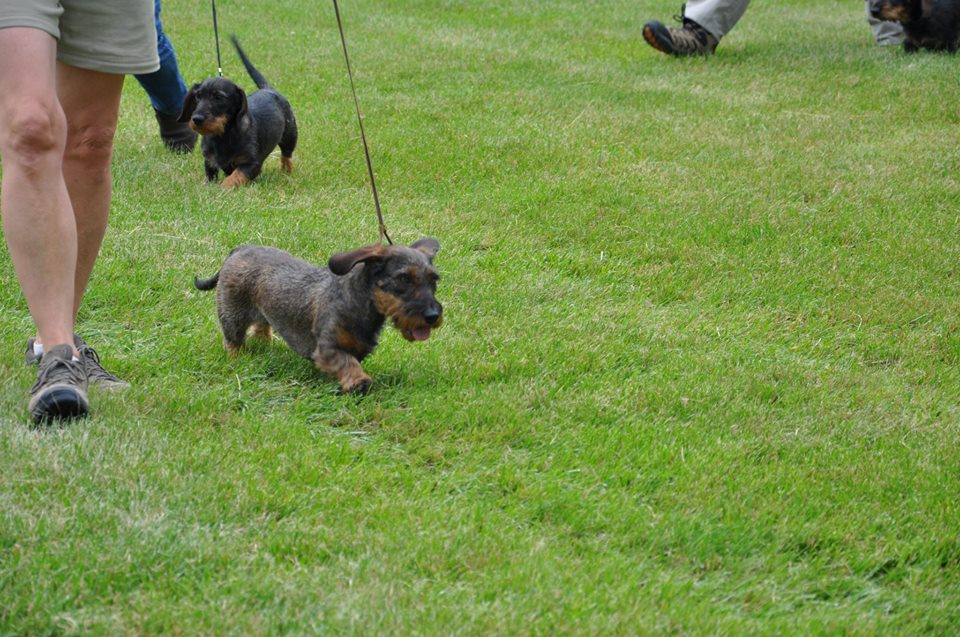
I showed Tuesday, and I did not handle her too well. Her gait in the pretty high grass was not that great. In spite of this she also received "Excellent" rating. In my opinion her weakness is in her somewhat roached topline, so I was surprised to read on her evaluation form the judge's comment "straight topline". The picture below shows Tuesday when she was in the ring with other "excellent" wires at the end of the show. She is the second dog on the left.


A big thank you to Patt Nance for taking pictures of Tuesday at the Zuchtschau!
Jolanta (me) handling Tuesday in the show ring.

For those unfamiliar with the FCI system of dogs shows and evaluations, this is a certificate I received for Tuesday at the end of show.

The evaluation form shows her weight 7.9 kg (17.4 lbs) and chest circumference 39 cm (14.4 inches). It also shows other traits that a judge evaluates.
Since Tuesday and Theo's brother Sky was "Excellent" and Best in Zuchtschau last year, it looks so far like the breeding of Paika (FC Paika v Moosbach-Zuzelek SW) to Moose (FC Nurmi von Moosbach-Zuzelek) produced some really nice looking dogs for the field.

To be continued....

Thursday, June 13, 2013

Urgent! A young Bavarian at a Georgia shelter needs to be rescued NOW!

This came through Facebook and I am reposting it. To me it looks like a young Bavarian Mountain Bloodhound. The message next to the picture says:

Sweet Mona's time is up tomorrow!! Help! We had someone interested but we haven't heard back from them so we are so worried about this sweet girl. She's young, well mannered, gets along w all dogs, very gentle. She's available and urgent at Jones County Animal Control in Gray, Ga. 478-986-1427 - 395 Eatonton Highway. M-F 9-1; sat 9-12. Serious inquiries can email us at jcacdogs@yahoo.com. We can arrange transport anywhere.

UPDATE: It looks like Mona's owners found her :-)


Monday, June 10, 2013

Trackfest through the eyes of a new UBT member

Many thanks to Willette for this great report from Trackfest.  
By Willette Brown

As I waited for my turn to run my UBT II test track, I reflected on the last few days… The three of us had driven with five dogs from Maine and New Hampshire, a twenty plus hour drive. My friends,  Joanne and Susanne, are experienced trackers with all the stories to prove it.  I am a neophyte with a handful of tracks, (a few "finds" I might add), and lots of mixed emotions. I complain about my ankle, I worry about bears,  I'm not really fond of blood or you know, the other stuff, and having been a Bambi lover in my early youth, I struggle a bit to find the unequivocal "go ahead".  I guess my prey drive is a bit on the weak side.  But I have this totally awesome dog, and when I watch her work my pride is bigger than all of my misgivings or fears and all I want is to understand her more deeply and help her become the best she can be.

So... I loaded up my gear and chimed in a story or two as the miles fell behind us.

The testing morning was cool and sunny, the fields were heavy with dew (good scenting), and the view from the hill was spectacular. Green fields rolled away to deep woods for 360 degrees. The first dog was down and working beautifully.  He was slowly and deliberately crossing the field and approaching the second check.  The hay gently swayed as he moved and all I could see was the white tip of his tail above the timothy.  My confidence wavered. Would I find the two beds? Would I see the blood spots after 20 hours overnight? Would we make at least two checks?   Would I even be able to read her, or for that matter, believe her? "Trust your dog" I keep repeating to myself, we have learned that over and over all weekend.

For two days we have shared more information than I think I can possibly absorb about training and tracking.  I am awed by the collective experience that I am in the company of.  John Jeanneney, who is a walking encyclopedia, would probably pop up first if I were to google "tracking wounded deer".  He is so generous with his knowledge and has so much depth of experience that I find myself hoping new questions will pop in my head so I can get as much out of him as possible.  I am certain that there is no question he can't answer.  Andy Bensing, a tornado of a person,  is intuitive and confident. He  truly "knows" how to  read dogs and train their handlers. This is a gift that he has maximized in every way.  He tries to stuff as much information as he can into our heads as the weekend unfolds.  I  briefly worried that he may use that e-collar on me if I'm not careful, but as it turned out, Andy was a steady, supportive guide for me and my dogs.

Other speakers were equally informative. Larry Gohlke, whose stories of how to jump on a deer made us laugh (and mentally weigh ourselves), demonstrated a wealth of knowledge and experience hunting, tracking, and training.  He is the "go to" guy for anyone looking for encouragement and an extra pair of hands. Alan Wade led the talk for tracking equipment. Lights, GPS, and other essential tools for trackers to use… it is also worth mentioning that he did a demonstration with a spear (a spear, who knew?) that would be coveted by a Masai warrior. And, channeling Martha Stewart, Cheri Faust showed us how to process, store, and use blood for training.  I was relieved to learn that she kept a special blender just for that…I suspect that the handouts, the schedule, the food, and the speakers were all organized by her as well. No detail was missing.

Each day was well balanced with lots of hands on work.  We practiced pacing 100 yards,  then laying 300 yard lines, and then after a couple of hours ( and a good lunch) we put our dogs down on the lines.  My young dog needed a lot of encouragement to stay focused on the line. I think he was looking for rabbits at first,  but Alan, our instructor, patiently helped him find his way around the track.  My older, more experienced dog went the next day and Andy picked an exercise for her to help her focus on the task at hand.  I have never felt her pull on the end of the line with such confidence and certainty.  And a big thank you to Chris who sat in the brush and waited for her to find him and a particularly stinky lure.  We learned our weaknesses (many) and our strengths (a few) and we learned what to do to make our partnership better. It was obvious that the trainers had all shared what they observed from the first day and worked to make the second day really productive.

My friend, Susanne Hamilton, was also judging and teaching. She has endless energy for sharing her time and knowledge about tracking, and she has a "No Deer Left Behind" policy that makes many hunters here in Maine tip their hats in admiration.   She was either roaring off in a Gator to teach,  laying lines, or most importantly, posing for pictures with her legendary tracking dog, Buster.  (Truth: Buster was a bit bored with all the paparazzi and genealogical connections.  He simply wanted to get out there and track SOMETHING). Chuck Collier, also a judge/trainer, and Susanne took a bunch of pics of their dogs together.  Chuck's dog, Moose, is a famous tracker himself, and a son of Buster.  I think they were comparing conquests… or at least their owners were.


 Now it was day three, testing day. I watched Kirk, "Hound on a Rope" Vaughan, working his dog, and I knew that he was a handler whose heart beat straight down the rope and into his dog.  I felt humble and awed, and not a little out of my league. I listened as Cheri gave Kirk a wonderful recap of his test.  It was clear to me that she had truly observed their working relationship and was able to offer a constructive, thoughtful critique.  His pride in his dog was evident. And his smile was as wide as the field we stood in when she said he passed with flying colors.


After a truck ride to a remote field, it was time to run my dog, Quilla.  I brought her up to the start, listening carefully as my judge described the point of loss.  As I put her down and directed her to "find it," there was barely a split second before she leaned into the leash and began to work. No time for me to be insecure.  "At YOUR pace", Andy's words, were in my head. She took me forward, past the last flag and on to the unmarked track. "Look for confirmation," I thought, and there it was!  I noted it to the judges following me and kept going.  I glued my eyes to the line that Quilla was working. She yipped quietly every so often and I knew ( I knew!) to look more carefully there because she was telling me "there's a spot!"  Down the road we went and eventually after some looping at the first check (including her climbing up a bank that I was pretty certain no one would have laid a line on) we went down into the field.  Then the first bed appeared, YAY!

My confidence began to grow. More blood, here and there, then the second bed emerged in the tall grass. Wow, what a thrill!  What an awesome dog!  My heart rate increased as I realized that she was dead on, still certain, and still moving with that perfect pull on the line.  Before I knew it, we had arrived at the end, and I was surprised to feel a bit disappointed...finished already? I leaned over and lavished praise on Quilla. When we got back to the truck, Andy said, " If that test had been in Germany your dog would have gotten a 100. It was a picture perfect track."  Now it was my turn to grin from ear to ear.

After the testing was finished we sat down to a late lunch and I asked Kirk, who had driven 17 hours from North Carolina to be at Trackfest,  what he thought about his experience.  He said, " I feel like I have a whole new family!"

I couldn't have put it better myself.

This picture of Quilla was taken at a field trial a couple of years ago.


Wednesday, June 5, 2013

Joeri's first trip to the pond this summer

Most of our regular readers remember Joeri's problems with his back. Now six and a half months after his second incident his movement is still deficient. He is very mobile, that's for sure, and pain-free. But his topline looks sometimes like his back is broken, and his right hind leg does not have a normal range of movement. We carry him up and down the stairs. I don't think he will be tracking again because with as many dogs as we have it is not necessary for him to do it. We would not want to risk another relapse. However, he is a very happy dog, with a great attitude, and today he really enjoyed his first trip to the pond. He loves to retrieve from the water, and I think we are going to have a lot of fun together this summer.


It feels like summer is here.

Tuesday, June 4, 2013

Trackfest 2013 was a good opportunity to learn from old timers, network with other handlers and test your blood trailing dog


I am sure that we will have a more formal report from Trackfest 2013 held by the United Blood Trackers in Arena, Wisconsin on June 1-3. John was there on Saturday and Sunday. From the feedback that participants have left on Facebook it sounds like it was a very successful event. I am sorry that I had to miss it!

Sunday, June 2, 2013

The bond of natural love: Mielikki and her puppies


Mielikki and her puppies are doing really well. She is a terrific mother, and her puppies are thriving. For updates on Mielikki's puppies go to our puppy journal at http://borntotrackpuppies.blogspot.com/

Thursday, May 30, 2013

Wirehaired teckel puppies out of European hunting lines


It is not easy to get a dachshund puppy bred out of European hunting lines. If you are looking for one, you are in luck as Ed and Barbie Wills from Concord, NH, have a male puppy available. The parents of the 24-day-old puppies are FC Viola von der Hardt-Hohe, JE and FC Bernd vom Ahorn Wald, ME, CGC. This is the third and last time that this breeding has been done.  It has produced very good trackers in the past. Ed and Barbie are hunters and trackers, and they are also members of the United Blood Trackers. Ed was instrumental in legalizing blood tracking in New Hampshire. You can reach Barbie and Ed by e-mail at kmteckels@comcast.net

Saturday, May 25, 2013

Adventurous Chihuahua Penny finally gets reunited with her family after 17 days on the run: part 2

Continued from the May 21 post.

The phone went quiet again but late on day 11 and early on day 12 there were two sightings close to each other in an area that made sense.  The day 11 sighting sounded very reliable and upon checking it with Eibe it was very easy to confirm.  When Eibe crossed the exact spot the dog was reportedly seen the night before she whipped her head and took off like a rocket.  With that sighting confirmed I directed Penny’s family to concentrate their search and public notification efforts in that area, which paid off with two more sightings on day 14 and 15 less than ½ mile away.

The day 14 sighting witness called in right away, and my wife and I were on site within 45 minutes.  We actually saw Penny along the side of the road on the way there.  My wife got out of the car and followed her and got within 15 feet of Penny but then she just took off.  After Penny ran off I put Eibe down on the trail just 10 minutes behind her.  But  two hours later after 3 ½ miles of tracking in the pouring rain without ever seeing her again it was obvious we were not going to run her down.

Yes, that really is a Teddy Bear behind that Blood Tracker!
Penny was spotted again the next day about 200 yards from where my wife originally saw her so at that point I set up a feeding station in the area with a game camera in hopes of eventually trapping her in a live trap.  Unfortunately, she left the area after that and the next place she was spotted was two days later on day 17, 2 ½ miles away on the other side of town just before dark.

Feeding station monitored with a trail cam set up in the area where Penny was sighted three days in a row.  Note live trap on left.  The door is wired open until the dog feeds regularly at the station and then the food is moved inside the trap.  Unfortunately Penny left the area after the feeding station was set up.
The next day, on day 18, I went out and confirmed  the previous evening’s sighting.  This was a really good sighting with very reliable witnesses.  Penny was seen casually walking up a grass strip along a school football field she wandered into.  The witness was aware of the missing dog from a Facebook posting and the Neon Posters we had blanketed the area with.  As the witness was slowly approaching the dog, it wandered into a neighbors unfenced yard. The neighbor really hates dogs, and he came out and angrily chased the dog. Penny ran up an alley and into a college campus.  I mention all this because the accurate information about the dog’s course and behavior allowed me to confirm for myself my tracking dog's actions.  As I worked Eibe to confirm the sighting, it was crystal clear that my suspicion  that scenting on these lost dogs changes according to their emotional state was correct.  When Eibe engaged the line where Penny was casually walking the night before, Eibe began tracking at a normal speed but when she hit the place where the dog was chased by the neighbor, she became excited and much more animated.  I thought I was seeing this in the previous tracks where she crossed busy streets and likely was chased but this confirmed it.

I first learned of a tracking dogs ability to interpret its quarry’s emotions and physical state while accompanying professional blood trackers in Germany several years ago.  My dog Eibe began to develop this ability this past fall in her 4th season tracking wounded deer.  There were some deer that we tracked that she began to realize were not gettable due to the minimal nature of their wounds and I believe the nature of their stress levels as we pursued them.  The deer being minimally wounded could easily stay in front of us and Eibe would notice this lack of fear scent and actually stop pursuing them.   From previous experience she could tell that they were not injured enough for us to catch up to.  Now I was seeing this same behavior in tracking lost dogs.

With the day 17 sighting so reliable and confirmed I directed the family to re-center their efforts in that area and after hours of searching and re-searching the neighborhood the next day, the owner’s son spotted Penny on the last pass of the day.  He chased her several blocks but this time she went to ground under a porch in a crawl space instead of just keeping on running.  Most likely tired and getting run down from 19 days on the lamb.  He got bit by the now 4 ½ lb. Chihuahua when he crawled in and tried to grab her but he eventually scooped her up in his coat and the saga was over.

Final map of the Penny case.  Red flags are neon posters.  Green flags are sightings.  Yellow dotted lines are places we tracked Penny or confirmed sightings.
This aerial map of the 3 ½ miles in suburban neighborhoods that we tracked Penny one day in the rain but could not catch up with her.  We started only 10 minutes behind her. 
As you can see there is a lot more to tracking lost pets than tracking wounded deer, but if you are a tracking addict like I am I highly recommend you give it a try.  The satisfaction you get will equal that which you get in the deer woods and the joy of the reunited dog owners is unsurpassed.

Penny happy to be home and her owner very grateful to have her back.


A week after Penny was back home I was invited to a welcome home party for family and friends who assisted in Penny’s recovery.  When tracking deer for hunters I have been invited back to do some hunting but I have never before been invited to a party where the dogs wore hats!