Search This Blog

Showing posts with label den work. Show all posts

Thursday, October 4, 2012

Garmin's outings: Development of a young hunting dachshund

I know, I know, just when you expected a report from another blood tracking adventure we have something different here, this time from Teddy Moritz. It is an article about how she goes about developing a young hunting dachshund Garmin and how she adjusts her training methods according to the young dog's temperament. Well worth reading as it has broad applications.

On the other note, a big THANK YOU for all the submissions for the blog. We really appreciate them. This is a very busy time of the year, and our hands are full. We will be posting as quickly as we can, but sometimes there will be a delay, and sometimes there will be 2-3 articles/reports posted on the same day. Above all we want the blog to be educational and interesting, so we always welcome reports that allow all of us to learn something new. Also because of the time constraints, the less editing I have to do, the faster the post will appear on the blog. If I have to pull info from various sources, like Facebook and several e-mails, that usually takes more time.


Garmin's Outings by Teddy Moritz


Garmin is a two year old miniature longhaired dachshund, about eight pounds with a 13 inch chest. She runs rabbits for me in the winter, and trees squirrels as well. She's a pretty good hole dog but lacks a certain amount of confidence, which I believe is an inherited trait. I know her sire and dam, and both are dogs who are happier when told what to do rather than think independently. Those traits are not a bad thing, all around, making the dogs very voice-controlled and obedient but also less likely to be the ones out and about finding game. Despite raising Garmin from about 9 weeks, she shows her sire's "please give me instructions" attitude. Not always, but enough that I have started taking her out alone, even leaving the lurcher home. If he's along she'll look to him for game. She does hunt out and knows where to find game but isn't quite the A-team.

In hunting her by herself I have seen an improvement in her earthwork. She's fine on rabbits, she just needed some confidence doing earthwork on harder quarry. Last spring she did confront and bolt a vixen in a natal den, taking a bite and coming out looking surprised. She went back in and moved the fox till it bolted. Garmin is by no means a hard dog but she'll stay with her quarry if it is in front of her. However, when I used her to dig groundhogs she would give up if the chuck back-filled  a lot before I could dig to her. With this hot dry summer the ground was very hard and I sometimes just couldn't get there.

Recently Garmin and her kennel mate Bane got into a quarry under a pile of very long, thick telephone poles. Bane moved it more than Garmin even though there seemed to be several tunnel openings. I heard Bane growl Garmin off a few times, which did nothing for her confidence. Finally Bane cornered the quarry under a buried telephone pole, which was weighted down by several more poles. I wasn't able to dig to the quarry nor was I able to bar the poles off the area. The quarry was apparently in the back of a slightly wider portion of the den so the two dogs could work side by side. From the growling I knew we had a possum. It had been awhile since the dogs had seen any earth quarry so I let them work  it. It was good to hear the dogs in a confrontation. The lurcher was with us and he lay nearby waiting for some action.

After awhile I cleared the dusty, sandy soil away from the entrance and could see Bane working the possum. I could hear Garmin but didn't know quite where she was in the den. That precluded any thoughts of shooting Ol Smiley, which I really didn't want to do. It wasn't doing any harm to crops where it was and I don't like killing something I can't use for meat for the dogs. I cut through some roots and then ran my trowel next to Bane. When I touched the possum both dogs grabbed hold and began pulling. I think Garmin was pulling against Bane so not much happened except the possum kept growling. Eventually I could see the possum's foot and helped Bane pull it. By then it had 'sulled' and there was no fight or growling. When I slowly pulled the possum out Garmin was attached to it as well. I think this work was good for her as I let her work and Bane didn't keep her away. Sometimes if Garmin doesn't stick with her quarry I'll pull her out and let Bane work it. That surely isn't good for her confidence but I am always anxious to get to the quarry.

Next time out Garmin bayed a groundhog I saw run in. This den is a difficult one because it is under a heavily trafficked farm road, basically compacted clay. The road drops off about ten feet to a railroad track. The ground under the clay is very light sand and there is one den opening at the bottom of the slope. The groundhog also had an entrance at the edge of the road. It was a tight opening because someone had shoved a big limb into the hole. Garmin squeezed her way past the wooden obstacle and began barking. I let her work because I've lost chucks in this den before. Her barking moved to the middle of the road but at two feet. I thought I ought to be able to dig that much. I started to dig and bar met very, very hard clay. Meanwhile my noise moved the groundhog a few feet further along, and Garmin's bark and the locator collar indicated her whereabouts under ground. Then she shifted to the bottom den opening and I alerted the lurcher, who was resting in the shade of the car, the day being very sunny and hot. He went down to the hole, sniffed and came back up. I heard Garmin bark near the hole but then her barking receded back up the slope. No bolt today.

I found her again and pounded and dug and pounded and dug, feeling as if I was making no progress at all. Very frustrating. Garmin came out once or twice, coated in yellow sand. She would sniff the hole down the slope then re-enter the top hole. I got the feeling the groundhog was walling her off or going deep, burying itself in the sand. After awhile I took a break to get some water and Garmin came out again. I let her wander around and gave her water also. The she went down the slope. I waited awhile and didn't hear her bark so I got out the locator. I couldn't get a signal so  presumed the groundhog had indeed gone quite deep, off the box. I turned the box to search mode and still couldn't find the dog. I looked along the rest of the slope thinking perhaps the chuck had bolted and she was in a different hole. I walked along the edge of the roadway and used the locator but got no signal. Had the battery gone dead in the collar?

Suddenly I heard a yip from across the railroad tracks, in a thick bit of brush, trees and briars. I saw Garmin come out, her tail wagging and her nose down. She trailed back into the briars, gave some more yips. I knew then she'd given up on the woodchuck and was running a rabbit. At first I was disappointed but since the digging was so difficult and I was making no progress, I had to laugh. Garmin knew we weren't going to get the varmint and since she likes to run rabbits she left me to my worthless efforts and went and found herself some quarry that ran and left a nice track. I let her run for awhile as hawking season is approaching and she needs practice on cottontails.

On another day I took Garmin to a big woodlot bordered by peach orchards on one side and a river on the other. Squirrel season is open and I know Garmin will tree the bushytails. The leaves are still thick on the trees so seeing a treed squirrel isn't easy. Basically I just wanted to again work Garmin alone. She did a good job of hunting out through the trees and swamp and barked tree once but the tree was full of holes so no squirrel was on the outside. We even bumped a deer but Garmin is so soft I yelled at her and told her no and she came off the deer right  then. Running deer will just get a dog killed as the deer often go right to a road.

As we came out of the woods there appeared a three hole den right at the edge of the woods. Hello! Garmin indicated one hole and barked into it. Good enough. I called her off and walked her to the car. I drove back to the den and let her go in. She soon was barking and digging. I located her and the den seemed to curve right back to one of the openings. I quickly shoveled it full of sand since I only had the shotgun and not the lurcher. If the chuck had bolted it would have been gone to another den. I dug to Garmin after I cut away greenbriar and shrubs. There were lots of roots to cut away as I dug into the soft sand. Garmin kept going each time I opened to her and each time I cleaned away the roots. The last time she moved up I heard a lot of growling from the quarry. I thought I was digging to another possum. However, Garmin kept moving sand back, as if something was backfilling. After one time I opened to her there was a wall of sand and roots ahead of her. She came out and wandered off, as if she felt she had lost the quarry. I let her go and waited. When she came back I encouraged her to re-enter and she did. I had cleared the den while she was off thinking and she smelled her quarry and began digging and barking again. It was as if she decided she could do this with my help.

The den went a big deeper, running under one of the exits so I had more digging to do just to get to the the den. I barred and found it, then opened to it, cutting roots and using the post hole digger to clear the sand. I guess I got to the quarry because Garmin forced her way up the tunnel and really began barking. The growling continued. I decided to shoot the quarry rather than dig another hole. I put the .22 to use and the growling stopped. Garmin slid up the tunnel, barked a few times then began tugging. She pulled and yanked and bounced up and down in her efforts. I let her work, feeling she had earned this reward by staying with the quarry after all. I then saw the back toes of the critter and I took hold too. It was a big groundhog and it wasn't quite dead so Garmin and I pulled it slowly out and I administered some more lead. Then I let Garmin pull it all the way out. It was a very fat, heavily furred groundhog. I let Garmin chew on it a bit and of course took a hero shot with the camera. I was pleased that she stayed with the quarry after one mental setback. I think she will continued to stay at back-filled walls know that she better knows I will help her and that she can succeed.

Friday, April 16, 2010

Den work as a school for character - Gerte's Day

I heard from Teddy that she got some really good e-mail response to her piece on digging woodchucks with dachshunds. I think it would a good idea to follow her article with the one that John wrote in 1997. In his introduction to his article he said:

"Our standard wirehaired dachshunds specialize in tracking wounded deer and at 20 pounds plus most are too large to be practical on foxes and woodchucks unless they work with a mini-dachshunds or small terrier that can get right up to the quarry and bay it. Still I do some hunting underground with the standards, because I find that the bonding experience that comes out of this is important for close dog handler cooperation in other types of work.

Underground work can also be a test of character. The great French blood tracker Hubert Stoquert once told me: "I want my tracking dogs to be willing to go head to head with a fox underground. A dog like that won't be afraid to push a wounded wild boar." I learned from my experiences with my old tracking dachshund Max that work on underground quarry can also be a school for character and even a form of shock therapy. Let me tell you the story of Gerte vom Dornenfeld, a wire dachshund bitch of about 17 pounds and you be the judge. "

Gerte vom Dornenfeld and Fausto del Grande Futaie (1993)

Gerte's Day
by John Jeanneney, 1997

Gerte vom Dornenfeld was what modern day teachers call an underachiever. Her gifts were everything her breeder Frau Lore Schlechtingen could have hoped for: intelligence, nose and desire. But, for reasons not clearly known, Gerte did not put all this together. A catalyst was missing.

The problem did not emerge right away. As a young dog she tracked and found two deer in situations of respectable difficulty. She also knew how to charm and for a long time her social gifts covered up her failures in the field. She could carry on little barked "conversations". Her personality was especially admired at my university office and at the veterinarians. But Gerte was bred to be a blood tracker not a party girl; we wanted her to live by the stern code of the bumper stickers on the battered pick-ups: "when the tailgate drops, the bull shit stops." In the stern, rough world of deer hunting it is not enough to "sparkle".

In her second and third years we tried to bring Gerte along carefully. When you are developing a young dog, you try to select calls with well defined scent lines and a high probability of success. If you can help it, you don't put a young dog down on the wild goose chases where the deer may or may not have been hit well, where the dry leaves and scent are blowing around in the wind and the dog has nothing very definite to work with. I used old Max for these uncertain situation calls. Princess Gerte got the "dead deer for sure" calls on which she looked composed, competent, even stylish. She showed us everything but the deer. In frustration on five different calls I hiked back to the car and got old Max. And old Max, fumbling and bumbling on in his "Detective Columbo" style found the five wounded deer that Princess Gerte had missed. It took me longer than it should have to figure out what was happening.

There seemed to be a pattern. Gerte would start out well, but within a half mile she would make a check and then start working another line. It would be a real line, an old deer line, but not the scent line of the wounded deer we wanted. We would methodically track another mile, working checks, following deer runs, going where a deer would go, but there would not be a drop of blood and the deer would never bed down.

When all this dawned on me, I knew that Gerte's "mistakes" were not mistakes, but quite deliberate. Back-up dog Max, with less nose and less brains, would pick through Gerte's checks with little difficulty and show us a line headed in a different direction. Eventually he would show us the deer. Gerte was too intelligent and too fine-nosed to unconsciously change to another line in such a situation.

I could only speculate about what had gone wrong. Maybe Gerte had become deer shy. I have known one blood tracking dog that tracked ghost lines to avoid confrontations after one scary encounter with an angry eight pointer. There had been no similar incident in Gerte's life, but she seemed to be "blinking", as the bird dog people, say when a pointer deliberately ignores bird scent to avoid failure and reprimand. Something had turned Gerte off, but I could not put my finger on it.

I had other dogs that could do the job, so after her five failures Gerte stayed home. She went to field trials where she seemed to model her behavior after the old nursery rhyme:

There was a little girl who had a little curl
right in the middle of her forehead;
when she was good she was very, very good
and when she was bad she was horrid.

She was usually "very, very good" on hot, dry days and "horrid" on damp, easy-scenting days when faster, more aggressive dogs dominated her.

From age three to age seven Gerte got few tidbits of recognition. She was not abused, but she clearly sensed that dogs and humans did not take her too seriously. Among our adult dogs she settled to the bottom of the pack hierarchy. She could still turn on her social sparkle, but she seemed a little brittle and desperate. In the house she languished with the sad air of a European aristocrat exiled in a raw, cold country where no one understood her. Here a good animal psychologist or a handler with more time and fewer good dogs to rely on would have given Gerte more support. Instead, things just took their natural course and circumstances led Gerte to cure herself. The cure might be called "shock therapy" but no one planned it that way. This is how it came to pass on Gerte's Day, November 22, 1995.

The adventure began with no dogs present; I was deer hunting with a friend on a large cattle farm. We hunted by making short drives to one another through small draws (valleys) of brush and briars. I flushed a red fox and my friend shot it with his .22 caliber revolver since he did not want bisect to it with a heavy deer slug. The fox seemed hard hit but it struggled to a nearby den and escaped. We returned home and brought back Fausto, a twenty-four pound male and Gerte. I expected that Fausto would have the simple work of retrieving a dead or weakened fox. Gerte, smaller and somewhat less aggressive, was held in reserve in case the den proved too tight for Fausto.

The den was indeed too tight for Fausto. He did make contact with a fox and was bitten, but he could not counterattack because a rock prevented his advance. We dug down ahead of Fausto, only half a yard down, and there was the fox which Jim shot with his handgun and I drew. It was a vixen and not the right fox; there was but a single bullet hole and she was a lighter color than the original wounded fox.

There had to be another fox inside somewhere, but the den, with its single modest entrance, was actually more complex than I had thought. There were at least two long horizontal galleries, and also a near vertical pipe plunging down five feet to another level. I suspected that the wounded fox was down deep on the second level which would be very difficult to access. Everything was too small for Fausto, so I entered Gerte to verify where the second fox had gone. Gerte was not interested in the steep dive down to a lower level, and quickly located and bayed the second fox out at the end of one of the horizontal galleries. We dug down to the entrance of a regular chamber or Kessel and opened things up to see Gerte baying furiously right in the fox's face. She had taken a good bite across the top of the muzzle, and didn't seem to notice. She was not up to throttling the fox, but she had certainly held him at bay and prevented him from escaping to a safer part of the den. The fox was actually in pretty good shape; when he bit my well-gloved hand he had excellent jaw power. When we finally exposed and shot him, we found that he was wounded in the rear in a way that would not have killed him for a long time.

I was surprised and pleased at Gerte's performance, but this was just the beginning of her heroic day. While we had been digging the foxes, two of the deer hunters on the farm, the Lynchs, father and son, drove by on one of the internal roads. They helped in the digging and the father reminded me that I had found a deer for him nineteen years ago with Clary. His son had just wounded another deer, had tracked it several kilometers and then had run out of blood trail and lost it. Would I find it for them? They felt that the buck could not go much farther since it had lost so much blood.

Gerte was tired, but she was right at hand, and it should not take long. Gerte and I were trapped into the situation; there was not much point in trying to explain to the Lynchs that fox work is psychologically very different and that Gerte had not blood tracked for two years. I had a long tracking leash with me and we drove almost all the way to their point of loss on the wounded buck. The line was only four hours old, but scent in the area had been thoroughly muddled by the hunters searching back and forth. Gerte made several big circles around the last drop of visible blood, took a scent line and at a hundred yards showed us a smudge of blood on a weed stem. Then we went more than a thousand yards with no visible blood. I hoped that we were on the right track. Then suddenly the scent warmed up and I knew that we had a deer moving ahead of us through the abandoned, overgrown fields. There were expanses of dense, low wild rose briars and when I began to see drops of bright fresh blood the first thing I did was check Gerte's nose and ears. She was clean. She had him!

The buck went another two miles. The first time that we sighted him I could see that one hind leg was dragging. We were now in a combination of open hardwoods and briars. I tried to get the hunter, Jim Lynch, out in front to intercept him, but the deer would always change direction at the critical moment. Once the buck doubled back on his track for fifty yards and then went off in a new direction. Gerte came to the dead end which was marked with a few drops of blood; she made two small quick circles and tracked back on the line to where the buck had exited in the new direction. She had recognized the double almost immediately.

We saw the deer again and then he went into a big marsh. Gerte was visibly tired, but she kept working methodically as the buck zigzagged back and forth through the shallow water and high weeds. Then I saw the buck lying down within five yards of Jim Lynch who was peering off into the distance and did not see him. When Jim finally made eye contact with the deer it leapt up one last time; all ended in a volley shots and great splashes of water. I was the most pleased, Gerte was a very tired second and the Jim Lynch was very impressed too.


Two days later Gerte had completely recovered from the bites and exhaustion. She made it clear to us all that she was enormously pleased with herself and what she had achieved. Gerte pushed herself up the social ladder of adult dachshunds in the house and began to growl at any dog who became too familiar. She began to guard my special deer searching coat from the others. Surprisingly they seemed to understand and tolerate this assertiveness which would have been unacceptable before "Gerte's day".

Since that day two years ago Gerte has been our tracking dog number #1. The psychological lift that came from her successful fox den and tracking experiences has seemed to stay with her. She has not always been the wonder dog, but she has done some remarkable tracking, particularly when the scent was old and the conditions were difficult. Gerte, the underachiever, has found herself.

Wednesday, April 14, 2010

Digging woodchucks with dachshunds

Today we are in for a treat -  a very informative article written by Teddy Moritz. There are a lot of misconceptions in this country about what kind of dachshunds are suitable for den work. After all the dachshund was created as a versatile earthdog, and it is used fox hunting extensively throughout Europe. Here, in the United States hunters use dachshunds in a more specialized fashion - standards are used mainly for blood tracking and minis for woodchuck and rabbit hunting. We can better understand the reasons for this when we take a closer look at what is involved in  digging woodchucks with dachshunds.

There is no better qualified person to write about this than Teddy Moritz, a huntress extraordinaire. She has been digging ground game since the mid-1970's. She digs groundhogs on farms during the summer and hawks for rabbits during the winter, all with miniature dachshunds. She also use these fine little hounds for treeing game for the gun. She is an AKC Field Trial judge, an AKC Earthdog judge, an AWTA judge and an earthworking judge for the NATC. Hawking and earthwork are her passions, and the dachshunds are ideal dogs to aid her and her hawk in the field.

Digging woodchucks with dachshunds

by Teddy Moritz

The woodchuck, or groundhog is a seven to ten pound rodent which lives in dens it digs in soil. A large groundhog can be up to 15 pounds, usually in September when it has eaten all summer and is getting ready to hibernate. This solid little species of marmot eats mainly vegetation and thrives on farm crops of all kinds, including orchard fruit. It will eat the bark of young trees and is not above some meat in its diet occasionally. It breeds early in the year and there are four to six pups, cared for solely by the mother animal.

Because it is considered an agricultural pest almost everywhere it is found, the groundhog has few supporters and is controlled by many methods. Most game departments consider the groundhog a varmint, therefore permitting them to be dispatched at any time, while other state game agencies set generous seasons. It is wise to check game laws if you are considering digging groundhogs with your dachshunds. Also, be aware that some states, particularly those which list the groundhog as a game animal, have laws forbidding digging animals out of their dens. These laws were originally aimed at people who dug fox out of dens, but those who wanted to dig groundhogs also ran afoul of these laws. Try to find a farmer who will let you do 'pest control' on his farm and you'll be set. Or talk to horse breeders, they always want the groundhogs out of their pastures.

If you live in a central to northern state east of the Mississippi River you should be able to get your dachshund into groundhogs. Western groundhogs are called marmots and they live in rocky areas in the mountains and are not easily taken with an earth dog. However, where groundhogs are found in the east, they are generally abundant. Ask any type of farmer for permission to dig groundhogs and he'll welcome you.

The groundhog is a squirrel which evolved to live in holes. Picture an overweight squirrel averaging seven to ten pounds, with teeth to match. A groundhog's head, like a squirrel's, is blunt and is very hard boned. There is essentially no 'throat' to grab so a dachshund who wants to be a 'throttler' as the Germans call them, will soon find his face rearranged by a groundhog. When threatened by a dog the groundhog in a den will either bolt or, much more likely, will turn around and backfill a wall of dirt between itself and the dog, even if the dog chews on the groundhog's rear end. They have tough hides and are expert diggers. If they are facing a dog in a den, they will fight by biting down hard, easily jabbing their big rodent teeth into the dog's lips, tongue, ears, nose, foot, whatever is closest. They generally don't hang on but bite and release. There are some 'hogs who do bite and hang on and they can do some damage. Dogs can have their teeth knocked out, their noses totally ripped open, etc. If you don't want your dog hurt, don't try to dig groundhogs.

Standard dachshunds can grab and draw, or pull, a groundhog out of a tunnel if it isn't too tightly buried. If the soil is dense and the groundhog decides to bury itself, even a grown man has trouble pulling it free. A big dachshund can yank on a buried groundhog for a good while before it can be dislodged. Above ground, a good standard dachshund ought to be able to subdue a groundhog if they get the right bite. Groundhogs in dens will also harbor behind roots and rocks, leaving only their big teeth visible. They will take bites and give bites to any dog who wants to confront them.

Now the crux of the matter. An average groundhog has the chest circumference of 14 inches or less. As in most animals, their head circumference is the largest part of their body. If an animal can get its head through an opening, it can get its body through. Not so with dogs. The biggest part of a dog is its chest circumference. (We're talking earth dogs here, dachshunds mainly). Thus a groundhog, fox, raccoon, skunk, or possum, all of which can and do live underground either most of the time or some of the time, have small chests. These animals are also very flexible and can move through their tunnels with speed. Since we are talking about groundhogs, their rib cages are very short and flexible, allowing them to flow between roots, over and around rocks and to jam themselves easily around ninety degree turns in their tunnels. Thus a standard dachshund is usually too big to consistently get to ground and make its way up to a groundhog. Sure, sometimes a standard will find a groundhog who has run into a short feeding hole and can yank it out. Standards certainly have the jaw power and the will to take on a groundhog but for the most part groundhogs go tightly into their dens, backfilling dirt as they go, hiding in dirt-filled side tunnels or going through their nests, which are solid barriers of grass.

So, your standard dachshund wants to have a groundhog. It smells one in a den and tries to jam itself into the tunnel. It may bark and dig and bite the sides of the tunnel and it may get into the den even up to its shoulders or tail. All this fierce activity simply alerts the groundhog that trouble is at the door. The rodent just goes to a tight place in its den and buries itself, waiting until the threat departs. You can participate in this hunt with your big dog in several ways. You can run a long stick or a flexible bit of hose into the den, first holding back your big dachshund because it will likely grab the stick in its frenzy to get into the den. Next you feel the direction in which the den is going, then you take your shovel and dig to the end of that stick. Your dog will gladly jam itself into the opening you've made, if you manage to hit the tunnel. Here's where you'll find the second drawback to a big dachshund. The first disadvantage was not being able to get very far into the tunnel, the second is not being able to fit into a dug hole. If your dog is to get back into the hole you've dug, you now have to dig a much longer hole for your standard to fit into. Once this is done, the dog may indicate which way the groundhog went. I say 'may' because while you are digging the groundhog is still burying itself in the tunnel, blocking off its scent. Your dog will eventually come to a solid wall of dirt with little groundhog scent.

This lack of hot scent will often stymie a dachshund until it learns to keep digging at the blockage. Or the groundhog may have woven itself through thick roots. Your standard is not as lean and flexible as the groundhog and can't maneuver like the rodent can. Or the groundhog may have simply slithered behind a big rock, dropping dirt or more rocks into the tunnel, thus again blocking off your dog. Now it's up to you to keep digging to find the tunnel again. Sounds like a lot of work, doesn't it? Well, it is. You wanted to do earthwork on groundhogs so get tuned in to your shovel.

Digging at the NATC natural den work test

Think about this: you are trying to hunt a ten pound animal with a twenty pound dog. That sort of imbalance is ok above ground. Most coon hounds are much larger than a coon. Fox hounds outweigh a fox by four or more times. A twenty pound dachshund trying to get through a tunnel made by a ten pound groundhog just isn't going to happen consistently. Ask anyone who has tried to dig groundhogs successfully and consistently with a standard dachshund and they'll tell you how much digging it requires. Measure your standard's chest circumference. Any number above 14 inches is too big, and even a dog with that chest size is often too big. In my experience, a dog with a chest of 12 inches or less is ideal.

So, your standard dachshund can handle hard quarry, quarry that bites back, if it can get its mouth on the game. How can you then work groundhogs and consistently give your standard a job? The answer is a miniature dachshund. If they are bred from hunting lines they should be shallow chested, narrowly built and up on the leg, meaning tall in comparison to show dachshunds. And I'm not knocking show dachshunds. Some of them have made excellent woodchuck dogs, despite their short legs and big chests. But for consistently good work underground, find one that has the least chest circumference, some leg under it, and as narrow shoulders as possible. Then when you check out woodchuck dens, if your standard indicates an occupant, you tie off your standard so it doesn't hog the hole, and let the miniature work through the tunnel.

Longhaired miniature dachshund 'Bane' entering dug open woodchuck tunnel.

Your earthdog should be wearing a transmitter collar, available in the US but made by the English company Deben. Once your miniature has located and bayed the quarry, you dig to the little barking dog. Then you block the dog off from the quarry, take it out of the den and either hand it to someone or tie it off. Quickly open the den the length of your standard, then drop the big dog into the tunnel. If all is done in an efficient manner, your standard can face the quarry and draw it, meaning pull it out. This is where flexibility and body strength are important. A groundhog is a fierce fighter and will use its rodent teeth to defend itself. Or it may have begun to bury itself and your standard will have to pull it out by the seat of its pants, then have to fight it out when the groundhog turns to defend itself.

Bane and a big groundhog he located and bayed.

I have seen standards in these situations and I am of the opinion that they are not good draw dogs. The reason is because they generally are too big to drop into the den to get the chuck, and even if they do, they are in an awkward position of hanging halfway into the den, trying to lift an unwilling and biting quarry. Most of their weight is then forward and they have a tough time pulling up and out. Their short legs don't allow them to stand up and pull up at the same time. Also, if you have to dig the den opening big enough to get the whole standard body in, by the time you've done that much more digging, the groundhog has either bolted or buried itself. Efficiency is lost because the standard has to chew on the groundhog awhile before it can draw it. In my experience a long legged dog of any breed is a much better draw dog than a standard dachshund, but if you only have a standard to use as a draw dog, then give it every chance to properly face its quarry. Don't ask it to drop straight down into a den where the groundhog can punish your dog. Quickly, and I do mean quickly, dig the den open away from the groundhog and drop your standard in. This gives the big dog some space to fence with the groundhog. If your dog is brave it will get a hold on the quarry. If your dog will allow you, lift the dog and the quarry its attached to out of the hole so your dog can properly dispatch the animal. The idea of earthwork is to locate and bay the quarry, then dispatch it as soon as possible. The varmint has given you the sport you came looking for, the least you can do is give it a timely death.

This woodchuck is being dispatched by Celtic, a lurcher.
Lurchers are mixed breed sighthounds, usually with a working breed as the minor contributor and greyhound as the majority of blood. The crosses were first made in the UK between Border and Bearded Collies and coursing greyhounds. The half-cross was bred back to a greyhound. The idea was to make a fast collie or a smart greyhound. The collie added coat and brains and biddability, the greyhound gave prey drive and speed. These dogs were designed and used to hunt up, catch, kill and retrieve game.

I use them because they are good-tempered and quiet around the kennel, tolerant of the dachshunds, and very useful in catching bolted quarry, and in dispatching game the dachshunds have bayed. They are big enough to handle hard quarry such as fox, raccoon, and groundhogs and can easily draw their quarry from dens.

Digging fox with dachshunds is another matter. Fox are valuable fur bearers and most states do not allow fox to be dug out of their earths. If you can get permission to dig fox in a pest control situation, you will quickly find out how tough your dachshund needs to be. A fox can get tight into a den and your dachshund will have to jam itself along the tunnel to get up to the fox. Again, a dachshund with a shallow chest, narrow shoulders and a bit of leg, as well as a very flexible body, is the ticket for consistent success. If your dachshund does get up to the fox, it will find out how hard a fox can bite. Many fox will bolt if pushed by a dog but the ones who chose to fight will use their long, sharp canine teeth to punish the dog's face. It takes a strong-willed dachshund to fight a fox successfully. Sometimes the dogs will get mouth to mouth and the fox will hang on and not let go. Or the fox will charge up the tunnel and bite the dog, then quickly retreat. This is where the big strong head on a dachshund is necessary, not only to give good bites but to take the punishment without having its jaw broken or teeth knocked out. American red foxes tend to be smaller than their European counterparts. Our red fox has become smaller so it may use groundhog dens for its home. Fox have even smaller chests than a large groundhog, averaging thirteen inches. They may weigh ten or more pounds, but their bodies are remarkably small and narrow and very flexible. They are a challenging quarry below ground.

Raccoons are often found in dens in the ground. Depending on their size, they can give your dachshund a real fight. Coons can turn in their skins, which means if your dog grabs the coon by the back, the coon just shifts itself around and grabs your dog. A coon will bite and chew on a dog, it will use its claws, front and back to scratch your dog and to hold onto your dog. If your dachshund wants to take the fight to a big coon, the coon is more than capable of defending itself. A coon will even take hold of your dogs collar so it can anchor itself better to bite more of your dog. A coon's hide is thick and in a healthy coon there is a layer of fat under the skin. Thus your dachshund can't punish the coon except by getting a throat or chest hold. In the meantime the coon will defend itself mightily. It's not easy to step in and help your dog when it's tangling with a coon. The coon is just as willing to take you on as the dog, so try to pin it down and help the dog finish it off. Raccoons are a worthy adversary for a hole dog.

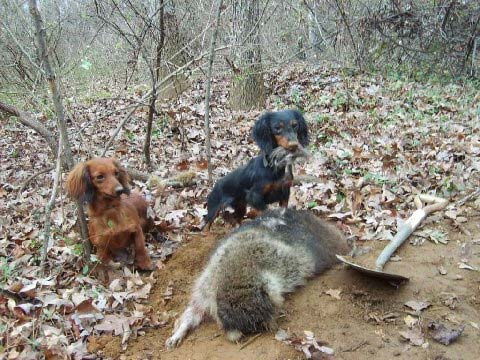
Nanus and Tar with coon they located and bayed in a den.

Most possums are easy quarry for a standard dachshund if the dog can get up to the possum in the den. A strong headed dog will bite the possum hard, making it 'sull' or act dead. The dog will pull the possum out of the den, shake it a bit, then let it go. Later on the possum will wake up and walk off. Unless you are doing pest control on a horse farm there's no reason to kill possum. Horse people don't want them around because they carry a disease horses can contract. Possums are scavengers and not a challenge to a standard dachshund.


Picture above was taken by Stacey Samela and shows Teddy with a mini wire of her breeding, Tess. (FC Tess von Moritz mw WC). The lurcher is Keeper, from David Hancock in England. Teddy writes: "Stacey and I were looking for a fox in a den one cold winter's day. I knew of a den in a big swampy area, on the only high ground around. Tess entered the den and began tugging on something, which was odd. She pulled and pulled and eventually came out with the big groundhog, which was alive but very much asleep in his hibernating state. We have no idea why he was so close to the entrance of the den, only about five feet in. I speculated the fox had begun to dig the den open for use as a whelping chamber and had dislodged the groundhog. The fox was not in the den. Tess searched diligently but came up empty. This den has about a dozen entrances/exits and there are big trees growing over it so Tess had to check many tunnels and get through the tree roots. The soil is very sandy and easily dug by the fox.

The coon was in another den and gave Tess a bad time. She located and bayed it while we dug. The merle lurcher in the photo, Keeper, and Stacey's lurcher, Tory, drew and dispatched the coon, a big boar.

Later as we worked along a drainage ditch the female mallard slipped out ahead of us but wouldn't fly. We saw she was injured and sent the lurchers after her. Tory swam the ditch up and down and eventually caught her and brought her to Stacey, who took the duck home and tried to rehab her but she died.

Teddy's note about chest circumference:

I measured my dogs this morning. All are two years old or more. I believe a dachshund is not 'finished' as far as size and chest circumference until it is at least two years old.

Bane: 2 year old male: 12 1/2" (32 cm)
Tar: 2 year old female: 11 1/2" (29 1/2 cm)
Nanus: 3 year old female: 13" (32 1/2 cm)
Navarre: 6 year old male: 13 3/4" (33 cm)
Gavia: 14 year old female: 13" (32 1/2 cm)
Fitz: 6 year old female: 10" (27 cm)
Note that Fitz is very small and therefore a good little rabbit hole dog. She weighs about 5 1/2 lbs hunting weight and is invaluable during rabbit season. She likes to work hard quarry as well but I use her only sparingly lest she get hurt. Last summer a groundhog bit her over both eyes, deeply. If it had bitten any lower she would have been blinded.

Jolanta's note: Our smallest standard-sized dachshunds imported from Germany have chest cicumferences of 18.5 inches (47 cm) - 2 year old Joeri and 11 year-old Asko. Tommy at two years has a chest measured at 20 inches (50.8 cm). Everybody else is above 21 inches.