Search This Blog

Showing posts with label tracking wounded moose. Show all posts

Tuesday, January 26, 2016

Video of wounded moose recovered by Susanne Hamilton and her dachshund Meggie

The use of tracking dogs in the recovery of wounded game has grown and expanded enormously in the last decade. The United Blood Trackers is still gathering numbers of recoveries from its members for the 2015/16 season, but in the previous season UBT members recovered 718 deer, 11 bear, 7 moose and 2 coyotes. 

One of the more active UBT trackers is our very good friend Susanne Hamilton from Maine. In fall 2015 she went on 73 tracks (while holding a full time job) and recovered 31 deer, 3 bears and 1 moose. Eight animals needed to be dispatched. Susanne tracks with Meggie and her sire Buster, who at 13.5 years made ten finds. Readers of this blog are very familiar with Buster, who is an amazing tracking dog. The video below shows Susanne and Meggie on a track of wounded moose. The track was 9-10 hours old and shows very well the spirit of tracking. You might notice that Meggie opens a lot on the track. Susanne said that the terrain was very rough and she moved slowly, too lowly for Meggie, who was getting impatient. There were also a lot of obstacles and Meggie swam at least 20 times. There were also times when Meggie tracked silently but the five minute footage chosen for the video does not reflect it.

Susanne, a top level dressage rider and trainer, is competitive by nature. Her passion for blood tracking is matched by very few handlers. Last fall she went on 6 tracks within 24 hours and recovered 4 of the 6 deer she tracked. This must be some kind of record! I don't think she slept in those 24 hours at all.

Monday, October 7, 2013

Terrific tracking season for Susanne Hamilton and her German dachshund Buster

We have written about Susanne Hamilton and her German dachshund Buster many times before. It is hard to believe but in June Buster turned 11 years old.  His age does not seem to be slowing him down, quite the opposite. So far he has had an outstanding tracking season. Susanne is a dedicated and driven tracker who travels long distances, often at night as after all she carries a full working schedule during the day. We wish this amazing tracking team from Maine many successful recoveries in the future.

Not too many handlers are willing to track a wounded bear at night. Susanne seems to be an exception.
 
Susanne wrote: We tracked it a quarter mile till point of loss, then we tracked it another quarter mile with only two spots of blood. It was still alive when we found it.... and put it out of its suffering quickly. The moose was 828 lbs with a 42 inch spread.

A 16-hour paunch shot. Smart hunter left it alone and Susanne and Buster found it in 200 yards!

A 17-pointer!

Hunters wrote about this track: Josh Callahan shot a doe last night which headed through brush that was murder to track in. We struggled to follow the blood trail for 4 hours. At 11 PM, Buster and handler Susanne Hamilton joined the search. Buster is an amazing blood trailing Dachshund...yes that's right, Dachshunds are great tracking dogs! Buster jumped on the blood trail and found the deer within 10 minutes.
 
Buster does not mind sharing his find with kids.


Friday, March 22, 2013

Tracking a crossbow shot moose in Quebec: Alain Ridel and Théo

I can't believe that we are still catching up with reports from the 2012/2013 tracking season. We just discovered this October e-mail from Alain Ridel, a UBT member from Quebec. Alain's tracking dog is a wirehaired dachshund Théo  who was imported from France. We bred Keena to Théo four years ago and he was a sire of our "P" litter that produced Paika. The report is about tracking a moose that was shot with a crossbow.

Hello John,
 I hope that your tracking season went very well. Up here things have been rather calm since up to now. I have had only 14 opportunities to track, and one of these was for myself as described below. This search took place on the land of the big maple syrup evaporator at Lac de l’Est. You were there with me. You should be able to recognize the people in the photo.

I shot this moose with my crossbow, and the arrow was equipped with an expandable head. He was shot in the lungs at 23 meters and the arrow passed all the way through. Both lungs were penetrated. The moose ran 234 meters before falling dead. Between the hit site and the place where we found the moose, we saw only two small wipes of blood on branches. However, you can judge the importance of the wound from the photos.

Théo had no difficulty in finding the bull moose despite the presence of two cows that were accompanying him when I shot. This moose, which weighed 834 pounds. field dressed, died a long way from everything, and we had to cut a path with a chain saw for almost a kilometer before we got to a decent wood road.

If you can write a short article on your blog about this hunt and the successful, but not very difficult search for the moose, it will demonstrate that a crossbow kills as efficiently as a conventional bow! It also shows that the same wound on a 230 pound whitetail or a 1000 pound moose produces quite different results in each case because the two species of game react differently.

Théo with his moose - lots of blood!!! clearly showing the physical capacities of a moose.

Alain Ridel with Théo

Théo sees his moose leave

On the job of opening up a pathway for almost a kilometer

Happiness after a very full day

Autumn colors in Quebec during the hunt

Thursday, March 29, 2012

Tracking news from Canada - Nouvelles Canadiennes de la Recherche

by John Jeanneney


The first Canadian Province to legalize leashed tracking dogs was British Columbia on their west coast. This occurred more than a quarter of a century ago. “B.C.” is an important province for big game hunting, but strangely the idea of tracking wounded deer,  elk, moose and bear never caught on there. Michael Schneider, a German who emigrated to B.C. and became a licensed guide, uses an Eastern European tracking dog Slovensky Kopov for tracking moose, but his successes have not inspired many to follow his course.

The French speaking Province of Quebec, on the eastern side of Canada, was the second province  to legalize, and here chiens de sang  (blood tracking dogs) caught on quickly in a big way. The reasons for the success of blood tracking in Quebec and the contrasting lack of interest in British Columbia are not easy to explain. The French speaking trackers in Quebec drew their tradition and inspiration from Europe, mainly France and Belgium, while in B.C. most guides saw blood tracking as a radical, foreign and unnecessary idea.

Chantal Bellemare with her wirehaired dachshund and their find. Chantal lives in Victoriaville, Quebec
In Quebec Simon Lemay, one of the major outfitters, maintains that you have to find a dead moose within six hours after its death if you are going to salvage the meat. The heavy coat, body mass, and internal body heart cause rapid spoilage. In British Columbia, which generally has warmer temperatures, there is little concern about this. Go figure! On certain things we hunters tend to think with our guts instead of our brains.

This moose was recovered by Denis Fortier with his teckel. Denis resides in Victoriaville, Quebec

A small group of hunters in Ontario, just west of Quebec, are pushing for legalization and it appears that they will succeed, No one knows what form the legalization will take since the Ministry of Natural Resources plays their cards close to the vest. I have worked with the trackers and provided them with background information, but they are now encountering doubts among hunters and wildlife officials, These are as negative as anything I encountered in New York State in 1975. If hunting practices are not tied into existing traditions, as was the case in Quebec, it takes a long time for things to change.

Nova Scotia, a small province on the Atlantic Coast, is the third province to legalize, and I will look forward to digging out the story of how this happened. In a former life I was a history professor; sometimes when I’m poorly focused on dogs and deer blood, the old urges come creeping back.

Returning to Quebec, the success that the trackers have had is really remarkable. Currently there are about 48 active trackers and many of them use European wirehaired dachshunds (Teckels). The small dogs have an advantage when tracking through thick back spruce, cutovers clogged with dead branches and in those awful alder swamps where all the alder shoots grow out at a 45 degree angle. They go under the trouble. Tracking on a long leash is mandated by law; in that wilderness country the trackers use about 18 meters of 4 mm polyethylene marine cordage. It works beautifully and doesn’t hang up in their type of thick stuff. I have tried it in our goldenrod fields, and here it is a nightmare.


Steve Durocher from Warwick, Quebec

This year the Quebec trackers found 103 whitetail deer, 86 moose and 6 bears. Their recovery rates ran about 40% which is a little better than what we do down here in the leashed tracking dogs states.  The trackers in Quebec are pretty consistent in maintaining this recovery rate from 2008  to 2011. These guys are good and tough to compete with. I haven’t come up yet with an excuse for why they do a bit better than we do, but I’m working on it.

Bows and crossbows are big in Quebec. About 73% of their calls are to track big game wounded by these two weapons.

Record keeping for tracking in Quebec is more tightly organized than in any of the American states. Alain Ridel does this on a voluntary basis for his tracking organization ACCSQ and for the Province of Quebec; it is a lot of work!

Gilles Deziel and his dachshund Whiskey

This moose was found by Bernard Demers and his dachshund

Stéphanie Marcoux from Warwick, Quebec

More pictures of big game recovered by trackers from Quebec can be viewed at http://www.accsq.com/photos.html

Sunday, December 19, 2010

Christmas greetings from Quebec

Thank you Alain and Marjolaine for the lovely card!

Bonjour John et Jolanta. De ma part ainsi que de Martjolaine je vous envoie nos bons voeux pour la nouvelle année 2011. Alain et Marjolaine
Alain Ridel is an experienced tracker of moose and whitetails in Quebec. His tracking dog Théo is a wirehaired dachshund imported from La Meute à Chéops, one of the leading kennels for hunting dachshunds in France (Théo is a sire of our Paika).

Tuesday, October 5, 2010

Puppy work and early conditioning

by John Jeanneney

This is a somewhat edited version of article that John wrote for Full Cry.

We are receiving some interesting feedback from folks who purchased our puppies last summer. I’d like to share some of it with you, but please don’t take this as an attempt to get puppy advertising on the cheap. We don’t have any puppies for sale.

The puppies we sold last summer were part of our project of conditioning pups at a very young age as a means of expanding their capacity to track later on. We used deer blood, deer liver drags and deer gland scents. I’ve written about this in a recent Full Cry article, “Nature and Nurture”, and I hope that our experiences will encourage some other breeders and owners of young puppies to try early conditioning. We’ll come back to the theory of puppy conditioning later. First, I want to get on with the stories, which are fun even if they’re not very “scientific”.

We sold a “conditioned” puppy at the age of 12 weeks to Justin Richins, an outfitter in Utah. Last August Justin flew all the way out from Salt Lake City to New York State to pick up Remy, his wirehaired puppy. Justin never told me that his friends thought he was nuts, but I suspect that something similar might have passed through their minds.

Remy was supposed to be “just a puppy”, but when Justin’s clients began to hunt this fall there came a need for a tracking dog. Puppy Remy was all Justin had. Within three weeks, Remy had found three elk in Utah, a Shiras moose in Wyoming… and an easy antelope that didn’t really need tracking. I guess that Justin was worried that Remy might get bored just tracking elk.


The three elk, and later the moose, were the big challenges. Now I really don’t understand why this worked so well. If Justin had consulted me in advance, I would have said “No, the pup is still too young for anything but short easy tracks.” One day Justin did call me on his cell in the middle of a track. “ We have tracked this wounded elk a half mile from the hit site”, he said, “and then we jumped him. This elk will go a couple hundred yards and then bed down . When Remy tracks up to him, he takes off again before we can see him in the thick stuff. We’ve gone ¾ of a mile. What should I do?” My answer was, “Give Remy a rest and a drink . You’ll get the elk if he keeps bedding like that.” And they did get the elk.

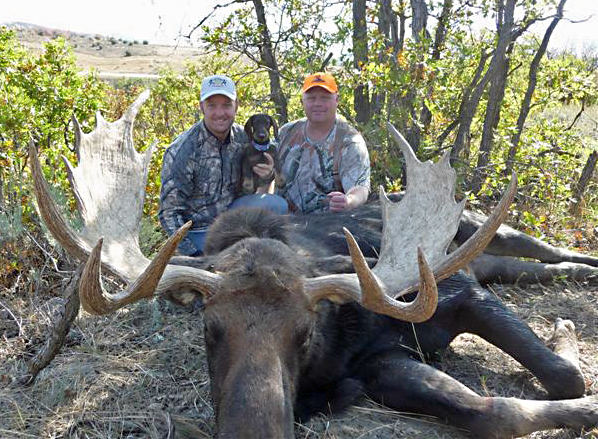
Remy was instrumental in recovering this record-sized moose
The moose in the photo did not go as far as that elk, but after the start there was no blood to work with. Justin and Remy had to track him through thick pines to move him out to where the hunter could get a finishing shot. Once the moose was dead there was a little trouble because Remy thought the animal was HIS and would not let the hunter approach. This is normal, especially for young males, but they have to learn to share.
Remy at the age of four months
The theory behind the early conditioning that Remy received is that very early stimulation of the rapidly growing mammal brain increases the density of neuron circuitry that is later used in mental activity. It has been scientifically proven, though extensive and expensive MRI research that this does work in human infants. This has not been scientifically proven in dogs; it is only a “probability”. There is interesting research, performed by Peter Hepper at Queen's University Belfast that seems to prove that very young puppies can be trained to recognize and like something, such as anise oil taste and smell, at a very early age. I admit that it’s a stretch to go from that to tracking wounded game.

Experimenting with the early conditioning theory probably isn’t practical for the breeder who has a litter of coonhound pups and is holding down a fulltime job. It’s too time-consuming. For a retired person, with more time and a special need to develop pups to their maximum potential, it may make sense. Certainly, it’s not the only way to develop an outstanding dog, but it’s worth thinking about. For developing dogs to do a specific task, like tracking, it has promise.

Below is a video of Remy tracking a fresh deer liver drag when he was ten weeks old.

Tuesday, February 2, 2010

Tracking wounded moose with dogs in Quebec

© 2010 John Jeanneney for Full Cry

Moose hunting is very different from deer hunting. Simon Lemay, a French Canadian outfitter, explained to me that one of the many differences is that there is a time limit for finding wounded moose that run off after the shot. You can’t just wait and find him the next morning in the time-honored American tradition.

In the case of a wounded moose you are dealing with a very large animal, 800 to 1200 pounds on the hoof. This huge and hot body mass is insulated by a coat almost as thick and dense as that of a bear. If you don’t get to the carcass in six or eight hours to open it up and cool it down, you are going to have a truckload of spoiled meat.

The size of the first moose we found was a revelation to me. The whitetails I am familiar with would have looked like cottontails along side of the moose pictured below. The call to track this one came in early one evening from near the New Brunswick border. Alain Ridel and I traveled more than a hundred miles one way to begin tracking shortly before midnight. It was difficult to get to the hit site down in a deep valley, but the rest was easy. Typically there was very little blood, and this only at the beginning, but the moose was well-hit and only went a 100 meters beyond the point where the hunters gave up. We did not stay to get the moose back up to the road. The hunters gutted him and spent a good part of the next day getting him back up the hill to the road with a big four wheeler.

Alain Ridel's Théo with the moose described above. Théo found 7 moose during the two moose seasons.

Moose hunters in Quebec, including outfitters like Simon Lemay, pioneered the use of leashed tracking dogs in Quebec several years ago. Dogs are being used more and more, not only for moose, but also for whitetails and black bears. I ran one tracking workshop in Quebec and attended another one presented by two trackers from France. Interest was high and people came from all over this vast province. I have to admit that I was pleased to see them using the same type of wirehaired dachshunds that I use down in New York.

I had made some good friends in Quebec, and was invited to come up with one of my dogs for some hands-on moose tracking experience last September. Over the ten days I learned a great deal, and covered many miles. We stayed much of the time at the evaporator house of a big maple sugar bush, where we could look down Lac de l’Est (East Lake) right into Maine. The language of my friends may have been French, but the game and the terrain were very similar to that of the moose country across the border. We actually tracked one moose that came within 100 meters of the border before he veered north. I’m glad he decided not to become an illegal immigrant.

Three moose trackers and their wirehaired dachshunds: Shown left to right are Phillipe Rainaud with Sky (three moose finds), Andre Hins with Gamine (seven moose finds), John Jeanneney, apprentice moose tracker, with Billy.

It’s worth emphasizing that from a tracker’s point of view we were not in a foreign country at all. What I saw and learned could have been applied just as well in Maine. Unfortunately, in Maine the interest in tracking dogs to find moose and other big game has been almost non-existent despite the fact that the State Legislature and the Maine DNR legalized the use of leashed tracking dogs ten years ago in 2000. Individual invitations to a tracking workshop last summer were sent to 540 Licensed Maine Guides. There was no response from the guides.

My romp in Quebec showed me that tracking wounded moose by eye is not an easy task. During hunting season the moose are no longer feeding on aquatic vegetation in wet areas that make for simple tracking of hoof marks. You don’t get much of a blood trail from a wounded moose, just as in the case of a wounded bear, because the heavy coat soaks up so much of the blood before it reaches the ground. The blood sign that you do see is generally wiped off on tree trunk and branches well off the ground.

From a dog’s point of nose a moose is easy to track. We are dealing with a big animal with lots of body scent. However, this scent does not seem to be as individualized as in the case of deer. Probably this is because moose have no interdigital glands between the cloves of their front hooves. There are small, barely visible interdigital glands between the rear hooves, but clearly these glands don’t play the same role with moose that they do in a whitetail. Fortunately, moose are more solitary and their density in a given area is usually lower than is the case with whitetails. Staying on the right line is not as difficult with moose as it is for whitetails.

From a handler’s standpoint following a dog that is following a moose is not so easy; it’s strenuous exercise. In Quebec, as in the northern US, the handler is required by law to keep control of the dog on a long leash, and this means that you have to go where the dog goes. Long legged moose stride with ease over the dead branches and dense young growth of the cutovers, but for a man this means stepping over, wriggling under or ramming through the same thick stuff. The off-lead, Garmin Astro tactics of our own Deep South would ease the situation, but this is politically out of the question in Quebec. In Quebec the handler cannot even carry a firearm as he tracks with his dog.

Tracking in Quebec made me realize that tracking wounded moose is not an activity for old men. My own tracking dog Billy is big and powerful for a dachshund, so he was a pretty good tow truck on some of the steeper uphill slopes. When there was a need to slow down in some of the thick stuff, Billy knew how to adjust his pace to his handler’s age. I agreed with the trackers I met in Quebec that a 20 to 30 pound dog is much more practical up there than a dog of twice the size.

I was in Quebec only for the bow and crossbow season, which coincided with the moose rut. Roughly a third of the moose tracked were recovered, although all reports on tracking activities have not been filed yet. The percentage of moose recoveries for the rifle season appears, at this point, to be slightly lower. We can assume that the majority of the moose not found actually survive, although it is nearly impossible to come up with verifiable numbers for this. Animals shot far back in the intestines can take more than a week to die. An experienced tracker, who can interpret the signs of the type of wound (placement of blood smears, color of blood, etc.), is in a good position to make an informed guess about the chances of survival.

There are problems with the present leashed tracking dog system in Quebec, and some of these will not be easy to solve. Most of the hunting area is owned by the Province, not by private individuals. In these undeveloped public areas communications are difficult. Cell phone coverage is poor, and the only way to get to a tracking site in these areas is over a sparse network of rocky logging roads. The game and hunter density is low so you drive far, but of course you can’t drive fast. Because of limited information relayed by the radio-telephones of the Provincial Rangers, we often drove for hours to track a lightly wounded moose that was impossible to retrieve. Things would have been better if we had been able to question hunters directly.

Hunter errors were more of a problem than I had expected. For bow and crossbow hunters Quebec’s training program could be improved. Some hunters seemed to have a very vague idea of where an arrow or cross bow bolt must be placed to produce a killing shot. Most were using crossbows, and there were too many who didn’t understand that the crossbow bolt is deflected off course when you shoot through brush. The short, heavy bolt also drops dramatically after about 35 yards. The crossbow is not a rifle.

In remote areas, like the Gaspé Peninsula of Quebec, tracking dogs can be used most effectively by outfitters and guides. As they work with clients they are in the best position to stay in touch, give advice and offer the services of a tracking dog when this is needed. Simon Lemay, the outfitter in the Lower Gaspé region of Quebec, has several wirehaired dachshund trackers and believes that they are a valuable asset to his business.

We Americans have something to learn from what is going on in Quebec. Guides and outfitters, especially, can profit since moose populations are expanding. In the Northeast: Vermont, New Hampshire and especially Maine have moose seasons. New York State has about 400 of these animals, but they are not hunted yet. Farther to the west they are now present in northern states from Michigan all the way to Washington. Moose are great travelers and they seem to be penetrating down from the North as if they had never heard of global warming.

Wednesday, December 16, 2009

Darren's trip to Illinois and Karl's first real tracking experiences


The pictures show Karl, a young wirehaired dachshund owned by Darren Doran. This is the first tracking season for Karl who was bred by Laurel Whistance-Smith. He was born February 18, 2009, and he is out of FC Pagan von Lowenherz and our Billy. Darren wrote:

"I'm back home now and Karl really liked his trip to Illinois. We stayed in a house in Hannibal, MO and crossed the Mississippi every day to go to the farm to hunt.

He's really a good dog. The first track was a doe Bobby shot. He knew he killed the deer and it was only about 50yd long. Karl was on the deer in less than a minute. The next was a doe I shot. Again I knew the deer was dead. The track was about 4 hr old. The deer ran through a blow down and directly into the wind. Karl came out of the blow down and immediately air scented the deer and went right to it.

The third was the deer in the picture this doe was shot by Jim and went about 100 yd. The track was 4 hrs old. These tracks were really very easy for Karl and I ran him on these so he would start to realize what his job is and how he fits in to this. As far as that goes I think he's getting it.

The track of the buck that Jim shot I mentioned in the email was different. We went to the hit site and the deer had left the bed; Jim saw him lay down in the night before. The deer had crossed the north line on to private property and we had to get permission to enter. Our contact in IL went to the outfitters camp, but no one was there to give permission. While we were waiting Bob and Jim walked east along the north line and saw the deer dead in a weed patch about 50 yds from his first bed. We really couldn't finish the track with Karl. He became confused as to why we stopped on the track and were just hanging around. The fact that it was raining wasn't helping either. I do believe he had air scented the dead deer when we first started. He left the blood line and charged toward the dead deer and was doing everything he could to get though the fence and go in that direction. We got the deer back on our side and let Karl chew on him as a reward. "

Thursday, October 8, 2009

How to locate blood tracking dogs that can help hunters recover their wounded deer

A deer hunting season has already opened in some states, and every day we get phone calls from hunters who would like to locate a blood tracking dog that could help them find their wounded big game.

If you are looking for tracking services, the United Blood Trackers website can help you. Go to http://www.unitedbloodtrackers.org/find-map.php, click on your state, you will see a list of available trackers. First, however, you should first learn whether tracking wounded big game with dogs is legal where you hunt. Regulations are controlled by state, and vary a lot from one state to another. Now this activity, which many view as a very integral part of ethical hunting, has been legalized in 18 states where any use of dogs in deer hunting, including the recovery of wounded deer, was previously illegal. State regulations can be checked at the United Blood Trackers’ website at http://www.unitedbloodtrackers.org/state-reg.php

If you live in New York state, calling Deer Search is your best option. This volunteer-based organization was formed in 1977, and currently has three chapters. For tracking services call:
- the mid-Hudson Valley area call (845) 227-5099
- Western part of New York state (716) 648-4355
- Finger Lakes Region (585) 935-5220
In the Capital District the number is (518) 872-1779.

In New York state only trackers licensed by Department of Environmental Conservation can track wounded game with leashed dogs. If there is no Deer Search tracker in your area, call your local conservation officer as he might know of local tracking services. Not all licensed handlers are members of Deer Search.

If you are looking for tracking services in Texas, go to http://www.texastrackers.com/Contacts.htm

Georgia has a published list of trackers at http://www.gon.com/page.php?id=67

Some blood trackers have personal websites and blogs describing their services:
I'll close this post with a good story from Steve about his young dachshund Ruby:

Earlier in the season I took Ruby out to track a deer that I had shot, and had seen go down in about 50 yards. She did great, but I have been looking forward to take her out on a trail where I didn't know where the deer was.

I am in an area where most of the hunting opportunities take place in very populated suburban areas, where the homeowners are desperate to reduce the population. This evening I shot a button buck about 15 minutes before dark. The shot looked a little high, but good. The deer ran across the road, and I lost sight of it as it crossed a large lawn. There was no problem finding the blood on the road, but about twenty yards onto the lawn, I couldn't advance the trail at all. After about an hour of searching all of the trails along the edge of the woods, and the landscaped beds around the houses, I made no progress.

The wind was absolutely howling, and I wasn't sure the dogs could pick up the scent on the open lawn, but it seemed like a good opportunity to get Ruby out on a challenging track. I took her to the last blood, and after a minute or two of working it out, she seemed sure of herself, and lead me to a small island of very thick cover, about twenty five feet across, in the middle of the lawn.

I had already searched it thoroughly while looking for blood earlier, and found nothing, but she seemed sure. She disappeared into the brush, and I got down on my knees and shined the light in to see her on the deer. It had apparently taken a final leap, and buried itself in the impenetrable thicket. There were no trails leading into it, and no visible blood on the brush where it jumped in. I was ecstatic.

The deer was not visible at all from the lawn, and had she not found it, I would have spent hours tomorrow searching the woods, sure that it had gone there. She saved all the time and anguish, and I couldn't be prouder.

Just goes to show that the trail doesn't have to be long, or the hit bad, to make recovery difficult, and a tracking dog a huge help!

Ruby with the deer she recovered.

Thursday, October 1, 2009

Another wounded moose recovered by Theo

This morning e-mail brought this picture with this caption: "A big bull moose found by Theo near New Brunswick. We got back to Mont Carmel at 5 AM!" Readers of this blog know that John is in Quebec and he has been staying with his friend Alain Ridel. I am sure that more info about this call will come but in the meantime trackers have to get some well deserved sleep.

Monday, September 21, 2009

Tracking wounded moose in Quebec

In a couple of days John will be going to Quebec to track wounded moose, and he will be staying with Alain Ridel at Mont Carmel. Alain and his wife Marjolaine own a wirehaired dachshund Theo imported from France, whom we used for breeding last winter.

Alain recent e-mail brought a picture of the Theo's recent recovery nad this short description:

"Hello John,

This is to give you a foretaste for next week. Moose hunting began yesterday morning; I left for a moose call at 9:15 PM and finished at 10:45 PM. The search took place in a forest filled with black spruce and a very, very large number of moose. The length of the track was 776 meters. There wasn't a drop of blood, even at the hit site. The animal was shot with a cross bow.

Théo worked very hard, but you can see the results. Greetings as I wait to share with you the joys of tracking. "


Friday, October 24, 2008

Tracking wounded moose with Théo in Québec, Canada

We started this blog with a short report on Theo, and we are happy to give you an update. Théo, a wirehaired dachshund, is owned by Alain and Marjolaine Ridel from Mont-Carmel, which is 100 miles north east from Québec City. He was imported from France, and is now just 8 months old.

He showed a great promise on artificial blood lines, but his multiple recoveries of wounded moose have proved his extraordinary talent. Some trails were very long and challenging. Alain e-mailed us several pictures, which we are happy to share.


We can only second Alain's word's: "Donc je ne peux dire que, Bravo Théo!!!! Tu est un champion!" - "Therefore I can only say, Bravo Théo!!!! You are a champion!"