Search This Blog

Showing posts with label tracking wounded elk. Show all posts

Thursday, October 24, 2013

"Von Moosbach-Zuzelek" puppies' first tracking season: Uncas (Moose) and Urho (Mongo)

In 2013 we had only one litter of puppies, which was out of FC Sky von Moosbach-Zuzelek and FC Mielikki Raptor. Both parents are young dogs themselves. Sky comes from several generations of our own breeding that produced a family of very accomplished blood trackers. Mielikki comes from Nordic bloodlines and has a very nice pedigree, but when you do an outcross as we did in this case, you always take some chances. Sometimes you win a lottery, and sometimes you don't.

The "U" litter was born on May 10, 2013 so these pups are just 5.5 months old. All of them have showed a lot of promise when we worked with them at a very early age. We are happy to see that this potential has been getting realized in the field and the pups are already helping hunters.

The four pictures below show Moose (registered name Uncas von Moosbach-Zuzelek) owned by Adam H. from PA. Since blood tracking dogs are illegal in PA Adam who lives close to Maryland border, tracks in that state.


September 24: Another find for a young Moose who looks really tiny in this picture. Adam H., Moose's owner, says: Last night I received a call around 7:30 from a buddy who shot a buck but had no blood! Moose and I drove down to Maryland and met him. After speaking with him I was pretty sure it was a probably a one lung/liver hit. The deer was angled towards him. I sat Moose down at the hit site and roughly 125 yards later (with no blood) Moose found the buck!! 


October 7: Adam  wrote yesterday: Good evening John and Jolanta, I just wanted to let you know that tonight Moose made his 3rd recovery of the year! The hunter hit the big old doe far front but had pretty good blood. She did zig zag several times through a standing cornfield! After about 150 yards he found her  He's the real deal  Thanks again you guys for an awesome little guy!

October 13: Adam wrote: "Good morning folks! Well, my boy did it again last night! This makes 4! I received a call last night from a buddy whose buddy hit a buck but didn't have much blood. Moose and I got to the hit site around 10:30. After approximately 125 yards Moose found him. With the deer angling away it appeared the arrow clipped the lungs and lodged into the brisket! (No exit hole)

Yesterday Moose has taught Adam a valuable lesson:

Good afternoon John and Jolanta,
Well I learned a very valuable lesson the other day - too bad it was the hard way!  I was down in Maryland doing some hunting on Monday evening and shot this buck. The shot felt and looked great! The buck was shot broadside at 19 yards and tore away after the arrow zipped through him! I eased out and gave the buck about 2.5-3 hours! I took my neighbor and Moose back down at around 9 pm to do the recovery. With ease Moose tracked the buck about 80 yards to a large puddle of blood and then he made a left down a ravine traveling about 150 yards with NO blood. I was certain with the shot I made he was off the track (since there was no more sign) - so I picked him up and brought him back to the hit site! He again made a left and I allowed him to travel even further this time but again there was no sign so again I brought him to the hit site.  This time he went straight from the blood out the ridge about 75 yards. As we crested down the ridge I heard a deer bust out of the thicket! I was sure we just jumped the deer so I picked Moose up and we left- I decided to come back in the a.m. so I could see better. The next morning I started him at the puddle where he again went left this time I just left him go - we went roughly 225 yards to a dead buck that had been ripped to shreds from coyotes.! The entire left side of the deer was eaten clean :( 

Hard lesson learned. I will now let Moose go for as long as he wants to go - trusting him completely!!!! I was so upset with myself BUT I swear to you Moose looked at me after he chewed on him for a little almost to say I TOLD YOU SO - you jack***! Haha. Thanks again for my boy! He's everything to me ;)
Adam
--------
Moose's brother Mongo (Urho von Moosbach-Zuzelek)  is owned by John Sakelaris and is a tracking dog at Vermejo Park Ranch in New Mexico.
 
 
The hunter in the picture wrote:
 
John,
I am more than happy to write a letter commending the tracking dog and the dog’s owner. Mongo was outstanding. I have worked with other deer in the past as we track many a wounded Whitetail at our place and I think Mongo can hold his own with any of the other dogs. I think it is a great service to the ranch to have a dog like that and we certainly appreciate his capabilities.
 
And John wrote to us:
 
I want to thank you again for the dog, he is fantastic. I have had big game hounds for the last 15 years and most of them barely know day from night until about 3 years old. Only then do they really come into their own and start to “think”. Mongo at 4 months shows incredible intelligence and problem solving ability. We just got back this morning from an all day and most of the night track where we went up and over 2 ridges with a whole lot in between. Several times I thought Mongo was not on track be he would prove us wrong when we would find blood. This last find was a real test and any blood tracking dog owner would be proud, not to mention one of a pup 5 months old. He is worn out today but still wants to go again." 

Monday, October 1, 2012

Tracking wounded elk and deer in New Mexico: Nadja's first season with a new owner


Recently we received an e-mail from John Sakelaris, who purchased Nadja (Nettie von Moosbach-Zuzelek) from Jeff Richardson.  He wrote about his first tracks with Nadja at Vermejo Ranch in New Mexico. "I thought you would enjoy the photo attached. Nadja and I have been successful in finding 1 elk and 1 deer out of 7 tracks. The ones we were unable to find were elk and to Nadja'a defense questionable in their severity/blood trail (archery wounds). The elk we did find was a great learning experience as the track went over 3 miles and took us 2 days to work out. I really learned allot on this track as well as the ones we did not find. Nadja is doing well and I really really like her pleasant personality. She stays is the house and gets lots of attention from my wife and kids as well as staying with me in my office or in the truck during the hunts."
 
John Sakelaris with Nadja and an elk they recovered.


A clever way of transporting Nadja.
 Nadja will have to adjust to tracking wounded elk, which poses some challenges. John wrote: "The elk we could not find mostly ran out of blood line but she continued to trail like she knew what she was doing but just following an elk trail. Elk are herd animals and there may have been 20-50 or more which went down the same trail that morning as the wounded one so I imagine she is overwhelmed by the scent and just keeps going leaving the blood and following the scent.

I was able to confirm this several times by finding blood in the other direction and in one case the dead animal itself. Even the one we did find she left several times on "elk highways" full of scent abandoning the search for blood and following the stronger scent. We successful by being able to visually confirm blood at key times and putting her back on track. I am worried that she will keep doing this and not concentrate on blood. I am worried because I cannot trust her when I see no blood for confirmation. Again to her defense, deer are not like this and that is her experience.

Also, we are in the rut so the scent of a rutting bull is at times so strong you and I can almost follow it. We go into rifle season now and the rut is ending so hopefully this will be less of an issue as a wounded bull now will likely be by himself or with one or two others his age and not rutted up with the cows"
.

Friday, November 4, 2011

Great pictures of Albis vom Jagdfeld from Montana with the elk he recovered.


We received these beautiful pictures from Susie Gardner from Ohio, a breeder of the young dachshund Albis vom Jagdfeld. Albis is just over one year old, and he is a son of FC Joeri vom Nonnenschlag and Melodie von Moosbach-Zuzelek. He is owned by Gob Kieckbusch from Montana. The picture shows Albis with a hunter and the elk he recovered.

Thursday, December 16, 2010

While tracking a wounded elk Remi runs into a porcupine

In the last 24 hours we received two pictures from Justin Richins showing that Remi (Remy v Moosbach-Zuzelek) is living an active life.

Justin's caption:This fox realy did not need any tracking but my little budy went nuts when I shot and wanted to track him anyway.

Justin says: Finaly had a chance to track again a wounded cow elk. Remi was doing great on the 16 hr old track, then he came to a thicket that I could not go through. I let him go off lead as I waited on the other side for him to come out and this is how he came out. We were lucky as he could have lost his eye.
For a good article on dealing with porcupine quills click here. Possible complications resulting from the injury due to porcupine quills are addressed here. Unfortunately, our dogs have had many encounters with porcupines, usually when they were off leash running rabbits. Luckily they did not suffer any long-term complications.

Remi, we hope you feel better soon!

Monday, October 25, 2010

Remi, a blood tracking wunderkind

Remi (Remy von Moosbach-Zuzelek, a Joeri/Gilda son) is just a puppy, and today he is turning five months old. We wrote about Remi on this blog before as he has making a name for himself at the R & K Hunting Company in Utah. We asked Justin Richins, his owner and handler, for more details, and few days ago we received this nice, thorough report from Justin Whitear, a guide at R & K. A big thank you to both Justins!

On September 29, 2010 we had a client who shot and wounded a bull elk. The elk was semi quartering towards us when the client took the shot. The shot went through the front shoulder and exited the same shoulder near the back of the shoulder, missing all vitals. The bull was able to cover a great distance of ground making our recovery impossible. As soon as the shot was made the bull elk spun around and headed into the same thick trees that he had just walked out of.

As we approached the clearing where the shot was made, we soon found a few drops of blood where the bull had ran into the trees. After following the blood for about 200 yards we could tell the animal had not been shot very well and we would need some assistance from Justin Richins. I made a call to Ken Duncan to pick Justin and Remi up at the bottom of the mountain. Within an hour and a half Justin and Remi had arrived and we soon watched this little puppy make a believer out of all us. As soon as they arrived I took Justin to where the shot had been made and that’s where Justin started his dog Remi.

At first Remi was very hyper and jumped around going back and forth from the blood trail to a possible rabbit or mouse track and then back to the blood trail. (Justin Richins comment to this statement was: Remi was just checking out all the wrong paths they tracked down with the blood/scent on there shoes at the hit site.) After 5 minutes of running around all of the sudden Remi ‘s disposition changed and he became very focused on the blood trail. At first we all watched this little puppy just kind of trot along and almost playing around like most puppies do and then something triggered Remi, maybe it was the taste of that blood, or the strong smell of fresh elk still on the ground, something turned this little puppy into a highly respectable dog that has the entire elk camp talking about Remi.

Remi’s nose never left the ground after the 50 yards or so of getting his wiggles out. Remi followed the blood track down a narrow path that was less than a foot wide, leading to a steep hill covered with thick oak trees. 35 yards from where the bull had been shot there was a large pool of blood about 6 inches long and 4 inches wide and then it slowed down to nearly one drop every 30 yards. Then at the 200 yard mark where we had stopped tracking and called Justin we could not locate any blood or which small game trail the bull had taken.

Remi was going at a pretty fast pace as he went over the hill and in fact missed the track and went about 20 feet down another game trail before turning around. He back tracked himself and then turned down a new trail. Watching this from above I had thought this is where the tracking would end. In my mind he had already missed the trail once and was now headed for a creek at the bottom of this large gully. After Remi crossed the creek he stayed at a pretty fast trot right up the other side of the creek and into some more thick trees. As we made our way into the trees I was very doubtful that Remi was even on the right trail.

At this point we were all in agreement that the bull had not been hit very well because of the distance we had traveled and the effort that would have been required to go up such a steep hill. As we continued going up through the trees we found a dot of blood and this was very exciting because we had gone close to a quarter mile without any blood sign. As we went further up the hill we came across a pretty good amount of blood where the bull had maybe laid down, not necessarily because he had been shot but it was getting late in the morning and most of the elk had bedded for the day.

As Remi made his way to the top of the ridge he worked his way out into an open meadow and started to head for the middle of it. Justin did not think that Remi was still on the trail so he took Remi back into the trees where the bull had laid down and started him over. Once again Remi worked his way up the hill and out into the opening towards the middle of large meadow. This time Justin let Remi go and we just followed. Justin and I were both thinking we had come to the end of our trail until we came to the other side of the meadow and found a small drop of blood leading into some more trees.

Justin and I were completely amazed that Remi was able to follow the same track through an open meadow that was 600 yards wide with a warm breeze and sun on the entire meadow Remi had still kept on the trail. As Remi made his way up the next bunch of trees he worked his way up until he came to a dirt road. Once Remi hit the road he kept doing half circles up the road and then back down to where the trail came out of the trees and into the road. After 3 or 4 times of going up the road and then turning back to where the trail came out of the trees Remi crossed the dirt road and followed a small game trail that lead into a giant basin that was covered with oak trees. The basin has to be close to 1 mile in length and ¾ of a mile wide.

As Remi worked closer to the big basin we came into a clearing where there were 10 to 15 beef cattle grazing. It only took a little bit of movement from the cows and Remi was on their tail barking and chasing them towards the basin. By now it was around 12:30 p.m. and we were exhausted and so was Remi. The good news was Remi had showed us where the bull had gone giving a game plan for the night hunt.

That night about 4:00 p.m. Kody Whitear and myself started into the basin looking for the bull. At the top of the basin we had a few spotters looking down towards us to make sure the bull didn’t slip out. About 45 min into our hike Bob Wixom, one of our guides, called and said he had spotted the wounded bull. We were able to make a stock on the bull and harvest the animal.

The recovery of this wounded bull would have never happened without Remi. From where we had shot the bull to where Remi last tracked the bull was close to 2 miles. Any good ethical hunter would have given up as soon as the elk had crossed the creek and its wound had stopped bleeding. I am so impressed with Justin’s dog I asked Justin to let me know when I would be able to get a dog like his. These dogs are incredible trackers and will save R&K many animals that would have suffered and died on the mountain and gone to waste without a dog to track them down.

Justin Richins with Remi at our place. Justin flew all the way from Utah to pick the pup up. Remi went to his new home on August 9, when he was 11 weeks old.
Not all puppies are as precocious as Remi. A breeder would like to see good blood tracking potential in young puppies. But every dog develops at his own pace and some late bloomers turned out to be terrific blood trackers and hunters.  We are very proud of Remi. He is in excellent hands and has a lot of opportunities to work. It is so satisfying to see that outfitters are starting to appreciate blood tracking dogs!

Tuesday, October 5, 2010

Puppy work and early conditioning

by John Jeanneney

This is a somewhat edited version of article that John wrote for Full Cry.

We are receiving some interesting feedback from folks who purchased our puppies last summer. I’d like to share some of it with you, but please don’t take this as an attempt to get puppy advertising on the cheap. We don’t have any puppies for sale.

The puppies we sold last summer were part of our project of conditioning pups at a very young age as a means of expanding their capacity to track later on. We used deer blood, deer liver drags and deer gland scents. I’ve written about this in a recent Full Cry article, “Nature and Nurture”, and I hope that our experiences will encourage some other breeders and owners of young puppies to try early conditioning. We’ll come back to the theory of puppy conditioning later. First, I want to get on with the stories, which are fun even if they’re not very “scientific”.

We sold a “conditioned” puppy at the age of 12 weeks to Justin Richins, an outfitter in Utah. Last August Justin flew all the way out from Salt Lake City to New York State to pick up Remy, his wirehaired puppy. Justin never told me that his friends thought he was nuts, but I suspect that something similar might have passed through their minds.

Remy was supposed to be “just a puppy”, but when Justin’s clients began to hunt this fall there came a need for a tracking dog. Puppy Remy was all Justin had. Within three weeks, Remy had found three elk in Utah, a Shiras moose in Wyoming… and an easy antelope that didn’t really need tracking. I guess that Justin was worried that Remy might get bored just tracking elk.


The three elk, and later the moose, were the big challenges. Now I really don’t understand why this worked so well. If Justin had consulted me in advance, I would have said “No, the pup is still too young for anything but short easy tracks.” One day Justin did call me on his cell in the middle of a track. “ We have tracked this wounded elk a half mile from the hit site”, he said, “and then we jumped him. This elk will go a couple hundred yards and then bed down . When Remy tracks up to him, he takes off again before we can see him in the thick stuff. We’ve gone ¾ of a mile. What should I do?” My answer was, “Give Remy a rest and a drink . You’ll get the elk if he keeps bedding like that.” And they did get the elk.

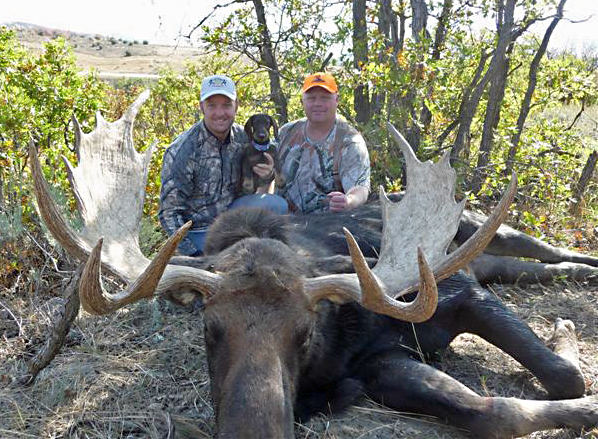
Remy was instrumental in recovering this record-sized moose
The moose in the photo did not go as far as that elk, but after the start there was no blood to work with. Justin and Remy had to track him through thick pines to move him out to where the hunter could get a finishing shot. Once the moose was dead there was a little trouble because Remy thought the animal was HIS and would not let the hunter approach. This is normal, especially for young males, but they have to learn to share.
Remy at the age of four months
The theory behind the early conditioning that Remy received is that very early stimulation of the rapidly growing mammal brain increases the density of neuron circuitry that is later used in mental activity. It has been scientifically proven, though extensive and expensive MRI research that this does work in human infants. This has not been scientifically proven in dogs; it is only a “probability”. There is interesting research, performed by Peter Hepper at Queen's University Belfast that seems to prove that very young puppies can be trained to recognize and like something, such as anise oil taste and smell, at a very early age. I admit that it’s a stretch to go from that to tracking wounded game.

Experimenting with the early conditioning theory probably isn’t practical for the breeder who has a litter of coonhound pups and is holding down a fulltime job. It’s too time-consuming. For a retired person, with more time and a special need to develop pups to their maximum potential, it may make sense. Certainly, it’s not the only way to develop an outstanding dog, but it’s worth thinking about. For developing dogs to do a specific task, like tracking, it has promise.

Below is a video of Remy tracking a fresh deer liver drag when he was ten weeks old.

Saturday, September 25, 2010

The elk that was recovered with Remy's assisstance

This is a continuation of the post from few days ago. Justin wrote today:
 

They just found that elk Remi tracked for 3/4 mile. Another hunter and guide were in the same are and decided to look again. Of course with out Remi taking the track to the point of loss it never would have been recovered. It was 1/2 mile east from where Remi left the tract. The hunter realy wanted a pic with Remi as he feels he was instrumental in finding it and he was sure the elk had run the opposite direction. I'm surprised it died!

We are proud of the young Remi!

Thursday, September 23, 2010

Remy finds his first elk

Justin Richins, an outfitter operating in Utah, Wyoming and Montana, bought Remy, one of our 2010 puppies (Joeri x Gilda). Remy got plenty of conditioning for blood tracking from the time he ventured out of the whelping box, but we are still surprised (“shaken” is a better word) to learn what he has been doing at the ripe old age of 15 weeks.

One of Justin’s hunters shot an elk, but there was little blood beyond the hit site; the hunter could not find the animal. Justin figured that he might as well let little Remy have a try at tracking it. To everyone’s amazement Remy followed the fairly fresh scent line for a quarter of a mile and found his first elk.

Even more impressive tracking work was to come. A hunter had taken an unadvisable head-on shot with a crossbow on another elk. Remy tracked that one ¾ of a mile with very occasional drops of blood to verify his good work. Remy continued on even farther, but there was no more blood at all to verify the line. All this occurred at night and Remy was tracking through areas filled with the hot lines of feeding elk.

Justin said that there were two government trappers who went along on the second call. They found it hard to believe what they saw. Finally Justin concluded that the elk was not mortally wounded, and that the crossbow bolt had glanced along the outside of the elk’s heavy rib cage with no penetration to the heart and lungs.

We hope that Remy is getting plenty of sleep and playtime.

Tuesday, December 29, 2009

Tracking wounded elk with Ziggy in New Mexico

It was great to hear from Jim Baker, who has been tracking wounded elk in New Mexico. He is an owner of "Ziggy" (Elka von Moosbach-Zuzelek), who was born February 28, 2008. Ziggy is a daughter of Billy and Gilda.

In Jim's own words:
"I describe how she did this year as phenomenal. At first I did not trust her on some of the first couple of times we went out. She was just going so fast and then I remembered from your book. If in doubt, trust your dog, so I did. She was called 12-14 times. Several of them were never to be found, high back shots and the elk was down, then gone. She found 5 of 8 possible. Some of the others I determined that the elk would probably live for at least few days or forever. After 2-3 miles with no real blood, and they got back with other elk.

The last one she found was at least 3 miles and 24 hours after the initial wound. I first realized I could trust her when we had gone 2-3 miles and I pulled her from the track as the bull got with other elk. We were just walking down a road that coincidentally the elk apparently came back on. She started getting excited and I looked down and there was a drop of blood about twice as big as a pinhead. I couldn't believe it. So after that wherever she wanted to go I was running behind her as best I could.

Here are a few photos."


Thursday, October 8, 2009

How to locate blood tracking dogs that can help hunters recover their wounded deer

A deer hunting season has already opened in some states, and every day we get phone calls from hunters who would like to locate a blood tracking dog that could help them find their wounded big game.

If you are looking for tracking services, the United Blood Trackers website can help you. Go to http://www.unitedbloodtrackers.org/find-map.php, click on your state, you will see a list of available trackers. First, however, you should first learn whether tracking wounded big game with dogs is legal where you hunt. Regulations are controlled by state, and vary a lot from one state to another. Now this activity, which many view as a very integral part of ethical hunting, has been legalized in 18 states where any use of dogs in deer hunting, including the recovery of wounded deer, was previously illegal. State regulations can be checked at the United Blood Trackers’ website at http://www.unitedbloodtrackers.org/state-reg.php

If you live in New York state, calling Deer Search is your best option. This volunteer-based organization was formed in 1977, and currently has three chapters. For tracking services call:
- the mid-Hudson Valley area call (845) 227-5099
- Western part of New York state (716) 648-4355
- Finger Lakes Region (585) 935-5220
In the Capital District the number is (518) 872-1779.

In New York state only trackers licensed by Department of Environmental Conservation can track wounded game with leashed dogs. If there is no Deer Search tracker in your area, call your local conservation officer as he might know of local tracking services. Not all licensed handlers are members of Deer Search.

If you are looking for tracking services in Texas, go to http://www.texastrackers.com/Contacts.htm

Georgia has a published list of trackers at http://www.gon.com/page.php?id=67

Some blood trackers have personal websites and blogs describing their services:
I'll close this post with a good story from Steve about his young dachshund Ruby:

Earlier in the season I took Ruby out to track a deer that I had shot, and had seen go down in about 50 yards. She did great, but I have been looking forward to take her out on a trail where I didn't know where the deer was.

I am in an area where most of the hunting opportunities take place in very populated suburban areas, where the homeowners are desperate to reduce the population. This evening I shot a button buck about 15 minutes before dark. The shot looked a little high, but good. The deer ran across the road, and I lost sight of it as it crossed a large lawn. There was no problem finding the blood on the road, but about twenty yards onto the lawn, I couldn't advance the trail at all. After about an hour of searching all of the trails along the edge of the woods, and the landscaped beds around the houses, I made no progress.

The wind was absolutely howling, and I wasn't sure the dogs could pick up the scent on the open lawn, but it seemed like a good opportunity to get Ruby out on a challenging track. I took her to the last blood, and after a minute or two of working it out, she seemed sure of herself, and lead me to a small island of very thick cover, about twenty five feet across, in the middle of the lawn.

I had already searched it thoroughly while looking for blood earlier, and found nothing, but she seemed sure. She disappeared into the brush, and I got down on my knees and shined the light in to see her on the deer. It had apparently taken a final leap, and buried itself in the impenetrable thicket. There were no trails leading into it, and no visible blood on the brush where it jumped in. I was ecstatic.

The deer was not visible at all from the lawn, and had she not found it, I would have spent hours tomorrow searching the woods, sure that it had gone there. She saved all the time and anguish, and I couldn't be prouder.

Just goes to show that the trail doesn't have to be long, or the hit bad, to make recovery difficult, and a tracking dog a huge help!

Ruby with the deer she recovered.

Thursday, May 28, 2009

Blood Tracking Adventures

by Jolanta Jeanneney for DCA Newsletter, October 2007

I have no doubt that the fall is my favorite time of the year. No more hot and humid days which prevent us from working with the dogs. We live in north-central New York, surrounded by the Helderberg Hills, where strong winds and deep snow do not make winters dachshund-friendly either. But September and October can be simply gorgeous when maple leaves change their colors and the woods entice with a wonderful scent of wet, decomposing leaves on the ground. This is also when dachshunds get a chance of real work – tracking wounded deer and bear for hunters. Our deer hunting season opened this year on October 13 and it will close on December 18. John, who is a principal tracker in this family, has distributed cards advertising our tracking services in local stores with hunting supply, coffee shops and any places that might be frequented by hunters. Also, as members of Deer Search (www.deersearch.org) and United Blood Trackers (www.unitedbloodtrackers.org) we get referrals through these organizations.

Last Sunday (October 21) was beautiful with temperature over 75 degrees. Leaves were spectacular, at their peak of color. We were tracking a wounded deer for a hunter in Rensselaer County, an hour drive from our place. Just when we were coming back from the field, another hunter called. By pure chance, he was only 20 minutes from us and he could not locate a deer wounded too far back in the early morning. Dogs can usually track successfully deer with this type of wounds. Even though there might not be much blood to work with, the scent left by the deer from the stomach wound is quite strong. After we met the hunter, Steve, who led us to the hunting grounds, it was quite a surprise to see his friend Jeff there. Jeff is an avid and experienced bowhunter but he has never seen tracking dogs in action. He had a camcorder in his hand so the pressure was on.

We had Elli and her son Arlo with us. Arlo is a littermate to Henry Holt’s Bear, Sherry Ruggieri’s Auggie and Dixie and our Amy and Emma. He is now four and a half years old and we got him back last December when his owner could not keep him any longer. For a while we were thinking about evaluating him and if he showed a good potential, re-selling him as a tracking dog. He was not worked at all by his previous owner but he was very promising as a puppy. We really liked what we saw last spring/summer in training on artificial lines, and also we have grown fond of him. Then this fall he finished his field championship with ease and three first places. We made a decision to keep him as we got attached to him; he seems very happy here and he is a hunting dog with a wonderful personality. Anyway, we decided to let him lead on his first natural deer call.

We started to track at 5:30 pm. The hunter showed us a short trail of sparse blood and Arlo followed it well. He was calm, tracked at a pretty slow pace and started to advance trail with a lot of confidence. Jeff thought that the deer must have veered off to the right but Arlo turned left to the field of golden rod. We did not see any blood but it is usually the case with a deer hit in this way. At this point we had no choice but to trust Arlo. The scent trail came very close to where our vehicles were parked. For a short time I had some doubts whether we were on a right track, but Arlo showed no hesitation. Jeff and Steve moved to the side, scouted the field ahead and saw that the bedded buck got up and started to move away. We saw the buck; his tail was down and his back was hunched up.

Arlo continued to track the cold scent methodically but then he hit the hot trail. It was not easy to handle Elli and trying to take pictures at the same time! When the dogs got on the hot line, they both opened and a quick pursuit followed.

The next 20 minutes were pretty hectic. Steve tried to arrow the deer, which bedded again, but unfortunately he missed. We got close to the buck several times but every time he would get up on his feet and run again. Even when we thought that he expired and Arlo jumped on him, deer got up, shook Arlo off, and ran again.

Finally Steve caught up with the buck again and put in another arrow. What an incredible will to live this deer had! Arlo, usually extremely possessive, pulled on the buck's leg but was not overly aggressive. Perhaps having been thrown off the deer cooled his appetite for a direct confrontation.

Elli was very possessive of the deer so we let the dogs enjoy their find one at a time. Jeff and Steve were very happy with getting this deer. We got back home at 9 pm very happy with dogs’ work. An e-mail from hunters was already waiting on our computer: “Steve and I wish to thank you very much for the exciting and successful search. The dogs worked amazingly well and Steve never would have recovered his deer without you guys and the dogs. You made a believer out of Steve and I with those dogs. Great way to end the day - don't you think.”

It is going to be a memorable call, and I posted some pictures at http://jola.smugmug.com/gallery/3693829

Two days later, we received a call from another distressed hunter. He arrowed a deer the previous evening at 5:30 pm. He was sure that the deer was shot in the stomach. We started to track at 10:30 am and John handled a two-year-old Bernie. It was a warm day, temperature around 70 degrees, and overcast sky. There was a good blood trail even though red leaves on the ground made spotting blood drops a bit difficult.

Bernie showed a good desire to track but he was too fast and not very focused. It was good to have a long blood trail to work with so we could actually evaluate Bernie's work as we were sure of where the deer went. After 150 yards of veering through the woods, the deer went into patches of goldenrod. Bernie was pulling ahead, and he was not very accurate. When we ran out of blood line, we did not have much confidence about whether Bernie was on the right track. We searched and searched but could not see more blood. After one hour we decided to take Bernie back to the car and bring a more experienced Billy.

It was not an easy task for Billy to track through the terrain already trampled by three people and one dog. I was getting a bit discouraged as we could not find more blood and advance the trail. I could not believe that the deer, which was bleeding so much, all of sudden, would stop leaving any blood behind. While John was working with Billy, the hunter and I decided to look a bit to the right of the track - the only direction not explored yet. We were successful and found more blood at the edge of another goldenrod field.

We marked the blood and called John with Billy. This time we were very optimistic about finding the buck. This new blood trail was not disturbed by us or another dog and in the very thick cover Billy should not have had problems with following it. We were right! Now Billy was pulling with a great strength and he acted very sure of himself. Forty yards later (and two hours from the start with Bernie) we found the deer. It was a very sad site as unfortunately coyotes got there first! The damage was severe and the meat was not salvageable. It was a lesson that these days in our area a hunter risks losing a wounded or dead deer to coyotes if he chooses not to track at night. Billy got his reward by tugging on the deer and getting a piece of venison.

This deer call illustrates well how blood tracking relies on a partnership of handler and his dog. We found this deer thanks to Billy but on the other hand he would have a very hard time locating the deer by himself given the circumstances.

Pictures from this call are posted at http://jola.smugmug.com/gallery/3702985

Laurel Whistance-Smith has been breeding dachshunds out of German bloodlines for at least 15 years. Last year she sold one of her puppies, Josy, to Christian Elwell, who is a big game outfitter in Alaska with a passion for hunting whitetails around and working with dogs. He spends late falls in Ithaca, NY. Recently he reported about his experiences in New Mexico.

“Hello Laurel, I’m in between trips for a couple of days and wanted to update you on Josy. What a dog. She had a ball this summer on my float trips. I got a life jacket for her and she rode on top of the gear while we floated.


We had no trouble with bears this summer thanks to Josy. A three year old Brown Bear had been terrorizing rafters at the head waters of the trip. No one had had the opportunity to pepper it with bird shot and it was becoming quite cheeky. When it came into our camp one night Josy lit out after it and chased it over a mile down stream at which point it dove in and swam for the other side, not to be seen again. This was only one of the many times she kept our camp and perimeter free of bears. She has a zero tolerance policy for them.

The big news is the time we spent on the Vermejo Ranch in northern New Mexico. The ranch itself is over 900 square miles and it has the best elk hunting in North America. This year was the first year New Mexico has allowed blood tracking with leashed dogs. Josy and I were invited to come down and see how we could do during bow season. Nothing like starting at the top. There were quite a few chuckles when people first saw the scurfy, short dog. A few people had heard of the breed, but no one really had any clue.

Our first call for elk was a gut hit bull we followed up 24 hours after it had been hit. We worked for six hours on hot, dry, rocky ground with almost no visible blood. Almost three hours later, through lots and lots of fresh elk tracks, we found the bull. Amazing how she worked. She is so determined.

The last elk we found was also hit really far back. She lost the line in the middle of the track and took 45 minutes to figure things out before she began to tug hard on the leash. We would find pin drops of blood every 10 meters or so. After three miles she stopped and made a hard left and started going up hill. Two miles away we found the bill, a large 6X6 so it was 3.2 miles and 1200 feet in elevation gain. There is no way in Hell any human could have found either of these bulls.

As for the people that laughed. I think that there might be a little corner in northern New Mexico where the cowboys have dachshunds instead of heelers.

Season total on recovered animals is: three elk and one black bear – not bad for seven days”.

Monday, April 13, 2009

Update on Ziggy who tracks wounded elk in New Mexico

Today we got a nice e-mail with the picture from Jim Baker, who tracks wounded elk and deer with Ziggy (Eika von Moosbach-Zuzelek) on a 600,00 acre ranch in New Mexico. Ziggy is one year old now, and she is out of our Billy and Gilda. This is what Jim said:

Just an update on Ziggy. I put about a 1/2 mile trail down Thursday at 3 pm and put her on it Sat at 9 am after 2-3 inches of snow. She didn't go perfectly, but only missed one 90 degree for a couple of minutes. She then crossed several overnight elk tracks in the snow and tried following. I corrected her and got her on line again. This happened twice. She then came acros 3 more sets of overnight elk tracks and checked each one and came back to follow the laid down line. I take her on a laid down track every 1-2 weeks and she solves them much quicker than I can lay them out. She is doing great as far as I can tell and is really a character. A couple of the photos didn't turn out too good, but she has an elk leg that I leave at the end of the trail and she carries it back to the truck very proud.

The below picture shows Ziggy at 13 weeks when she was still with us.


Tuesday, October 21, 2008

Elton - a tracker of wounded elk

We received these fantastic pictures from Jim J. who tracks wounded elk with Elton. Elton is is Elli's brother, and he is now 7.5 years old.


Like many teckels Elton loves to chew and tug on the hoof of recovered game.

And he also loves to sleep on his back (as many dachshunds do).

Thank you Jim for using Elton to blood track wounded game - he was bred specifically for this purpose.