Search This Blog

Sunday, May 16, 2010

The 14th Birthday for Lolly, outstanding field trial dachshund

Fourteen years ago, on May 16, 1996, Gerte vom Dornenfeld whelped a litter of 6 puppies. Four puppies survived, and two were lost during whelping. Gerte was eight years old at the time, and it was her last litter. This was our "U" litter, and actually it was a repeat breeding that produced our previous "S" litter. The sire was Zalud Staccato, a Czech dog, who lived in British Columbia, Canada. Logistics of the mating were nightmarish, but thanks to our friend Brigitte Walkey, things got done.

The four puppies in this litter were named: Ulrika (Lolly), Ulla (Brandy), Upton and Undine (Dee), and they all went to blood tracking homes in Deer Search. From the blood tracking point of view, "S" and "U" litters were the best we have ever bred. They were not great looking dogs and some of them did not open on live game, but  these dogs could track!

Lolly is the only one who still lives and thrives. In hands of Larry Gohlke, a close friend of ours from Wisconsin, Lolly has been living a more versatile life than most of her siblings, and she has accomplished great things in the field.

In 1999 Lolly won the Dachshund Club of America National Field Trial. John and I both were there and witnessed the win. It was a thrill! In 2006, at the age of 10.5 she won the Buckeye Dachshund Club Invitational Trial. These two are the most prestigious trials that a dachshund can win in this country. Lolly made it look so easy.


FC Ulrika von Moosbach-Zuzelek SE - pictures taken in October 2009

Lolly has now over 1000 lifetime DCA field merit points, and she is still placing in field trials. Two weeks ago she placed 4th in the highly competitive Field Champion Bitch stake at the Buckeye Dachshund Club trial in Ohio. We will talk about her breeding legacy some other time (there is a lot to write about that), but today we are celebrating her life - a great companion for the Gohlke family and outstanding versatile hunting dachshund.
Happy Birthday Lolly!

Saturday, May 15, 2010

A very old dog

It has been a week since we said good-bye to Alfi, and in that time I have been thinking a lot about old dogs. I think that a picture of the oldest dachshund I personally knew is the one of Gustav von Moosbach. Gustav was bred by John, and he was born on June 11, 1980. I am not sure how old he was when I took this picture - he was either 16 or 18. I am pretty sure that I took it on May 5, 1996 at Pine Plains, NY at the PRA clinic, but then for some reason the picture on my computer is labelled with the 1998 date. Unfortunately, I am not able to confirm the date with Gustav's owner.

So here it is Gustav von Moosbach, a wirehaired dachshund, at the age of 16 or 18.


The Power of the Dog

"There is sorrow enough in the natural way
From men and women to fill our day;
And when we are certain of sorrow in store,
Brothers and sisters, I bid you beware
Of giving your heart to a dog to tear.

Buy a pup and your money will buy
Love unflinching that cannot lie -
Perfect passion and worship fed
By a kick in the ribs or a pat on the head.
Nevertheless it is hardly fair
To risk your heart to a dog to tear.

When the fourteen years which Nature permits
Are closing in asthma, or tumour, or fits,
And the vet's unspoken prescription runs
To lethal chambers or loaded guns
Then you will find - it's your own affair -
But, you've given your heart to a dog to tear.

When the body that lived at your single will,
With its whimper of welcome, is stilled (how still!)
When the spirit that answered your every mood
Is gone - wherever it goes - for good,
You will discover how much you care,
And will give your heart to a dog to tear.

We've sorrow enough in the natural way
When it comes to burying Christian clay.
Our loves are not given, but only lent
At compound interest of cent per cent.
Though it is not always the case, I believe,
That the longer we've kept 'em, the more do we grieve.

For when debts are payable, right or wrong,
A short-term loan is as bad as a long.
So why in Heaven (before we are there)
Should we give our hearts to a dog to tear?"

Rudyard Kipling 

Friday, May 14, 2010

Paika, a new AKC Field Champion

It seemed like it was yesterday when Paika was born. Actually it took place on March 30, 2009, just a bit over a year ago. Last weekend at the field trials in Maryland Paika placed first in the OAAB stake of 30. Now with three placements, one win and 63.33 points she is a new AKC Field Champion. Good girl Paika!

Thursday, May 13, 2010

Do wirehaired dachshunds shed? How to groom them?

I was reminded about grooming needs of wirehaired dachshunds this morning when I was feeding our beagle Rip. Right now Rip is losing his winter coat and he is shedding profusely. Shedding is a natural process and for outdoor dogs such as Rip its timing is very seasonal. My guess is that many beaglers do not brush their beagles, but when dogs are worked on rabbits and go through heavy cover, they will lose the old and dead hair quickly as a new coat grows in. The natural brush will act as a grooming tool.

Rip as a puppy, eleven years ago

How does Rip compare with wirehaired dachshunds? In my experience wires shed very little. And a little bit of grooming goes a long way. Since we usually have around ten dachshunds, it is hard to say which ones shed more than others. I have written about problems with wirehaired coats before on this blog. This is anecdotal, but I was told by a couple of friends that their softer coated wires shed less than they harsher coated dogs.

With most wires, the best approach to grooming is by hand-stripping. This is the only way that will maintain a correct wiry and harsh texture of the coat. By pulling out old coat you will make room for a new and strong coat to grow in. If you clip your wire, you will just cut the hair tips, that's all. The old coat will not be removed, and in the long run the coat will lose its desirable harsh texture. I tried to find a good guide to stripping a wirehaired coat on the web, and the article I like very much (not too technical and lengthy) is  at https://www.btcoa.org/research/groomguide.html. It deals with Border Terrier's coat but principles are exactly the same.
"Kuba" had a perfect coat. Here he is posed on a grooming table, after his coat was stripped.

A good alternative to hand-stripping is Coat-King comb by Mars. It pulls the hair out quickly, and you can groom a wire much faster this way than by hand. I use it a lot for the fast, casual grooming. There is a lot of good info about this tool at http://www.groomersmall.com/coat_kings.htm. Make sure you see "before and after" pics at http://www.groomersmall.com/ck_results.htm .
"Tasha", Kuba's niece, was an exceptional blood tracker, who passed last year at the age of 14. This picture shows her with her natural coat, not groomed. If I were to groom her, I would hand strip her body coat with some help of King-Coat comb, and I would clip her furnishings and hair on her belly.

Clipping is recommended if a wirehaired dachshund has a very soft, fine and fluffy coat. Pulling out hair from this kind of coat would be very painful.

These pictures show Gunnar before and after his coat was clipped.

Many hunters and tracking dog handlers like a rather short coat as grooming needs of such dogs are minimal. The below picture shows Zosia von Moosbach-Zuzelek, a wirehaired dachshund with pretty short coat and minimal beard. Sometimes this kind of coat is called "pin wire", and it may never need to be stripped.

As we said before, wirehaired dachshunds' proper coat does not breed true. Even if you breed individuals with a very proper wirehaired coat, you will get, most likely, a wide range of coat textures in their offspring. The below picture shows Blitz, who technically is a smooth dachshund (he has a short body coat and no furnishings), and his grooming needs are not different than of a "regular' smooth dachshund - occasional brushing and nail clipping. He is a son of Alfi and Elli, both with excellent proper coats.


How often do we bathe our dogs? Very rarely, only if they get into something stinky and so dirty that we could not brush it out of their coat. If they get into heavy mud, we might rinse them, dry and brush them. Some of our dogs have never been bathed at all. Giving frequent baths and using shampoos is not recommended as it strips the skin of natural oils leaving it dry and itchy. Our dogs are allowed to swim in the pond as much as they want, but this is a different matter - no shampoos are used in that process!

"Winnie" (Wynnona von Moosbach-Zuzelek)

Tuesday, May 11, 2010

Alfi von der Hardt-Höhe is gone

November 5, 1997 - May 7, 2010

Sire: BCh 1997 Shadow van der Nerendijk, VII, BhFK/B, BhFN/B, Sp/B, SchwhK/B (Belgium)

Dam: GS 1994 Zara von der Hardt-Höhe, Sp/J, Vp/J, SchwhK, BhFK, GTSt 94/1994 (Germany)

Breeder: Heinrich Wyink, Germany
 
Alfi's ttitles/ratings: AKC - FC, FCI: Sp/J, Sp, SchwhK, SchwhK/40, SchwhN, Sw, St, Vp, BhFK, BhFN, BhDN, WaT, BhFK95, SchwhK-F, Sw/40, Waldsuche, Schußf ; conformation rated "Excellent"
 
On Friday, May 7, our twelve and a half  year old Alfi was put to sleep. In the last two weeks his abdomen got larger, and X-rays taken on Wednesday showed that it was filling with fluid. His heart was enlarged. We had an appointment with a cardiologist this week, but Alfi deteriorated very quickly on Thursday, and on Friday morning we made a decision to let him go. A quick necropsy showed that he suffered a congestive heart failure. He also had a tangerine-sized benign mass on his spleen and his pancreas were hard and inflamed.

Dogs are incredibly tough! On Wednesday he was a happy dog with a large belly, he ate, moved well and  showed no sign of discomfort. On Friday morning he would not eat and and move, and he was in a rough shape. I know that we made a right decision.
-----------

In 2000 as we were expanding and diversifying our breeding program we imported Alfi from Germany when he was 2.5 years old. He had already produced several litters there.A Gebrauchsieger, he came laden with DTK working titles and an "ideal" conformation rating.

We liked him very much, but he was a dominant tough dog, always in charge, and not always easy to handle. I would also describe him as hard headed, strong willed and independent. Very self-assured, when he walked into our dog yard for the first time, he looked like owned the place.

He has proved to be an exceptional producer.  He passed to his puppies enormous hunting desire, toughness, strong voice and a very nice working conformation. He sired five litters - three with Elli, one with Vamba and one with Laurel Whistance-Smith's Lutra.  His litters with Elli (26 pups) proved to be excellent producing such dogs as Billy, Emma, Arlo, Henry Holt's Bear, Sherry Ruggieri's Auggie and Dixie, Bill Yoder's Daryl, to name just few.  Alfi has produced ten field champions. He left a very impressive legacy, and he certainly made a big impact on blood tracking and field trial wires in this country.

But Alfi was not just a producer; he had real merit as individual. He has done very well in AKC field trials on cottontails. In the fall 2004 he was invited to run in the First Buckeye Invitational Field Trial. The best dachshund field champions were there from all over the country. Alfi won the trial convincingly. His son Auggie has won the Invitational twice since then.

Rest in peace Alfi! We'll always remember you and hold you in our hearts.


Saturday, May 8, 2010

Old Dog

Another great post from Teddy Moritz. Thank you Teddy! Gavia is an extraordinary dog.

Took Gavia out with her daughter Fitz today. Gavia is a month away from 15 years old and Fitz is almost 7. When I got to the farm and let them out they found a groundhog under some stainless steel tanks and ran it into a den. I put Gavia away and Fitz got into the den before I could get her transmitter collar on, not a good situation since she is small and can go pretty far into any den. I lost track of her when I dug a hole ahead of her, in the wrong direction as it turned out. I could hear her bark a few times and I could hear digging but I had no idea where she was. The ground was very muddy with roots and loose rock in it. Not good.

I got old Gavia out of the car and asked her opinion. She's hunted for me for her whole life and knows more than I ever will about locating game. She went to the original hole, sniffed a bit, then went to the deeper hole I'd dug. She listened but she's mostly deaf so she stuck her nose into the soil and sniffed a few times. Then she began to dig at the wall of the hole, but up higher than I thought the den would be. I went to the original hole and opened back to the blockage. I poked my trowel in and there was Fitz's nose. She had turned around and was trying to dig her way out. I put her transmitter collar on her and let her go back in. She began digging again and it turned out the groundhog had tunneled up, not down and was in a side room, just beyond the wall where Gavia was digging. I opened the hole and shot the varmint. Good dog work and a happy farmer.

Gavia and Fitz

Thursday, May 6, 2010

What's happening at born-to-track.com?

I am going to take a short break from blogging until next Monday as I am going tomorrow to another field trial, where I am judging on both days. It will be the same place as two weeks ago - at Shawsville, MD. But first, I'd like to share a short update on what is happening here.

John's book Dead On! is almost done, and we are putting final finishing touches. John will be leaving for Trackfest in Michigan on Thursday next week.

Spring is in a full swing - fruit frees are in their peak of flowering, and some look absolutely spectacular. Like this one:


Dog training has resumed. Young dogs are being trained for field obedience, blood tracking and field trials. Older dogs are run on rabbits for exercise, and occasionally they take a swim in the pond.

Paika running rabbits

Joeri is practising how to retrieve on land.

Asko, while on a walk around property, couldn't resist and jumped in for a quick swim.

New life is sprouting all around us.Like in the neighbor's field. 


Our females are pregnant and have 2-3 weeks to go in their pregnancy.

Keena is due around May 24. She was bred to Joeri.

The only bad news concerns Alfi, who is 12.5 years old, our oldest dog here. In the last couple of weeks he has developed a big belly. My first reaction was that he might have Cushings disease as one of its symptoms is abdomen enlargement. Yesterday we took him to a vet, and X-rays showed that his belly is full of fluid. We have an appointment with a specialist next week and will know more then. Alfi does not show any sign of discomfort, he eats and acts happy, but my gut feeling is that he is not going to be with us for much longer.

Tuesday, May 4, 2010

Journey to the Win - Part 3: Pre-test and Competition

by Andy Bensing

continued from http://borntotracknews.blogspot.com/2010/05/journey-to-win-part-2-training.html

Four weeks and 5 training lines into my spring training it was time to take the pre-test for the DSI Competition. Deer Search requires dogs to prove a certain degree of ability before they are allowed to enter the yearly competition so as to weed out dogs that have no business being there. That's what the pre-test is for. I felt well prepared for the pre-test but a few hours before the test I had what could have been a small disaster with Eibe on the drive to NY for the test. I pulled off to what looked like a safe spot to exercise her and when I let her out of the truck, she jumped out of the truck almost directly onto a rabbit I didn't see sitting there. She went tearing off into the distance after this rabbit completely ignoring my recall command at first and disappearing into a suburban neighborhood. I am lucky I didn't get arrested running though peoples yards that Sunday morning yelling for my dog. Actually she did try to come back but unbeknownst to me at the time she was stuck behind a fence. Once I finally found her stuck behind the fence and got her out and back into the truck, she was all torqued up and as gamey as you can imagine.

I was really concerned that in a couple of hours when I got to the pre-test and put her down to track, all she would do is go look for another rabbit. To settle her down after this incident I decided to stop before the pre-test and do a little mild obedience to remind her we do what I want not always what she wants. It seemed like a good plan to salvage the situation and it was a good plan, until the next disaster. I accidentally over corrected her with the e-collar and she got sucked into me like glue. Not a big deal any other time, the next day she would have surely been over it with no problem but I was going to be taking the pre-test in about an hour.

When I got to the pre-test I tried to mentally loosen her up but it wasn't looking good. She didn't want to leave my side by more than a few yards. With no time left to loosen her up, I took her to the start of the test line and started her in our usual routine. It took me about 3 minutes of coaxing her with encouragement and one re-start but she finally kicked in and did an excellent job on the pre-test line. Basically perfect. She ran the 450 meter line in 7 minutes flat once she finally kicked in. I certainly do not advocate high obedience pressure on a dog so close to a hunting test like accidentally happened to her but there was no doubt in my mind that the accidental over-correction made Eibe really focus on the blood trail and not fool around one little bit. I'm just glad that same overcorrection didn't go one step further and just completely shut her down for the rest day!

During the three weeks after the pre-test and before the Competition we did 3 more training lines continuing to focus on the same techniques but having less and less opportunity to do so because her line control had vastly improved and she rarely overshot a turn anymore. If she did overshoot a turn, she worked the check close and by herself with the pattern I had been teaching her. We were definitely ready for the Competition.

The weather forecast the week leading up to the DSI competition was not very promising for good tracking conditions. Cool and damp, which sounds good but too damp the day the blood is laid is never good. It was forecast to rain the day the blood was to be put down. I've seen trials and competitions in the past where the blood was laid in the rain or it rained shortly after the blood was put down and very good dogs the next day could barely smell it. The weather seemed to cooperate at the last minute on Friday when the tracks were laid. It was a little misty at times but it didn't actually rain until about 5pm when the last track was put down. I and everyone else expected the tracks should be fine. Saturday morning, the day of the Competition, started out damp and drizzling with there having been some light rain during the night. I thought tracking conditions should be pretty good

At the draw for running order Saturday morning the best draw I could get would be #4 and lucky for me that it what I drew. Competition rules state that certified dogs run first and then uncertified dogs run after that. There were 3 certified dogs competing, so they would get lines 1, 2, and 3. My thoughts were that the early lines would be the best since they had the most time for the blood to dry before it rained late on Friday. As it turned out scenting conditions were quite tough for all the lines and the draw position did not really matter. The 3 experienced dogs before me, 2 of which had won the Competition for a combined 4 of the last 5 years, had a tough time of it. As they tracked along, parts of the line seemed easy but they would hit big areas where they really had to work hard to find scent.

After a short lunch break, it was finally our turn. With the difficult conditions I thought Eibe might have a little trouble getting started. Sometimes I have to re-start her at the beginning a time or two to get her going when the scenting is tough. In DSI competitions, the gallery often follows pretty close. As a handler you can't control how close the judges follow but there is nothing wrong with telling the gallery what to do and that is what I did. I asked them to stay at the start until I was out 50 yards before following just in case I needed to re-start. I didn't want the gallery standing all over the line if I needed to go back to the hit site and start over. As it turned out, none of that was necessary. I went through my normal starting routine and Eibe zipped right down the line perfectly for the first 100 yards like there was nothing to it. It was looking real good.


Then just as the line got to an intersection of some rock walls, Eibe hit a dead spot like I was seeing all the dogs earlier in the day encounter. She worked that check for several minutes very intensely never going more than 10 meters from the line until she found the line again and off she went down the line only 60 meters and we hit another dead spot. This check lasted about the same amount of time as the first one but she worked this check even closer. After that 2nd check things smoothed out and for the next 500 meters Eibe pretty much just cruised along, except for a cross trail that she briefly got sucked down for about 20 meters but came right back. Eibe walked right through the first wound bed and indicated it to me with a brief stop and sniff. We missed the 2nd wound bed. The judges latter told me we were a few feet to the left of it but I just didn't see it and Eibe did not indicate it to me. A small mistake I made in our prep work was to put both hair and blood on my wound beds and the Deer Search Competition wound beds only had blood on them, so they were not as interesting to Eibe as the ones in training were. That's probably why she missed the 2nd bed. There were 3 turns in that 500 meter stretch and Eibe drilled them all with only a small circle at the 2nd turn.

We were cruising along nicely with what I figured was maybe 150 meters to go and I was thinking that we really had this one almost in the bag. Since I didn't know exactly where the line was I couldn't be positive how accurate Eibe had been but it sure felt good. I couldn't help but see some of the line markers along the way as we walked right past them. I figured we had a score of at least 92 in the making, maybe even more. Then as we were coming up a small hill and just as we came up on a flat under some pines we hit a big dead spot again. I can't say for sure how long it took to work that 50 meter section of the line out but it seemed like an eternity but was probably about 10 minutes. Our training preparations really paid off at this 3rd check. Eibe's checking pattern was wonderfully efficient. I chuckled a little to myself when I overheard one of the judges comment to another judge that " you can't teach that" referring to Eibe's beautifully efficient check work knowing that I certainly contributed to it with our training. At one point at this 3rd check I decided to pick Eibe up and use the directed search command I taught her to bring her into the known part of the line in hopes of blasting through the dead spot with some momentum. Finally Eibe found her way out of that mess and buzzed down the last 100 meter of the line to the skin. Actually, she winded the skin with about 60 meters to go and just ran to it. It was a nice fresh skin with quite a bit of meat on it so I got out my knife and cut her off a well deserved reward. After the congratulations and pictures I heard the judges announce that our score was a perfect 100 and I knew our mission was a total success. It was a long road the last 2 ½ years since I first brought Eibe home as a pup. An even longer road since 9 yrs ago when I bought my 1st blood tracking dog. I finally had the dog I had been seeking for so many years.

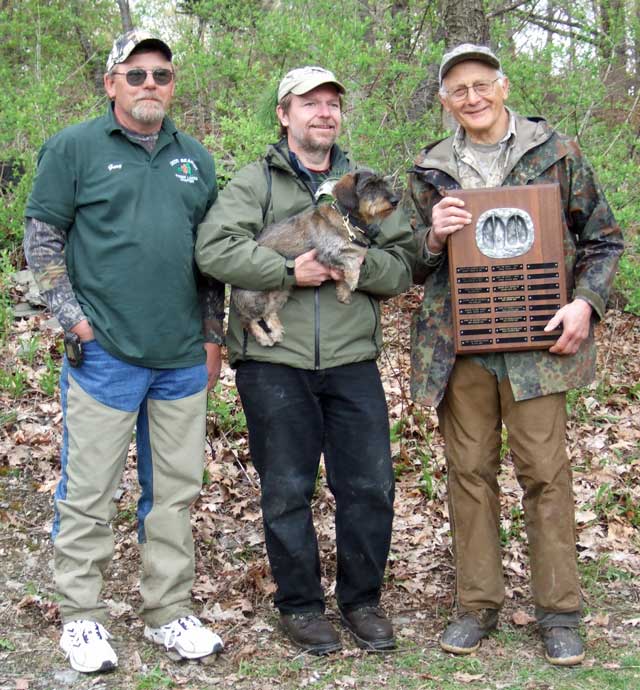
Gary Neal (Judge), me holding Eibe, and John Jeanneney (Judge) holding our trophy after winning the Deer Search Competition.

Monday, May 3, 2010

It is hard to keep up with Teddy Moritz and her hounds

It is impossible to keep up with Tedddy's adventures. One day it's woodchuck control: "I do woodchuck removal at a fairgrounds. The varmints harbor under sheds and in old barns. They eat in the extensive flower gardens and among the decorative shrubs. Bane, Navarre, the lurcher and I, plus the .22 rifle, got into five today and had success."


And next day she encounters a bear. For those who don't know Teddy - she lives in New Jersey, the state that is overrun by black bears.


Teddy's life is well lived and always full of adventures!

Sunday, May 2, 2010

The Maryland field trial I attended a week ago

I am late with this post, but it is better to write now than never. I am not going to make it to a lot of trials this spring, and the last weekend in Maryland was my first trial of the season.
Because my knee is not 100% yet, I took only two dogs with me - Paika and Ellie.

For Paika it was the second weekend of trialling ever (her first was last fall). On Saturday she did well and she placed 2nd in a stake of 42 open bitches. On Sunday she did not place. I could see that she had trouble with too much scent as in some areas of the field there were just too many rabbits. Here at home we don't have many rabbits now and when she gets one going there is a very low chance running into another one. At the Maryland Beagle Club grounds there are a lot of rabbits, but a dachshund is expected to follow only one rabbit, the one that was tally-hoed. I could see that for Paika it was hard to ignore the scent of other rabbits. It will come with experience.

For those who are not familiar with field trials for dachshunds I recommend checking out the website http://www.dfwdachshund.com/ Click at the top on "field trial". Read "What is a Field Trial" and see videos by following links placed under the picture.

In Maryland the stakes were big, and the total entry on Saturday was 108. Can you imagine 108 dachshunds - 18 open dogs, 42 open bitches and 48 field champions? All in various sizes, coats and colors. Anyway, it was a long day.

The Absolute Winner of the trial on Saturday was a standard longhair dachshund "Reggie" (FC Sunlight’s Reliant Rex v Bakum)  owned by Michael Nothstein, Phyllis Meseroll and Karin Boyd.

Mike Nothstein with Truman, Reggie's uncle (?)

I took a lot of pictures and they all (185) can be seen at click here.
It was good to see friends after a long winter break.  Also I enjoyed seeing Lykke, who is our Joeri's daughter. She is bred/owned by Laurel Whistance-Smith from Canada.

Lykke von Löwenherz (FC Joeri vom Nonnenschlag x FC FC Diamant Lily von Löwenherz)

Interestingly, Lykke's sister, Greta owned by "Skip" Charles Richter from Wisconsin, attended on the same weekend a trial in Roscoe, IL, and placed 1st on Saturday and 2nd on Sunday in the open bitch stake. This was Greta and Skip's first trial ever. Skip sent me two pictures taken at the awards ceremony.

Greta von Löwenherz (FC Joeri vom Nonnenschlag x FC FC Diamant Lily von Löwenherz) with her owner Skip

When I was coming back home on Sunday night, I ran into a horrendous hail storm on Hwy 81. It was followed by an hour long downpour. I have not seen anything like that in quite a while. I had to stop and spend a night at a nearby motel. The picture shows how it looked like from the inside of the car.

Saturday, May 1, 2010

Journey to the Win - Part 2: Training

by Andy Bensing

Continued from http://borntotracknews.blogspot.com/2010/04/journey-to-win-part-1.html

Over the winter while there was snow on the ground and tracking training was not possible, I worked on polishing Eibe's obedience. I focused on down stays under big distraction and highly distracted recalls as I always do. The handler respect gained through obedience training would be invaluable when working on my 3 goals once there was clear ground. I believe obedience is the foundation for everything you do with your dog.

The ground finally cleared by the first week of March. I was able to run nine 20-hour training lines averaging 1100 meters each in those 7 weeks before the competition.

Line control

Eibe had a tendency to drift off the line to the right, regardless of wind direction. She would stray off with nose to the ground, sometimes as much as 10 or 15 yards, then suddenly stop on her own, loop back to her left and go directly back to the line and continue on. I called it saw toothing because of the shape it made on my GPS.

Saw toothing

The fix for this was easy. I started consistently scolding her verbally with a harsh "NO" as soon as I saw her drift off to the right. I had to be careful with wind direction when doing this. If the wind was right to left, there wasn't a problem. With a right to left wind, Eibe drifting the line to the right could be corrected with no chance for a accidental correction while she had the line in her nose. If the wind was left to right or from the front or back, I had to be careful not to unknowingly correct her while she did have the line in her nose. In these situations, I would let her go quite far off the line, maybe 10 yards, before scolding "NO". Even if she did have the line in her nose at that point, I felt she would interpret the correction for being too far from the line in the first place. The tricky part of this technique was dealing with Eibe's soft temperament when not in drive. The nature of this technique is such that it shuts down the dogs drive to "drift" and counts on the dogs drive for the blood line to take over and bring her back to the line. This shutting down did cause Eibe some problems the first few times I corrected her for drifting. She stopped drifting when I scolded her but went out of drive completely and it took some coaxing to get her back into drive to follow the blood line. After the 2nd or 3rd training session using this technique there was no longer a problem with her shutting down. She figured out the "NO" was specifically for drifting, not for being in trouble in general. There was no more shutting down and actually I was able to accelerate the pace of training by raising the harshness of my voice on the "NO” without danger of her going out of drive for the blood line.

Directed "Search" Command and Check Improvement

As I mentioned before, Eibe naturally had an inefficient method to work checks and a tendency to get stuck in circles run by game. I needed a formal directed "Search" command to work on both of these problems. Getting stuck in circles would be instantly solved when the search command was learned in that I could take Eibe out of the circle and direct her to search in the direction I indicated until she hit the line coming off the circle. The problem I had on real tracks in the past was that she would go right back to the circle where she wanted to be and not in the direction I wanted her to search. I also planned to use the directed search command to teach or perhaps better said, imprint, an efficient search pattern for Eibe to use at checks. I knew from my work years ago teaching search patterns to drug detection dogs that search patterns could be taught relatively easily.

To teach the directed search command I set my training lines up so that there were numerous 90-degree turns or sometimes even acute angle turns along the way. I also made it a point to put extra scent (blood or hair) on the point of the turn. The goal was to have Eibe overshoot the turn as far as she wanted and then when she indicated/realized that she was past the line, lead her in a efficient pattern until she re-acquired the line and made the turn. When doing this, it is vitally important that you wait until the dog starts the check herself and then you immediately take over and you as the handler direct the search pattern not allowing the dog to fall back into her old inefficient ways. If you take over and initiate the searching pattern before the dog indicates by itself it has overshot the turn, you may inadvertently teach the dog to come to you for help when it loses the line. Obviously not something you want the dog to learn. By waiting until the dog actually starts the check herself, all you are doing is showing the dog how you want her to do it. I made it a point to be well back on the tracking line as we approached the turn so as not to influence her at the turn and when she began to make the check herself, I quickly took control and moved up closer to her on the line and with an authoritative but friendly tone of voice kept repeating the word "Search" as I led her in the pattern I wanted her to learn.


Desired search pattern to be taught

Part of the success of this technique is in the fact that the dog is hearing the word "Search" at the same moment she has decided to search herself (at the beginning of the check). It's the same concept of repeating "Hurry up" to a young puppy when you take him out to urinate. He hears "Hurry up" as he is thinking about and actually urinating anyway and before you know it when you say "Hurry up" the dog will actually urinate on command.

I place extra scent right on the turn for 2 reasons. First, I hoped to be subtly teaching the dog that when lost, go directly back to the last place you had it. Some dogs do that naturally but Eibe didn't all the time. My thoughts were that as the dog passes over the extra scent she would of course take a little extra note of it and when lost shortly thereafter it would only be natural to be drawn back to the last "good" spot. Secondly I was hoping the dog would think of this extra scented spot, the last place there was a good scent, as the center of her search pattern. Most people would agree that a good check dog starts from that point of loss and makes increasingly larger concentric circles from that point out until it re-acquires the line. That is what I wanted to teach my dog. The exact pattern you should teach your dog if you try this really should be based on the individual quirks and tendencies specific to that dog. I describe below exactly what I did with Eibe merely as an example of my thought process, not as a recipe of how it must be done.

Eibe's natural way of working a check at a turn was to search to the right first for about 90 degrees then randomly go here or there checking other places and she kept intermittently going back to that 90 degree slice of pie and searching again and again. Not a very good way to do it unless the line happened to run through that 90 degree wedge. She sometimes went back to the point of the turn to look but not always.


Eibe's inefficient natural search pattern

As I mentioned before the other tendency Eibe had when tracking was to drift to the right of the line then go directly left back to the line when she realized she had lost it in that "saw tooth" pattern I described earlier. Since Eibe already had a strong habit of searching left when off the line after drifting right and loosing the line, I decided to use that habit and teach her to search to the left, counter clockwise, at checks. Eibe picked this pattern up faster than I expected. After working on it only a few times, I could see her starting to use the pattern on her own. Her checks also got tighter at the same time, probably as a result of the line control work I was doing to reduce drifting.