Search This Blog

Saturday, August 6, 2011

In case you missed it

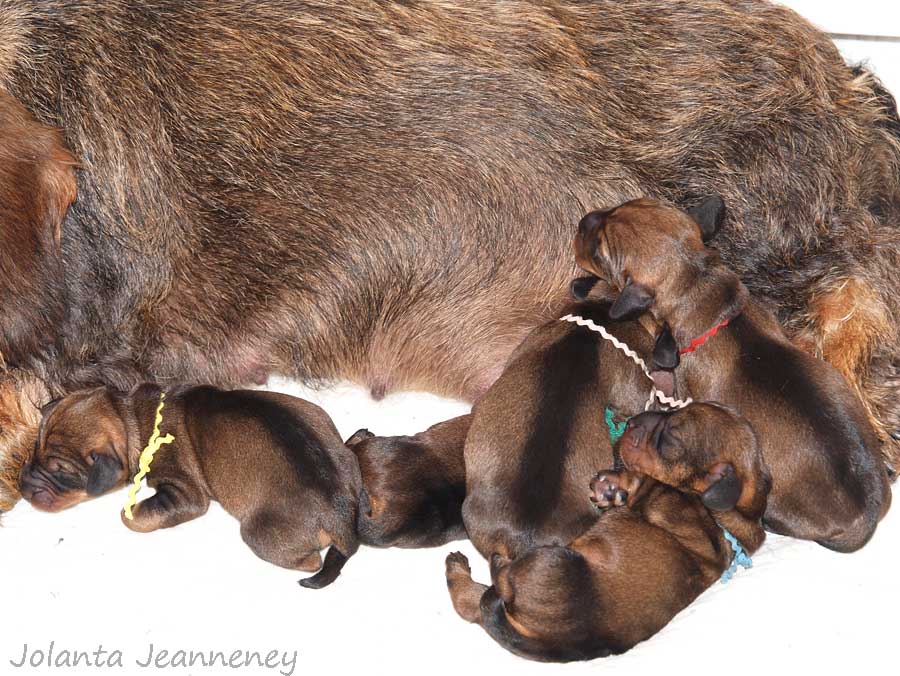
On Thursday, August 4, 2011 our Paika (FC Paika von Moosbach-Zuzelek) whelped five puppies - four males and one female. The proud sire of this litter is Moose (FC Nurmi v Moosbach-Zuzelek) owned by Chuck Collier.

Picture taken on the day of breeding when John traveled to Michigan to breed Paika to Moose. On the left - Chcuk with Moose, on the right John with Paika

Paika during whelping - first pup came out at 10:30 AM, last at 3:40 PM

Pups are identified by the color of ribbon around their next. The pink one is the only girl in the litter.
We will be reporting on the pups at our puppy journal http://borntotrackpuppies.blogspot.com/.   


Tuesday, August 2, 2011

Tracking wounded deer with Sackett

I found this post on the Long Range Hunting Online Magazine website and I think you'd enjoy it. I don't know a real name of the author, but it looks like he is located in Troy, South Carolina. I hope that he does not mind me reposting his story.
I met with my dad and two other hunting buddies at our hunting camp early on a Saturday morning in November 1994. We loaded up in my dad's truck and headed out to our desired hunting location for the morning hunt. We drove about 30 miles to a piece of Game Management Area in Edgefield County, South Carolina. Upon arrival we bailed out of the truck and went to the back to get out our climbing treestands. What! My treestand was not there! I thought that my dad loaded it, and he thought that I did. Well, the truth of the matter was that it was laying in the driveway at our hunting camp 30 miles away. Time for plan B. I rummaged around in the back of the truck and found a folding chair. I grabbed the folding chair and off we went, down an old gated logging road. I found a straight where I could see about 150-200 yards and set up my chair on the edge of the road. I then went to the edge of the old road and cut a forked stick for a shooting rest. I was shooting a Ruger M77 in 300WinMag this morning. I had been sitting there about 45 minutes after first light when out ran a big ole doe, at about 125 yards. Before I thought I had pulled the trigger on her, at the report of the rifle she went down, only to get up and run off. I was kicking my own butt, because I knew that I should not have shot. It was a rushed shot, what my buddies and I call a "combat shot". A couple of hours later when my dad came along and asked what I shot, I told him a "world record doe". We then walked down to where I had shot her and she was not there? There was a little blood but not much. We then began to track her. After a couple of hundred yards she went into an old over grown clear cut. There were black-berry briers ten feet tall, and the under growth was so thick that I was down to crawling. We looked for that deer for hours, with no luck! I was sick..Sick to my stomach at not being able to find that deer, but it was so thick that you could have crawled within ten feet of the deer and never have seen it. On the way back to camp, I swore that by the next year I would have a dog to use for tracking wounded deer.

In South Carolina it is legal to use a dog to track wound deer as long as the dog is kept on a leash. I then began my search for a beagle puppy. I was unable to locate a puppy and I did not want a grown dog. That year at Christmas my parents showed up at my house with my Christmas present. It was a 10 week old puppy, a 1/2 Australian Blue Heeler and 1/2 beagle. What a pretty little dog, white with blue marle and big blue eyes. My dad said that he had been calling him "Sackett" from the Louis L'Amour books about the famous Sackett family. I liked that and thus he was named Sackett.

I began working with him that every first day. I taught him to sit, to stay, and most importantly to track wounded deer. All that winter and summer when I would cook any venison I would save the blood from the packs. I would pour the blood into ice cube trays, then I could just get a cube of blood, thaw out one cube of blood, mix it with bottled deer scent then pour this over a drag cloth. I started out by using this drag to play with Sackett. I would pull it around him, letting him get it in his mouth and tug against me. I'd hold it in the air having him jump for it. Run around the yard with him chasing me. Then I began tying him up letting him watch me pull the drag through the yard. I'd then go get Sackett and let him track the scent trail until he found the drag. This progressed until I was tying Sackett up out of sight from me pulling the drag, then going and getting Sackett and letting him find the drag. He never missed.

Fast forward to the following summer. I was a police sergeant back then. One night one of my guys responded to a deer vs vehicle collision. After the vehicle was towed and everyone was gone I loaded the deer into the trunk of my patrol vehicle and took it to my house. The next morning I tied that deer behind my riding lawn mower and drug it around my yard, through the neighbors yard and then hid the deer under some leaves. I then went and got Sackett, when I got his bell down he got excited knowing that we were going to play his favorite game. I took him around to the start of the trail. He hit it and off he went. Well, I sure was proud of him when he trailed the deer to it's hiding spot. When he found the deer, well, I guess it kinda buffaloed him. He jumped back and began to growl. I could hardly wait for deer season to see what Sackett could do in the real world.

I continued to work with Sackett all summer long and when deer season rolled around I was ready and so was Sackett, I thought. On August 15, opening day of rifle season in the Low Country of South Carolina I was there at my Uncle's hunting camp, with Sackett. Opening evening I shot a buck, it ran about 75 yards before dieing. I could hardly wait to go get Sackett. Even though it was a short trail, I was excited to put him on it. Sackett worked like a champ, he took me straight to the buck. I continued all year to put him on as any deer as possible that was killed, no matter how short the trail was. I figured that the extra time spent would pay off one day, when he really had to work at a track of a wounded deer.

His chance came in December of that year. My dad shot a spike buck one evening and he saw the deer go down when he shot. It then jumped up and ran off. We got Sackett and went back after dark. Sackett hit the trail and off he went. Dad insisted that Sackett was going in the wrong direction. I started over again. Sackett again went in what dad said was the wrong way. On the third try, dad said, just let him go in that direction a while and let him see that he is wrong. Then maybe he'll go the right way. It sounded good to me, so off Sackett and I went again, in the wrong direction. Well, we went about 200 hundred yards, and there layed dad's spike!

I continued to work with Sackett that entire hunting season. Sackett found every deer that he was put on. I'll glad admit that the majority of those deer that first year would have been found without Sackett. But I looked at it as training for Sackett. I learned one of the most important lessons of tracking wounded deer that year, and that is to trust your dog! That's right, if you are using a trust worthy dog then trust him, a dog knows so much more than we can ever comprehend.

The day after Christmas that first year I was hunting in the Low Country of South Carolina and had my .357Mag with me. Shorty, after daylight a doe came out at about 30 yards. I decided to shoot her with my pistol. I took aim and shot. The doe ran off. I checked and there was a good blood trail. I later went and got Sackett to track the doe. My Uncle and I tracked the doe until we came to a big soy bean field. I was following Sackett on the leash and my Uncle followed the actual blood trail. Sackett was parallel to the trail by approximately 25 yards. Then when we entered the woods again, Sackett moved back to the actual blood trail. From this and many other times of following Sackett I learned that the scent will "drift" due to weather conditions.

Another lesson learned and Sackett was the best at "straightening" out this trail of any dog I have used since. Often times Sackett would "lose" the trail. I'd leave someone standing at the last blood found, and I'd begin circling around with Sackett. I would look for blood. Most times with no luck. Then I'd remember rule #1, Trust the dog. I'd go back to the last blood and let Sackett work his magic. What I learned was that often, in fact just about every trail that I followed for 1/2 mile or more a deer would do this. I'd come to a place where a deer stood for a period of time, usually evidenced by a large quantity of blood on the ground. Then the trail "just quit". From that spot forward unable to locate any blood. What happens here more times than not the deer has stood in place for a time, then turned around and walked back in the same trail it walked in on. After a short distance 75 to 100 yards the deer turns off in at 90 degree angle. This can be hard to work out, but if you ever find this scenario try walking back on the trail that you followed in paying close attention for where the deer left the trail.

After that first year I advertised Sackett for tracking would deer, I called it "Blood Trail Trackers...Shot a trophy? Can't Find It? Sackett Can!" For $30.00 I'd come out and look for your deer with an additional $20.00 when the deer was found. Sackett found over 300 deer in his life. Sadly in January of 2006 Sackett was poisoned by people on nearby property while they were trying to radiate coyotes!! I used Sackett for 10 seasons and learned more about tracking wounded deer than I ever imagined possible. Rest In Peace Ole Sackett Buddy I know that your chasing those deer in the Happy Hunting Grounds.        

Monday, August 1, 2011

Waiting for Paika to whelp

While I am sitting with Paika and waiting for her to go into labor, I looked back at some pictures from the past.

This picture shows FC Sabina von Moosbach-Zuzelek who was Paika's great-granddam. She whelped 10 puppies in 2000, and this is how she looked like on the day of whelping.

FC Gilda v Moosbach-Zuzelek whelped 8 puppies two years ago. She is Sabina's daughter and Paika's granddam.
Keena, Paika's mom, had 9 puppies a year ago.
And this was Paika yesterday. My guess is that she will have no more than 7 puppies.

What do you think?

For updates on this litter go to our "other" blog


Saturday, July 30, 2011

Well trained German teckels - perfect field obedience

Today will be a busy day so we are just going to post a short video of well trained German teckels. This is an example of perfect field obedience, and, yes, dachshunds can be trained.

Thursday, July 28, 2011

Future blood trackers are getting ready for the NYSDEC exam

Wednesday, July 27 was a busy day with two future trackers coming to Berne with their dogs. We ran  8-hour-old evaluation blood lines, and then settled down for a preparation session for the NYSDEC Leashed Tracking Dog Exam which is coming up on August 19.

Eli Clement lives in Albany with his family and a young mini longhair dachshund, Shyla. Eli plans to track with her in the Albany Pine Bush and surrounding, bowhunting-only areas of the Capital District. Shyla demonstrated that she has profited from Eli’s early training with her. She is a calm dog with the desire and line sense to become a very capable tracking dog. She will be finding deer this fall. Anther plus is that her “cute” small size will win the hearts of the suburbanites when Eli asks permission to track across their back yards.

     
Eli Clement with Shyla


Eli’s friend Ben Barth lives in Cold Brook, northeast of Utica in the Adirondack State Park. This is far, far away from the Albany suburbs in bear and beaver country. Fortunately Ben’s  dog Arrow is a big strong dachshund ready for the challenges of rough country. At Berne Arrow was calm and focused on his blood trail. With ease he figured out a hairpin turn and some other difficult checks and found the deer skin. Ben and Arrow will be tracking wounded deer most of the time, but bear calls will certainly come. To be prepared Ben took home several containers of frozen bear  blood.


Ben and Arrow are approaching a deer hide at the end of the track.


Genti and Beth Shero drove up from Poughkeepsie to see Arrow and his work. They are the breeders of Arrow (Billy von Moosbach-Zuzelek x Mariel von Munterkeit). They were pleased to see what North Country living can do for a dachshund. Does deep snow make a dachshunds legs grow longer?

John Jeanneney, Ben Barth, Eli Clement with Shyla, Genti Shero and Beth Shero with Dea.

Wednesday, July 27, 2011

An evening walk ends with great pictures of the sky

It was a busy day, which was focused on blood tracking, but more about that tomorrow. This evening I went out with Asko, and while he was running rabbits I marveled over the beauty of the sky. Click on images to see enlargements.


Monday, July 25, 2011

Visiting Genti and Beth and their puppies

Yesterday we went to Poughkepsie, NY, to see Genti and Beth's wirehaired dachshund puppies. The pups were sired by our Tommy so we were very curious to see what he has produced. We were very impressed with pups, who now are six and a half weeks old.

Muriel is the pups' aunt and she loves to play with them. This experience is invaluable for the pups. She is gentle with them and does not push them too far.

Bernie is a really nice looking pup with excellent dark wild boar coat.

Bella is an only girl in the litter of three. She can stand up to the boys and assert herself.


As usually we had a great time with the Sheros, but the most adorable member of their pack is their daughter Dea, who is the best behaved baby I have ever seen.

Dea - a future Tracking Goddess

Beth and Dea. Can you see the glow on Beth's face? I think that the motherhood really agrees with her.

Beth and Genti have been working very hard to develop their Tracking Dog Supply business and they need your support. It is great to see young people seriously interested in all aspects of blood tracking dogs, so the next time you need to a tracking collar or leash, consider getting them from Genti and Beth's store.


Genti with Bernie. Bernie says - where is your beard dude?

Great conversation, great food and puppies were main ingredients of the most enjoyable visit.

Muriel and Bart played vigorously.

Puppies at this age are incredibly cute!

Saturday, July 23, 2011

The Whoa Post for Blood Tracking

by Andy Bensing 

I am taking a different approach in training my young dog, Atlee, than I did with my older dog, Eibe.  With Eibe it was important to me to get her to a high level of performance as quickly as possible.  I was not totally satisfied with the dog I was tracking with when I bought Eibe, and I hoped for Eibe to be the one to replace him.  Now that I am wonderfully satisfied with her and have found a great new tracking home for my old dog, I have the luxury of taking a much slower approach with my young dog Atlee.  Atlee shows me terrific natural tracking ability and comes from a pedigree loaded with dogs that turned out as terrific tracking dogs with minimal training so I am not overly concerned with doing my normally large amount of artificial line training.  He's 10 months old and even counting short puppy drags starting at 11 weeks of age I have only had him on 14 artificial blood lines so far. 

My end goal for Atlee is to have a dog that while tracking never goes more than 30 or 40 feet in front of me so that the majority of the time I can just let the tracking line drag on the ground at my feet and not have to worry about him kicking into high gear and running off down the track, even if we jump the deer.  I track a lot in thick cover and sometimes swampy areas and having the ability to drop the line and let my dog work his way through nasty obstacles while I walk comfortably around them appeals to me.  In thinking my plan over I decided to use the whoa command to accomplish this.  The whoa command is basically a stand stay from a distance and is more commonly used with bird dogs to stop them in their tracks especially when there is some extremely large temptation nearby but I thought it would be a good fit for my use in blood tracking.  In researching the different methods of teaching the whoa command (of which there are many) I decided on using the "whoa post" method as taught by Rick Smith .

The 2 links below give a detailed explanation of how the method is done.  I will basically replace distractions in general for the normal bird work done at the end and described in the articles.

My plan is to teach the whoa command completely away and separately from blood tracking.  When my dog will easily stop in his tracks on a verbal command in a relaxed manner from 50 yards away while he is chasing a squirrel or some other big distraction I will bring the command to the blood line.  I also will not introduce the whoa command on the blood line until Atlee's on leash tracking is at a very proficient level.  At that point I will start dropping the leash and letting it drag and if Atlee gets farther than 30 feet in front of me, I will whoa him until I catch up.  In training I will build up until he will track nicely in front of me completely off the leash so that when we track for real with the leash on and dragging, it should be a piece of cake.  My thoughts are that he will quickly figure out that I will let him do what he wants as long as he does not get too far in front, in which case I will stop him.  Below is a video showing where I am with Atlee's whoa training at this time.  We are starting to work on distractions.  I am very happy that I finally found a good use for my wife's new kittens!


Friday, July 22, 2011

Ontario Blood Tracking Workshop

by John Jeanneney

The Canadian Province of Ontario lies just west of the Province of Quebec. The terrain and the big game in the two provinces are quite similar: moose, whitetail deer, black bear and caribou are the principle big game animals hunted. There the similarities end. Quebec has an active program of using tracking dogs to find wounded animals. Ontario has nothing of the kind.

In Quebec the principle language is French, and outfitters had access to tracking ideas and inspiration that came from France. Their tracking dogs, in this case wirehaired dachshunds, came from France and Belgium. A tracking dog handler’s association ACCSQ was founded in 2008 and today it has 240 members. The hunting regulations for big game have been officially “reinterpreted” by the Ministry of Natural Resources (MNR)  and in 2009 ACCSQ handlers found 71 moose, 88 deer and 4 bears. An impressive beginning.

Meanwhile nothing much has been happening in Ontario where leashed tracking dogs have been deemed illegal by most provincial conservation officers. A couple of  tracking workshops for NAVHDA in the 90s, presented  by Hans Klein and myself, did not produce enduring interest. What Ontario seemed to lack was a “Point Man”, someone who could rally the Hunter Lobby (OFAH), hunting clubs and individual hunters to encourage the MNR to change regulations on the use of dogs, in this case leashed tracking dogs. Drawing on the American experience, we have learned that state Fish and Game Departments seldom make a move unless there is evidence of  strong sportsmen support.

Laurel Whistance-Smith of Pontypool, Ontario, was fully aware of these problems when she organized the recent tracking workshop  that took place there. Laurel is a retired biologist of the Ontario MNR, and she is also a long-time breeder of the European type of wirehaired dachshunds. She has not tracked herself, but she has bred a number of fine tracking dogs that are working in the United States. The workshop was to be a small, rather informal gathering of people who have bought dogs from Laurel in the last couple of years. These dogs were sired by our stud dogs, Billy, Joeri and Tommy.

With some doubts in my mind about a long term impact of the workshop I agreed to conduct it on July 17 and 18. Darren Doran, the “Point Man” for New Jersey’s experimental program accompanied me and was tremendously valuable for both his dog and  political experience. On Friday afternoon, the 16th, we laid out five training/evaluation  lines of about 400 meters for the people we expected to come with partially trained dogs. These lines were to be worked the next morning. Weather predictions were for a very hot Saturday for where we would be working, 20 miles north of Lake Ontario. We wanted to begin the dog work as early as possible, and then use the hottest part of the day for PowerPoint presentations.

On Saturday morning only three dogs and handlers showed up and were available to work the five lines that we had laid out. This was disappointing! However,  I was impressed with the dogs that were present. Scott Leindecker worked his 10-month-old bitch Arwen first. She showed excellent tracking desire and line control. We liked the way she worked her checks with focused intent. She showed that she was ready to find wounded deer as soon as the Ontario MNR gives her the go ahead.

Scott Leindecker and Arwen find the deer skin at the end of the track.
The next dog, Yoda was handled by his owner Ernie Schroeder.  Yoda worked more slowly with somewhat closer check work than Arwen. This is a style that I have grown to appreciate more and more as I get older and older! At 2 ½  Yoda is ready for real work!

Ernie Schroeder and Yoda
Cesar owned by Tom Bunge showed that he was a good dog that had been corrupted by disrespectful grey squirrels. At home frisking squirrels in his back yard had teased him to a frenzy. Once he scented squirrels on his evaluation blood line, it was all over. He could focus on nothing else. There are good ways to de-squirrel a tracking dog, and these were discussed when we finally got to the deer skin at the end of the line.

Tom Bunge and Cesar
Later in the morning Tom worked Cesar on a second, unused line and things went better. It was siesta time for the squirrels and they were no longer laying seductive trails for Caesar. He focused better on the most important thing in the world: blood tracking.

After lunch we moved into Laurel’s spacious garage and examined  the structure and growth of tracking legislation in the United States and Canada. At this point Kerry Coleman joined our group. Kenny is a recently retired biologist from the Ontario MNR who is now on the Governing Board of OFAH. Kerry was enthusiastic about the leashed tracking dog idea and had many concrete ideas about how it could be implemented in Ontario. He believes that more promotion and the foundation of an Ontario tracking organization will be essential. I made it clear that UBT could be very helpful in a future Ontario campaign, and I pointed out what we had done in the United States. The importance of the field experience in neighboring Quebec was recognized, but the provincial  legal structure in Quebec is quite different from that of Ontario. Ontario will not be able to follow the Quebec plan the way Vermont followed the New York plan in 1996.


At this point the workshop really became a meeting, and I could see that the long-awaited point men  for Ontario were emerging. Scott Leindecker, who lives in Sault Ste. Marie, far to the west  near Michigan’s Upper Peninsula, is an Ontario Provincial Police  officer, who clearly has the drive to hunt, track and promote. He reminded me a bit of Chuck Collier, the Michigan State Police Officer who lives not too far away from him. They both have gifted tracking  dogs, and as we all know,  that helps to keep the fires burning.

Nancy and Scott Leindecker from Sault Ste Marie
Ernie Schroeder was equally impressive. He is a chiropractor who can arrange his schedule to accommodate the things that are important to him ….like hunting and tracking. He has a strong background in hunting dogs  and now he has a very good wirehaired dachshund. He lives close to the political action sites of Toronto and Peterborough, and he is motivated to help the cause.

Tom Bunge has some work to do with his squirrel dog, but he has the great advantage of hunting experience as a forester in his native Germany. Currently he is an engineer with all the electronic media skills to organize hunters in the digital age.

Laurel Whistance-Smith, hostess of the workshop, does not track herself, but she is an excellent organizer and has maintained excellent contacts in the MNR where she worked for twenty years. Clearly Ontario now has what it takes to get a tracking program going.

We wound down on late Saturday afternoon with a mini-course on the grooming of wirehaired dachshunds. Vicki Thomas showed us how to strip down a wire coat so that a sometimes shaggy dog becomes a sleek, well-protected worker, which can slip through the briars and burrs. Vicki Thomas is a well-known show judge and professional groomer. Her practical advice was useful for working dachshund owners even if they never go to a dog show.
Vicki Thomas grooms Arwen

Arwen - before grooming
Arwen - after grooming. Arwen was bred by Laurel Whistance-Smith and she is out of Hexel is a daughter of our Tommy vom Linteler-Forst
Yoda was also bred by Laurel and he is out of Lily and our Joeri vom Nonnenschlag
The Sunday workshop program began at 7AM as we all munched breakfast and I went over  the slides of a practical PowerPoint program on the tricks, trials and tribulations of finding wounded game in the woods with a tracking dog. We concluded at noon. It was an excellent  workshop with little lecture and lots of discussion.

Many thanks to Darren Doran  for all his help including some of the photos above.

Thursday, July 21, 2011

Stalking a goldenrod crab spider in our backyard

We have a couple of really nice articles waiting for posting, John's report on the blood tracking workshop in Ontario and Andy's article on teaching "whoa", but today the readers will have to endure some shots from our backyard.

The other day when I was watering our plants (we grow mainly vegetables for our own consumption and very few flowers), I noticed an odd looking spot on one the rudbeckias. When I looked closer, I realized that it looked like a yellow spider. It was camouflaged perfectly as it had yellow body with a pair of red stripes, exactly the color of the flower. Of course, I had to investigate.

Click on the image to see better how well the goldenrod crab spider is camouflaged - it has the same body color (yellow) and red stripes as the rudbeckia petals have.
As it turned out this is Misumena vatia, also called the goldenrod crab spider, and it is the largest flower spider. According to one of the nature sites: "Crab spiders don't build webs to catch their prey. Instead, they rely on camouflage and ambush. These colourful spiders blend into their surroundings amongst leaves and flowers, where they lie in wait for unsuspecting flies and bees. Some species can even change colour to match the flower they are on."

I watched the spider for the next few days, and snapped two different pictures of the prey it caught.

First the spider caught a small fly.
The next day I saw it ingesting a large fly, which was actually as large as the spider itself.
The spider sat on the same flower for at least three days, and then moved to the next one. Today it was gone. In a strange way I am going to miss it.


Wednesday, July 20, 2011

Teddy Moritz's narrow-chested minis for rabbit hawking

by Teddy Moritz
Because I breed small miniature longhairs for rabbit hawking, I need leggy but narrow dogs. I have seen and admire other miniature longhairs with this build which are bred in Germany. Some people comment the dogs look weedy and too thin. Well, in my experience, a rabbit being a three pound animal, a rabbit dachshund also needs to be small and narrow in order to consistently get to the rabbit when it harbors in a tight spot. Also, when I sell a pup to a falconer or gun hunter, I tell them pointedly that a miniature with the right build can get out of a three inch gap in a fence. Most people don't believe me until their dachshund is found on the outside of their fenced yard.
 
We reconfigured our chain link kennels today and used a door panel that had a rather large gap between the door and its support pipe. I knew the opening would allow some of the dachshunds to get out so I used this door panel for the lurcher. On a whim, I let all the dachshunds out to explore the new kennel set up. It took Tar less than two minutes to find the gap in the door panel and to get out. I decided to take a photo of her escaping to show how she did it. I put her back in the kennel and waited with the camera. She obliged me by getting out again. Tar is a three year old female, has had one litter and weighs 7 pounds, so her body is mature. The tape measure proves the gap is three inches wide. And yes, it will be blocked off so Tar doesn't get into the lurcher's run and escape. (And to prove she's feeling better, Fitz tried to get into the kennel through the same gap to be with her kennel mates. She is smaller than Tar so I know she'd easily slip into or out of this gap).

Tape measure showing the width of the gap, three inches which is 7.62 cm)

Tar with her head and neck through the opening.


Narrow shoulders allow Tar to get her front legs out.

Narrow shoulders allow Tar to get her front legs out.

Tuesday, July 19, 2011

Proofing Search Patterns - seeing into my dog's mind's eye

By Andy Bensing

After our last training line 2 weeks ago I had a good feeling that Eibe had developed a clear picture in her head of how to recognize dead spots and efficiently work them out.  As mentioned in previous articles, I also believe that for some time now she actually recognizes back tracks as soon as she smells that the line has doubled over itself.   I set today's training line up as a proofing exercise to see if my assumptions were correct.  Since we had been focusing lately on dead spots and had not done any backtracks for quite a while my plan was to lay out a dead spot on the line to assure that she was thinking about dead spots. and then 150m later go right into a backtrack. This way I could see if she would recognize the back track and work it in her usual backtrack efficient way or would she initially think it was another dead spot and work it that way.  I also threw in a couple of sharp 90 degree turns to compare her style on them as well.  Overall, the line was 1050 meters long laid with tracking shoes and a squirt of blood on the ground every 50 steps or so and I aged it overnight (15 hours). 

Click on the image
I am trying a new technology (for me) with this article so check out the videos below.  The videos show how Eibe ultimately worked through the above exercise but also show some of the great value in using your GPS and associated desktop software while blood tracking both on training and natural lines.  The videos are not of my dog but rather they are taken from my computer screen and show how you can evaluate you and your dog's actions when you get back home after tracking.

A tracking team in the making

Thank you Justin for this adorable picture of your baby and Remi.
What kind of shoes is Remi wearing??? He looks very comfortable.

I'd say this is a great tracking team in the making!

Monday, July 18, 2011

Contest for the best caption... and a winner is

It took us a while to go over all the captions. We REALLY appreciate all the submissions and the time you guys put into the contest. I hope that you had as much fun as we did.

In the end we both agreed on the number #1 caption, which was submitted by Claire Mancha. We both loved it.

Don't cry Keena! All the prettiest girls have mustaches.

Congratulations Claire. I'll be contacting you by e-mail.

Don't cry Keena! All the prettiest girls have mustaches.


Quenotte's first recovery

It was a hard decision but a right one. Quenotte turned out not to be a breeding prospect (we'll have a separate post on this in a few days) so with a very heavy heart we decided to let her go to a new home. Often buyers of our puppies wonder how difficult it must be to let puppies go to new homes. When pups leave us at 10-12 weeks, it is not difficult. From the beginning we know that they will not be staying here. However, when you keep a pup for over a year, you get really attached. To place youngsters like Quenotte in a new home is very difficult on the emotional level.

Luckily we could not ask for a better home for Quenotte. Now she lives with Kevin and Dawn Wilson and their teenage daughter Baylee in Virginia. She is their only dog so she gets plenty of attention and love. Kevin is a year-round bowhunter and District leader for Suburban Whitetail Management of Norther Virginia. In certain northern Virginia suburbs there is year-round controlled bowhunting of nuisance deer on special depredation permits. The excessive numbers of deer carry Lyme disease, cause accidents on highways and destroy shrubbery in peoples yards.  Quenotte will have year-round opportunities to track wounded deer. Is there anything more that you could ask for?

On Saturday I received e-mail from Kevin saying: "Quenotte recovered her first deer this morning. The deer went about 300 yards on a single lung and gut/belly shot. I will send details later but she did a great job. More to follow including video. Kevin"

I got a little teary-eyed as we miss Quenotte, but we know that she is doing now what she was bred for. Thank you Kevin!

Kevin with Quenotte and the deer she recovered

Saturday, July 16, 2011

Getting closer to Karl. A wirehaired dachshund's portrait.

While John and Darren are in Ontario giving a blood tracking workshop, Karl is staying here. I could not help myself and had to take some pictures of him. As it turned out he is a very cooperative dog, and we both had fun. Even though I love black and white photography I have not done it in years. I tried to work with one of Karl's portraits and thought that I actually like the b&w version better than the color one. What do you think? Click on the images to see a larger version.